Side Lying Single Leg Kick
The Side Lying Single Leg Kick is a mat-based movement drawn from the Pilates side kick series. You lie on your side with your upper body propped on your forearm, keep both legs long, and kick the top leg forward before sweeping it back behind you in one smooth, controlled sequence. Because the leg moves freely while the trunk stays planted, the exercise trains the quadriceps and hip musculature through a long arc of motion while the side of your waist works overtime to keep you from rolling.
The most obvious work happens in the top leg. Kicking the leg forward with the knee soft and the foot flexed loads the quadriceps, particularly the rectus femoris, which crosses both the hip and the knee. Sweeping the leg back into extension behind you shifts the demand toward the glutes and the muscles along the outer hip. The bottom leg, pressed firmly into the mat, acts as an anchor and quietly builds hip stability.
What makes this exercise worth programming is the anti-rotation demand. A stacked, still pelvis is the whole game here. Your obliques and deep core have to hold the trunk square while the leg swings through a range that naturally wants to drag the hips forward and back. That combination of moving limb and quiet torso makes it a useful tool for anyone who wants hip mobility and trunk control in the same drill, which is why it shows up in Pilates classes, general warm-ups, and lower-body accessory work alike.
Setup quality determines everything in this movement. If your elbow drifts out from under your shoulder, your neck takes strain. If your hips fold forward or backward, the kick loses its target and your lower back starts compensating. Take a few seconds to stack the shoulder, lift the waist off the floor, and place the supporting hand in front of you before the first kick, and the exercise immediately becomes more precise.
Most people use the Side Lying Single Leg Kick for moderate reps per side, often paired with the side-lying leg lift or inner thigh raise to cover the hip in a single block. It requires nothing but a mat and a small patch of floor, and the intensity comes entirely from control, not load. Move the leg like a pendulum, keep the torso untouched by the motion, and you will feel exactly where this exercise is supposed to live.
One practical safety note: the neck and the supporting shoulder are the two areas to watch. Keep your head neutral, looking straight ahead rather than craning up or dropping it, and if your shoulder tires before your legs do, lower your torso to lie flatter on the mat and continue the kicks from there.
[ Workout Log & Planner ]
Put your next workout in Fitwill
Keep your plan and training log ready when you are.


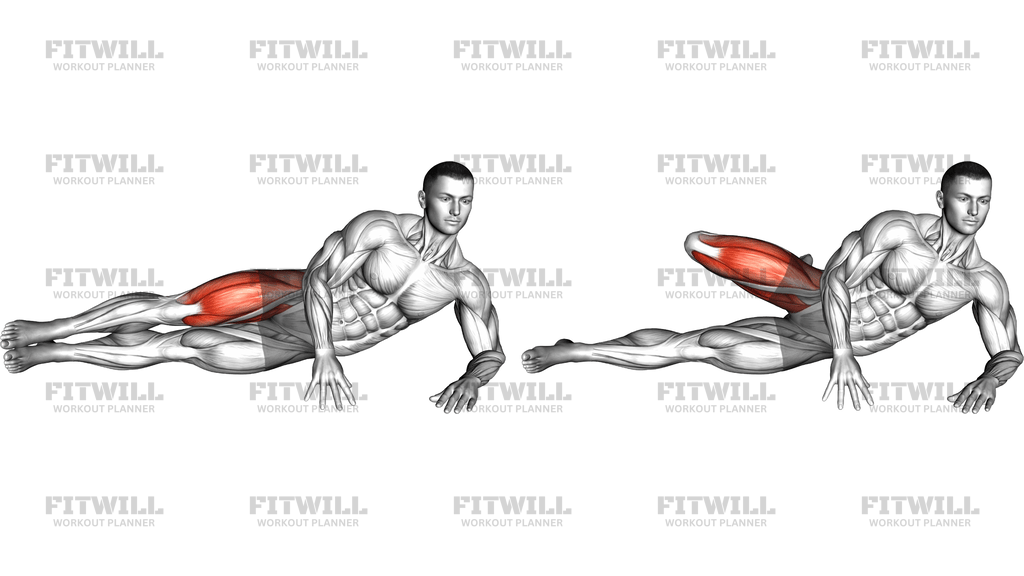
Instructions
- Lie on your right side on an exercise mat with both legs extended and stacked, and line your ankles, knees, hips, and shoulders up in one long line.
- Prop your upper body on your right forearm so the elbow sits directly under the shoulder, and rest your left hand flat on the mat in front of your torso for balance.
- Lift your waist slightly off the mat so the side of your torso is active, draw your shoulder blades down, and keep your head neutral with your gaze forward.
- Brace your trunk gently and hold the pelvis square, as if a line runs straight through both hip points perpendicular to your direction of gaze.
- Bring the top (left) leg slightly forward and kick it ahead of your body with the knee soft and the foot flexed, as if reaching the heel toward the wall in front of you.
- Without pausing, sweep the same leg back behind you, extending the hip and pointing the toe, letting the leg travel past the bottom leg.
- Continue the forward-and-back kick as a fluid pendulum rhythm, keeping the range long but never letting the leg swing higher than your trunk can stay still for.
- Exhale as the leg kicks forward and inhale as it sweeps back, matching the breath to the beat of the movement.
- Complete your reps on this side, then lower the torso carefully, roll to the other side, restack your setup, and repeat with the right leg on top.
Tips & Tricks
- If your torso rocks forward every time the leg kicks forward, shrink the range instead of muscling through; a shorter kick with a still pelvis does more than a big one that drags your hips.
- The supporting elbow tends to slide away from the body as you fatigue, which collapses the shoulder; check that your forearm stays perpendicular to the mat for every rep.
- Keep the kicking knee soft on the forward swing. Snapping the knee straight ahead of you turns this into a knee-joint exercise instead of a hip and thigh exercise.
- Flex the foot as the leg comes forward and point the toe as it sweeps back. This small detail lengthens the kick and keeps the hamstring from gripping on the back swing.
- Your bottom leg is not dead weight; press it actively into the mat. Letting it go slack is one of the most common reasons the whole body wobbles.
- Lift the waist. If you sink onto your ribs, the obliques stop working and the shoulder picks up the slack, which is where support-side discomfort usually starts.
- Work at a tempo you could talk through. Fast, jerky kicks are almost always a sign the core has checked out of the exercise.
- If a full forearm prop bothers your shoulder, drop your torso so you rest flat on the side of your torso with your head on your bottom arm, and perform the same kicks from there.
Frequently Asked Questions
Which muscles does the Side Lying Single Leg Kick work the most?
The kicking leg drives most of the work through the quadriceps on the forward kick and the glutes and outer hip muscles on the back sweep. The obliques and deep core work continuously to keep the pelvis and trunk from rotating with the leg.
Is the Side Lying Single Leg Kick suitable for beginners?
Yes, it is a low-load bodyweight exercise, but beginners should reduce the kick height and keep the trunk still before chasing a bigger range. If the forearm prop is uncomfortable, lying flat on the side with the head on the bottom arm is a simpler starting position.
Why should the knee stay soft when I kick the leg forward?
A slightly bent knee lets the hip and thigh muscles do the work and prevents you from snapping into full knee extension with speed. This keeps the emphasis on the intended muscles and protects the knee joint.
Why do my hips move back and forth during the kick?
That swing means the range of the kick exceeds what your trunk can stabilize. Shorten the kick, brace the trunk gently, and think about keeping the top hip stacked directly over the bottom hip throughout every rep.
How does the Side Lying Single Leg Kick differ from a side-lying leg lift?
The leg lift moves the top leg straight up against gravity, while the kick swings the leg forward and back along the body. The kick adds hip flexion and extension, which brings the quadriceps and hip flexors into the picture to a greater degree.
My supporting shoulder aches before my legs fatigue. What should I change?
Check that the elbow is directly under the shoulder and that your hand in front is sharing some of the load. If it still bothers you, lie flatter on the mat with your head supported on your bottom arm and keep performing the kicks.
Can I substitute the Side Lying Single Leg Kick with a standing kick-back?
A standing kick-back or cable kick-back covers the hip extension portion, but it removes the side-lying stabilization demand, so your obliques and outer hips do less work. The substitution is reasonable for glute volume but not a full replacement.
How many reps should I do on each side?
Somewhere between 8 and 15 controlled kicks per side works well for most people, done as a steady pendulum rhythm. Stop the set when your trunk starts rotating or your supporting shoulder fatigues, not just when the leg gets tired.
Should I do the Side Lying Single Leg Kick as a warm-up or a main exercise?
It fits both roles. Early in a session it wakes up the hips and trunk at low intensity, and as a main block it works well for higher reps when you want a load-free challenge for the thighs and core.