Resistance Band Seated Shoulder Stretch Behind The
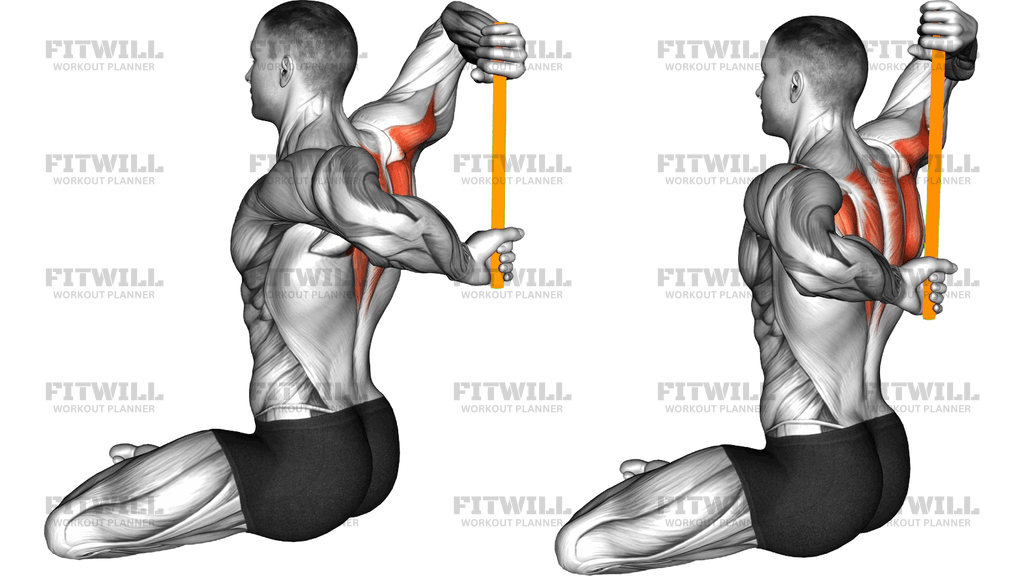
The Resistance Band Seated Shoulder Stretch Behind The Back targets one of the trickiest positions in the upper body: deep internal rotation of the shoulder combined with extension behind the torso. You sit on the floor and hold a resistance band with one arm reaching overhead and the other arm reaching up from behind your lower back, so the band connects both hands along your spine. By pulling gently with the top hand, you guide the bottom hand higher up the back, which lengthens the rotator cuff muscles and the back of the shoulder on the lower arm.
This position is hard to reach with bodyweight alone, which is exactly why the band helps. It acts as an adjustable connector: shorten your grip or increase tension to deepen the stretch, or widen your hands to ease off. People who struggle to scratch their own upper back, lifters pressing heavy overhead, throwers, swimmers, and anyone spending long hours at a desk with rounded shoulders all tend to benefit from this kind of work.
The setup matters because the stretch is only effective when your torso stays upright and still. Sit tall on the floor with your legs folded comfortably to one side or crossed, and let the stretch come from the shoulder joint rather than from leaning or twisting your spine. If you crank your torso around to force the hands closer, you rob the shoulder of the stretch and load your lower back instead.
To perform it well, focus on slow, steady pressure. The top hand pulls the band upward in small increments while the bottom hand keeps a relaxed but secure grip. You should feel a strong but tolerable stretch along the outer and rear aspect of the bottom shoulder, and sometimes down the back of the upper arm. Hold the end position, breathe steadily, and let the tissue ease out over time rather than forcing range.
This stretch fits well at the end of upper body sessions, on rest days, or as part of a shoulder mobility routine. Two to three rounds of twenty to thirty seconds per side is a practical starting point. Always work both sides, since a noticeable difference between shoulders usually points to the side that needs the extra attention.
Keep the intensity honest: a stretch should feel like tension, never sharp pain, pinching, or numbness in the arm. If you have a current shoulder injury or a history of dislocation, shorten the range, lighten the band tension, and check with a qualified professional before loading this position.
[ Workout Log & Planner ]
Put your next workout in Fitwill
Keep your plan and training log ready when you are.


Instructions
- Sit on the floor with your legs folded comfortably to one side or crossed, and sit up tall on your sit bones with your spine long.
- Hold a resistance band in both hands: raise your top arm overhead and bend the elbow so the band hangs down behind your head and back.
- Reach your other arm behind your lower back, palm facing out, and grip the lower end of the band so both hands are connected behind your torso.
- Brace your core lightly and keep your chest facing forward; do not twist your torso or lean sideways to make the hands meet.
- Gently pull the band upward with the top hand so the bottom hand slides higher along your back, increasing shoulder internal rotation.
- Stop when you feel a firm stretch across the outer and rear part of the bottom shoulder, and hold that position.
- Breathe slowly and steadily through the hold, letting the tension ease slightly with each exhale.
- Release by easing the top hand's pull first, then carefully separate your grips one hand at a time and let the band fall slack.
- Repeat on the other side, spending equal time on each arm, and re-set your seated posture before every rep.
Tips & Tricks
- If the bottom arm cannot reach the band behind your back, widen your hand spacing on the band or use a longer band rather than arching your lower back to close the gap.
- A common mistake is shrugging the top shoulder toward the ear as you pull; keep the top elbow high but the shoulder blade settled down.
- Avoid letting the bottom elbow flare far out to the side; keeping it closer to your ribs keeps the stretch in the shoulder instead of straining the elbow.
- The stretch should live in the bottom shoulder, not in the wrist; if your bottom wrist aches, adjust your grip angle on the band.
- Keep your ribcage stacked over your pelvis; flaring the ribs forward usually means you are substituting spine extension for shoulder range.
- Progress by sliding the bottom hand a little higher each week, not by yanking the band harder in a single session.
- Never jerk the band upward; the small muscles of the rotator cuff respond poorly to bouncing in this deep position.
- If one side is noticeably tighter, start with that side and match the tighter side's range on the looser side rather than maxing both out.
- A light towel draped over the band where it contacts your lower back can reduce any digging sensation if the band presses into your spine.
Frequently Asked Questions
Which muscles does the Resistance Band Seated Shoulder Stretch Behind The Back target?
It primarily lengthens the rotator cuff muscles on the back of the bottom shoulder, along with the rear deltoid area. The bottom arm position also places a mild stretch on the triceps and surrounding shoulder tissues.
Why use a resistance band instead of just clasping my hands behind my back?
Most people's hands cannot reach each other in this deep position, and the band acts as an adjustable bridge. It lets you set exactly how much range you take, and it allows the top hand to pull the bottom hand progressively higher.
Is the Resistance Band Seated Shoulder Stretch Behind The Back suitable for beginners?
Yes, as long as beginners use generous hand spacing and light tension. Start with a wide grip where the stretch is mild, and only progress the range once the position feels comfortable and controlled.
Why should I sit on the floor instead of standing for this stretch?
Sitting removes momentum and locks out cheating strategies like stepping, swaying, or swinging the arms. It forces the stretch to come from the shoulder joint itself, which makes the hold more specific and easier to control.
How long should I hold each side?
Twenty to thirty seconds per hold works well, repeated two to three times per side. If the position is very tight for you, shorter holds of ten to fifteen seconds with more repetitions are a fine starting point.
I feel the stretch mostly in my elbow or wrist instead of my shoulder. What should I change?
Your bottom-hand grip is probably too aggressive or angled awkwardly. Relax the bottom grip, let the top hand do the pulling, and slightly rotate your bottom palm so the band rests across the back of your hand rather than forcing the fingers to clamp it.
What is the most common mistake in the Resistance Band Seated Shoulder Stretch Behind The Back?
Twisting or side-bending the torso to force the hands closer together. This shifts the stress away from the shoulder and into the spine, so keep your chest facing forward and accept a smaller range instead.
Can I do this stretch if one shoulder is injured or recently dislocated?
Not without clearance from a qualified professional. Deep internal rotation behind the back is a demanding position, and after an injury you should work within a rehab plan before adding band tension to it.
What can I use if I do not have a resistance band?
A towel, a strap, or a light stick all work as the connector behind your back. A towel or strap is more forgiving because it bends around the body, while a stick gives you a fixed width to gauge your progress.
When is the best time to include this stretch in my routine?
It works well after pressing, pulling, or throwing sessions when the shoulders are already warm, or as a stand-alone mobility drill on rest days. Reserve long holds for after training rather than before heavy lifting.