Lying Lat Row
The Lying Lat Row is a bodyweight back exercise performed face down on the floor. You start with your arms stretched out overhead in a long line, lift your chest slightly off the ground, and then pull your elbows down and back toward your ribs — the same pulling pattern you would use in a lat pulldown or pull-up, but with no equipment other than the floor beneath you. Because you are working horizontally against gravity, the movement challenges the lats through a long range while your spinal muscles work hard to hold your torso up.
This is a great option for people who want to train their back without a pull-up bar, cable machine, or dumbbells. Beginners who cannot yet do a single pull-up can use it to build the pulling pattern and lat strength first, and experienced lifters can use it as a warm-up, a finisher, or a travel-friendly back drill. It is also popular in physical preparation settings because it teaches shoulder-blade retraction and depression — pulling the shoulder blades down and together — which many people struggle to feel in heavier rowing exercises.
The primary muscles working are the lats, which drive the arms from overhead down toward the hips. Supporting them are the rear shoulders, the mid-back muscles like the rhomboids and lower traps, the biceps assisting the bend of the elbows, and the erector spinae along the lower back, which hold your chest lifted against gravity the entire time. Because the legs and hips stay in contact with the floor, the demand on the lower back is moderate but real, so lifting only as high as you can control matters.
Setup matters more than it looks. Lying flat with the arms overhead lengthens the lats before each pull, and keeping the forehead or nose just off the floor with a neutral neck protects the spine. If you let your chin poke forward or your chest collapse between reps, you lose the tension in the back muscles and start compensating with the shoulders and neck. A tall, proud chest with relaxed shoulders down away from the ears is the position to hold.
To execute it well, think of leading the pull with your elbows rather than your hands. Your arms should bend and travel back until your upper arms sit close to your sides, then straighten slowly back overhead without letting your hands or chest drop to the floor between repetitions. The movement should feel like you are trying to slide your elbows into your back pockets while keeping your torso lifted.
You will see this exercise used in home back workouts, warm-up routines before rows or pull-ups, and corrective programs for people who sit a lot and have trouble feeling their lats and mid-back. It pairs naturally with floor-based core work, since the face-down position trains the back of the body in the same session as planks and holds train the front.
[ Workout Log & Planner ]
Put your next workout in Fitwill
Keep your plan and training log ready when you are.


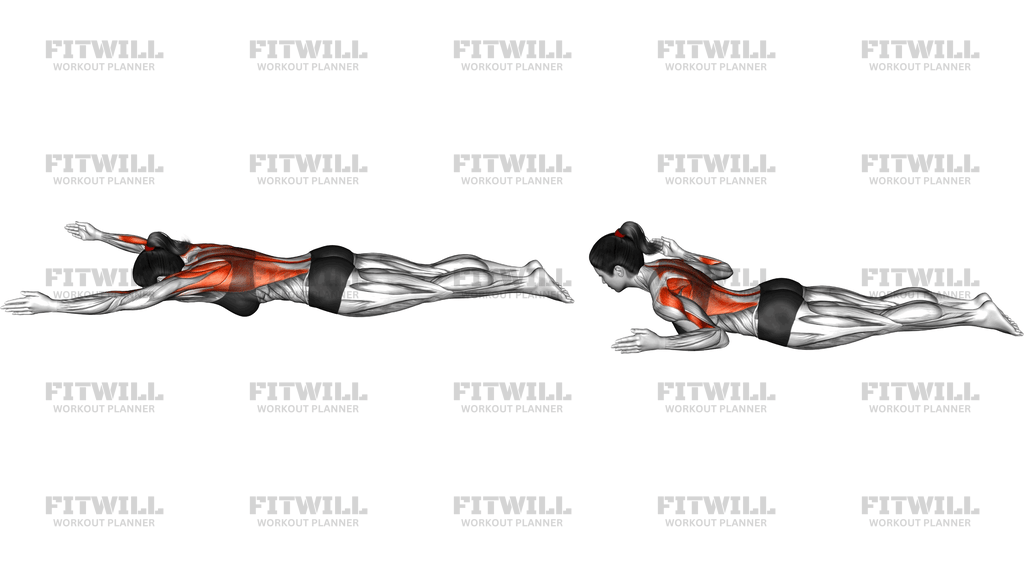
Instructions
- Lie face down on the floor with your legs straight behind you and your feet relaxed.
- Extend both arms straight overhead so they form a long line with your body, hands about shoulder-width apart, palms facing down.
- Lift your forehead and chest slightly off the floor and gently draw your shoulders down away from your ears.
- Brace your midsection and keep your neck neutral, looking at the floor rather than forward.
- From the overhead position, bend your elbows and pull them down and back toward your sides, leading with your elbows and squeezing your shoulder blades together.
- At the end of the pull, your upper arms should sit close to your ribs with your chest still lifted off the floor.
- Slowly straighten your arms back overhead to the starting position, keeping your hands and chest from resting on the floor between reps.
- Exhale as you pull your elbows down and back, and inhale as you extend your arms overhead.
- Complete your set, then lower your chest to the floor and rest before the next set.
- Keep your legs and hips in contact with the floor throughout each repetition.
Tips & Tricks
- If your lower back aches before your lats do, you are arching too hard — lift your chest only an inch or two off the floor and keep the ribs down.
- A common mistake is pulling with the hands instead of the elbows, which turns it into a shoulder exercise — think about dragging your elbows to your back pockets.
- Do not let your chin lift toward the ceiling; keep the back of your neck long by looking down at the floor.
- If your shoulders shrug up near your ears during the pull, reset with your shoulders pressed down before each repetition.
- Moving too fast turns this into a swinging motion — pause for a beat with your elbows at your sides so the mid-back actually does the work.
- You can make it harder by holding the pulled position for two or three seconds on each rep.
- If lifting both arms at once is too demanding, pull one arm at a time while the other stays extended overhead.
- Keep your legs relaxed and on the floor — tensing the glutes and lifting the legs shifts effort away from the lats.
- Place a folded towel under your forehead if lying flat on the floor bothers your face or neck.
Frequently Asked Questions
What muscles does the Lying Lat Row work?
The lats are the main drivers, pulling your arms from overhead down to your sides. The rear shoulders, rhomboids, lower traps, and biceps assist, while the erector spinae hold your chest lifted off the floor.
Is the Lying Lat Row good for beginners?
Yes, it is one of the most accessible bodyweight back exercises because it needs no equipment and uses only the resistance of your own arms against gravity. Beginners who cannot do pull-ups yet can build the pulling pattern here first.
Why do my arms start overhead in the Lying Lat Row?
The overhead starting position lengthens the lats fully before each pull, which mimics the bottom position of a pull-up or lat pulldown. It also means the lats work through a longer range than in most floor exercises.
How is the Lying Lat Row different from a regular row?
A regular row pulls horizontally from the front of your body, while this version pulls from overhead, which shifts more of the work to the lats and less to the middle back. Your spinal muscles also work harder because you are face down with your chest lifted.
Why does my lower back get tired before my lats?
The erector spinae must hold your chest off the floor for the whole set, so they fatigue quickly if you lift your torso too high or arch aggressively. Reduce the height of your chest lift and keep your ribs down so the pull stays in your back and arms.
Can I do the Lying Lat Row without a mat?
Yes, any firm surface works since you are only supporting the front of your body. A towel or thin mat under the forehead and hips improves comfort on hard floors.
How many reps should I do of the Lying Lat Row?
Aim for sets of 10 to 15 controlled repetitions, or use time-based sets of 20 to 40 seconds. Since the load is light, quality of the squeeze matters more than the number of reps.
What can I use instead of the Lying Lat Row?
Band pulldowns, straight-arm pulldowns on a cable machine, or inverted rows train similar pulling muscles. If you have no equipment, prone Y-T-W raises on the floor are a related substitute, though they emphasize the mid-back more than the lats.
Is the Lying Lat Row safe for my shoulders?
For most people it is gentle because the load is light and the floor limits your range. If you have a history of shoulder impingement, keep the pull within a pain-free range and avoid forcing the arms lower than feels comfortable at the start position.