Deep Breathe Flaps Plyo Squat
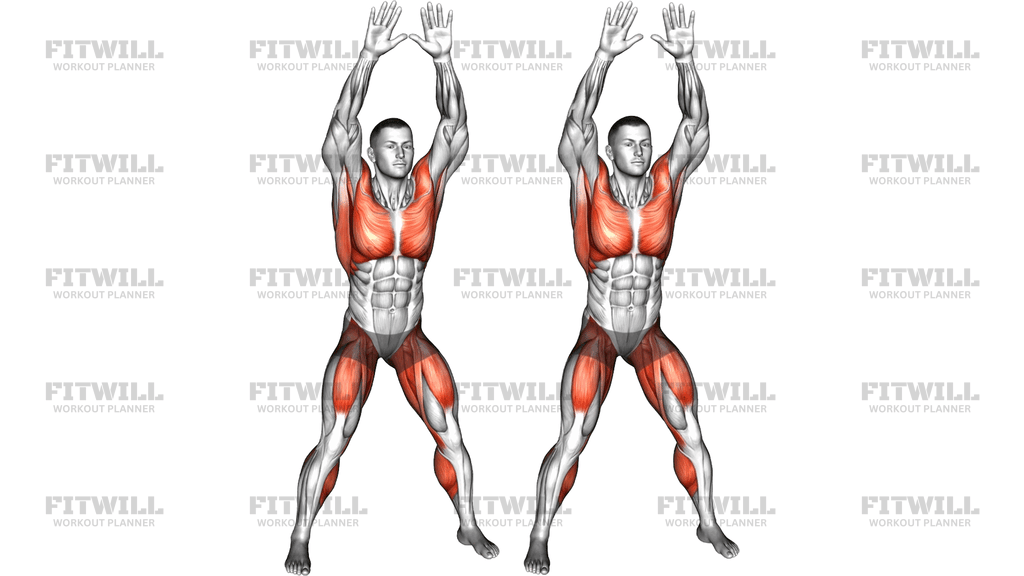
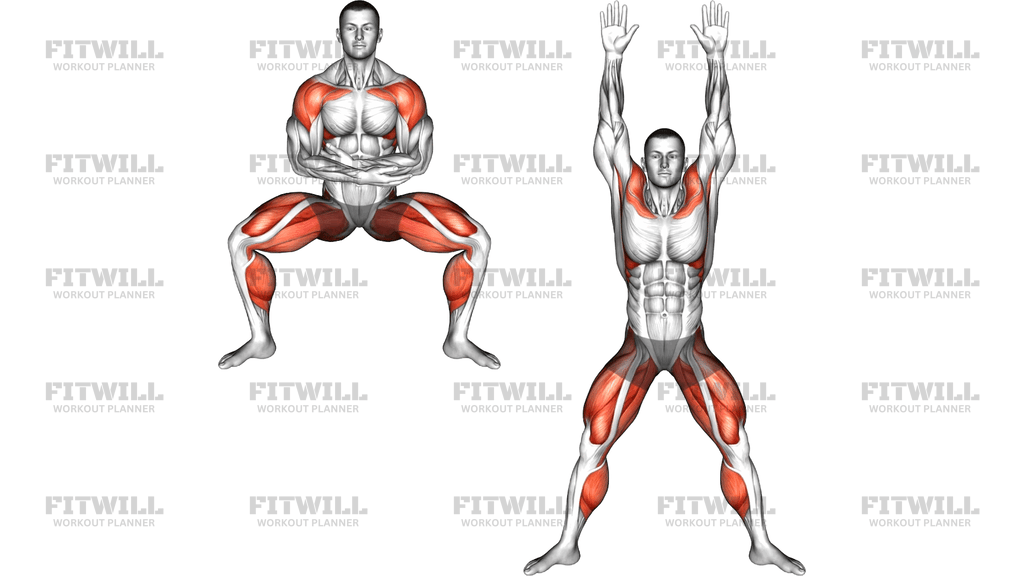
The Deep Breathe Flaps Plyo Squat is a bodyweight jump squat variation that pairs a wide-stance deep squat with a big overhead arm swing on every jump. You drop into a deep sumo-position squat with your arms crossed low in front of your body, then explosively jump up out of the squat, spreading your arms wide and up like flapping wings as you extend, before landing back into the deep squat and repeating. The breathing rhythm is built into the movement: you exhale forcefully on the jump and inhale as you sink back down.
This exercise is useful for anyone who wants explosive lower-body power without equipment. The wide stance shifts extra work onto the inner thighs and glutes compared with a standard jump squat, while the deep knee and hip angle forces the quads to generate force from a stretched position. The arm flaps are not just decoration; swinging the arms up on the jump adds momentum, raises the heart rate quickly, and teaches your upper and lower body to coordinate as one unit, which carries over to jumping, sprinting, and most field sports.
Setup matters more than it looks. A wide foot position with the toes angled slightly out changes the direction of force at your knees and hips, so your feet need to be planted wide enough that your knees track over your toes at the bottom. Because you are landing from a jump into a deep squat, the position you land in has to be identical to the position you jumped from, or your knees and hips will take uneven stress rep after rep.
To execute it well, sink fully into the squat with your chest tall and weight spread across the whole foot, cross your arms low in front of you, then drive the floor away and let the arms whip up and out to the sides as you rise. Land soft, absorb the impact by sitting straight back into the deep squat, and let the inhale happen naturally as you descend. Keep the rhythm continuous but not rushed; quality of the jump and the landing matters far more than how many reps you can rattle off.
This movement fits well as a warm-up finisher, a conditioning interval, or the power block of a leg session when you are fresh. It is best placed early in a workout when your legs still have snap in them, because deep landing mechanics deteriorate quickly once you are fatigued. Start with a few sets of six to ten reps, resting enough between sets that every jump stays crisp.
From a safety standpoint, protect your knees by keeping them pushed out over your toes at the bottom rather than letting them cave inward, and protect your lower back by keeping the chest up instead of folding forward. If you cannot reach a deep squat with a neutral spine yet, build depth gradually and shorten the range before adding jump volume.
[ Workout Log & Planner ]
Put your next workout in Fitwill
Keep your plan and training log ready when you are.


Instructions
- Stand with your feet roughly one and a half shoulder-widths apart, toes turned out about 30 to 45 degrees, and your weight spread evenly across the whole foot.
- Cross your arms in front of your lower chest with your hands relaxed, and let your shoulders stay down away from your ears.
- Brace your midsection, keep your chest tall, and push your hips back and down into a deep sumo squat, letting your knees travel out over your toes until your thighs are at least parallel to the floor.
- Inhale deeply as you sink into the bottom position and pause there for a beat.
- Exhale forcefully and drive through your heels and mid-foot to jump straight up, uncrossing and swinging your arms out wide and overhead in a smooth flapping arc as you extend.
- Reach full extension at the top with the arms up and the legs long, but do not over-arch your lower back.
- Land back into the same wide stance with soft knees, absorbing the impact by sinking directly into the deep squat and letting your arms drift back down to the crossed position in front of you.
- Inhale at the bottom, reset your brace, and begin the next jump immediately if you are doing continuous reps, or pause between reps if you are focusing on power.
- Finish the set by stepping the feet in slowly rather than jumping down from a partially squatted position, and shake out the legs before your next set.
Tips & Tricks
- The most common fault is letting the knees collapse inward at the bottom of the wide stance; actively think about spreading the floor apart with your feet as you descend and land.
- If your heels lift when you jump, widen your stance slightly less and make sure you are driving through the mid-foot, not the toes.
- Keep the arm flap a controlled swing rather than a jerky throw; the arms should lead slightly on the way up and trail down as you land, staying relaxed at the shoulders.
- Do not fold your chest over your thighs at the bottom to feel deeper; a deep squat with a tall chest trains the hips better and keeps your spine neutral.
- Land quietly. A loud, heavy landing means the impact is reaching your joints instead of being absorbed by the quads, glutes, and calves.
- If your inner thighs cramp in the wide position, shorten the range for a week or two and add a few static deep sumo squats before attempting the jump version.
- Stop the set when your jump height visibly drops; deep plyo squats done tired train slow, sloppy landings instead of power.
- Exhale sharply through the mouth on the jump rather than holding your breath, since the breath cycle is what makes the movement rhythm sustainable across a full set.
- On a hard floor, a thin mat or a sprung surface reduces landing noise and lets you focus on the squat depth instead of protecting your heels.
Frequently Asked Questions
Which muscles does the Deep Breathe Flaps Plyo Squat work the most?
The quads and glutes do most of the work, since they produce the force for the jump and control the landing. The inner thighs work hard because of the wide stance, and the calves, shoulders, and core assist on every rep.
Why does the Deep Breathe Flaps Plyo Squat use a wide stance instead of a normal squat stance?
The wide stance with toes turned out places greater demand on the adductors and glutes and allows a deeper squat for many people. It also widens your base, which makes landings more stable.
Is the Deep Breathe Flaps Plyo Squat suitable for beginners?
Beginners should first learn a controlled deep sumo squat without jumping and only add the jump once they can land softly in the exact same wide position. Starting with shallow jumps or even a fast bodyweight rise without leaving the floor is a sensible progression.
What is the purpose of the arm flaps in the Deep Breathe Flaps Plyo Squat?
The arm swing adds upward momentum to the jump and coordinates the upper and lower body, while the wide overhead reach opens the chest and shoulders between reps. It also raises the heart rate faster than a plain jump squat.
How deep should I squat in the Deep Breathe Flaps Plyo Squat?
Aim for thighs at or just below parallel as long as you can keep your chest tall, heels down, and knees tracking over your toes. Depth that costs you your landing position is counterproductive.
Why do my knees cave in when I land from the Deep Breathe Flaps Plyo Squat?
That usually means the wide stance is asking more from your glutes and inner thighs than they currently control. Cue spreading the floor with your feet on every landing, and temporarily reduce jump height or stance width until the position holds.
How many reps and sets of the Deep Breathe Flaps Plyo Squat should I do?
Two to four sets of six to ten quality jumps works well for power, while longer continuous sets of 20 to 30 seconds turn it into a conditioning drill. Rest enough between sets that each jump stays explosive.
What can I substitute if jumping is uncomfortable in the Deep Breathe Flaps Plyo Squat?
Perform the same wide-stance deep squat with the arm flap and breathing rhythm, but rise forcefully onto your toes without leaving the floor. This keeps most of the coordination and muscle work while removing the landing impact.
Should I wear shoes or go barefoot for the Deep Breathe Flaps Plyo Squat?
Either works, but a flat, cushioned shoe with a stable heel is the safer choice for repeated jump landings. Avoid soft, heavily cushioned running shoes that let your ankles wobble on landing.
Can I do the Deep Breathe Flaps Plyo Squat every day?
Daily practice is not necessary because the landings create fatigue your legs need time to recover from. Two to four sessions per week, with at least a day between them, gives better long-term progress.