Sitting Back Squeeze Pulse On A Chair
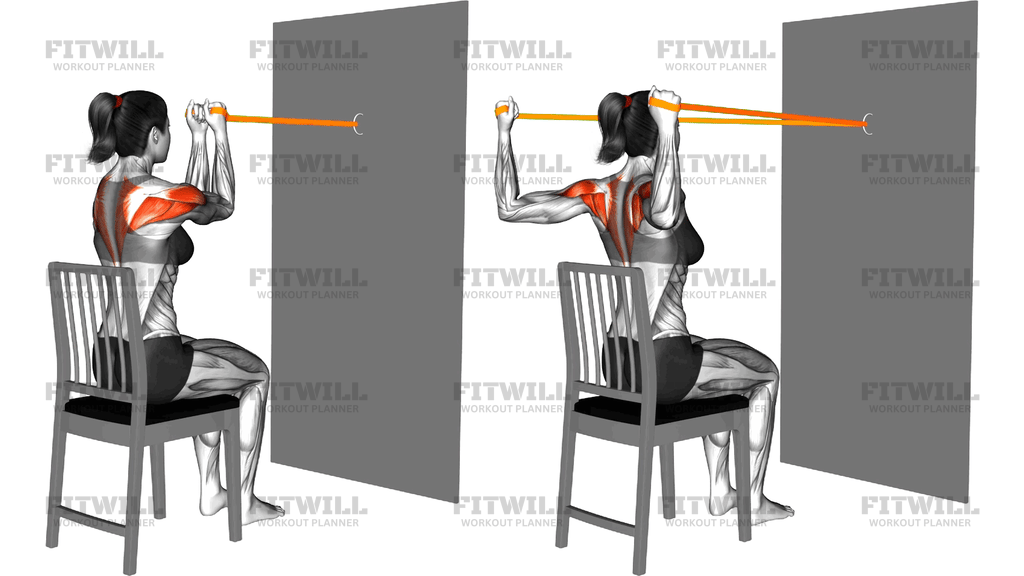
The Sitting Back Squeeze Pulse On A Chair is a simple, equipment-light movement that targets the muscles between and behind your shoulder blades. You sit on a chair facing its backrest, lift your arms into a goalpost position with elbows bent at about shoulder height, and perform small, sharp backward pulses that squeeze the shoulder blades together. The chair back acts as a cue for posture and keeps your torso upright and stable, so all of the work happens in the upper back rather than in the lower spine.
This exercise trains the rhomboids, mid and lower trapezius, and the rear delts — the muscle group responsible for pulling your shoulder blades back and down. These muscles are chronically underused in desk-bound lifestyles, which is why rounded shoulders and upper-back stiffness are so common. Because the movement uses short pulses at the end range of the squeeze, it builds awareness of a contraction many people have never consciously felt, and it does so with zero load beyond your own body weight.
It is especially useful for office workers, beginners, older adults, and anyone recovering general upper-back endurance after long periods of inactivity. It also works well as a warm-up primer before rows, pull-ups, or pulldowns, and as a posture reset you can perform quietly at a desk between meetings. Since the pulses are small and controlled, it is easy to regulate effort and stop before fatigue ruins your form.
Setup matters more than it appears. Sitting with the chair back in front of you encourages a tall, open chest and prevents you from leaning back or slumping into the seat. Straddle the seat so your torso is supported by your own posture, keep feet flat on the floor, and make sure your elbows never drop below shoulder height during the pulses. If your elbows sag, the front of your shoulders takes over and the upper back loses tension.
To execute well, lift the arms first, draw the shoulder blades gently back and down, and then pulse the elbows backward an inch or two in a steady rhythm. Each pulse should feel like a crisp pinch between the shoulder blades, not a big arm swing. Keep the neck relaxed, jaw loose, and breathing steady throughout the set.
The most common mistakes are shrugging the shoulders toward the ears, arching the lower back to fake a bigger squeeze, and pulsing so fast that momentum replaces muscle work. Slow down, reduce the range slightly, and focus on quality of the contraction over the number of pulses. If you feel it mostly in the neck, lower your elbows slightly and soften the effort.
Fitwill
Log Workouts, Track Progress & Build Strength.
Achieve more with Fitwill: explore over 9600 exercises with images and videos, access built-in and custom workouts, perfect for both gym and home sessions, and see real results.
Start your journey. Download today!




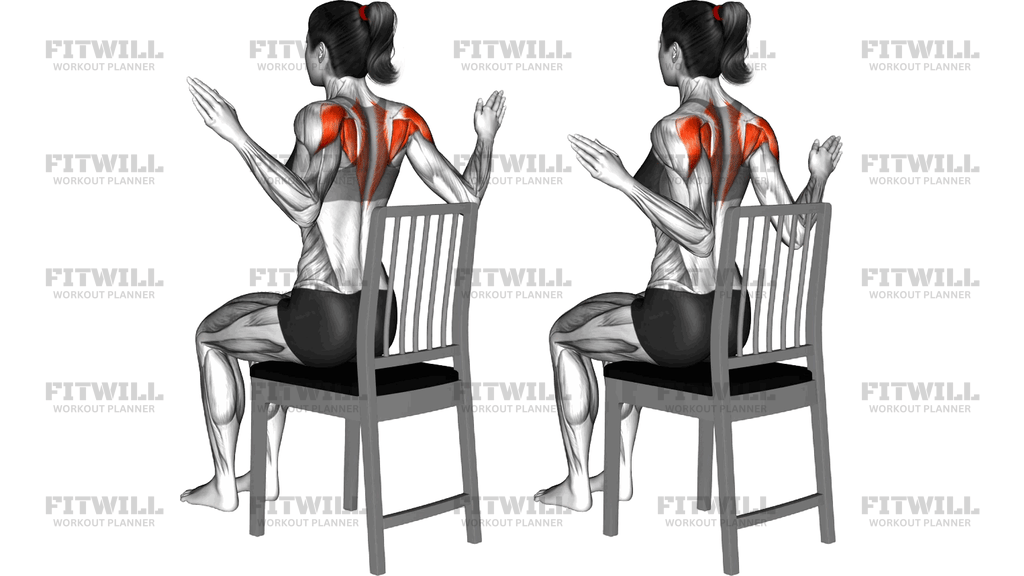
Instructions
- Sit on a sturdy chair facing its backrest, straddling the seat with one leg on each side so the backrest is in front of your chest.
- Place both feet flat on the floor, sit tall on your sit bones, and let the chair backrest remind you to keep your chest open without leaning on it.
- Raise both arms out to the sides into a goalpost position: elbows bent to roughly 90 degrees and lifted to shoulder height, palms facing forward.
- Draw your shoulder blades gently back and down to establish light tension across the upper back before you start pulsing.
- Pulse both elbows backward an inch or two in a small, controlled rhythm, feeling a pinch between the shoulder blades at each pulse.
- Keep the elbows at or very near shoulder height the whole time; do not let them drop toward your ribs or drift up toward your ears.
- Exhale on each backward pulse and inhale as the arms ease forward, keeping the breath rhythmic rather than held.
- Continue for the desired number of pulses, then lower the arms slowly to your sides to release the contraction.
- Reset your posture — lift the chest, relax the shoulders, settle the feet — before starting the next set.
- Keep the pulses crisp but not jerky; the torso should stay almost still while the arms and shoulder blades do the work.
Tips & Tricks
- If you feel the work in your neck instead of between your shoulder blades, lower your elbows an inch or two and reduce the pulse force — the traps are taking over from the rhomboids.
- Imagine holding a pencil between your shoulder blades and cracking it with every pulse; this image keeps the focus on the squeeze rather than on arm speed.
- Do not press your chest into the chair backrest for leverage — hover just behind it so your own upper-back muscles hold you upright.
- A slow tempo of about one pulse per second works better than frantic fluttering; speed hides the fact that the blades are not actually moving.
- Check your lower back: if it arches hard with each pulse, brace your abs lightly and tilt your pelvis to neutral so the spine stops compensating.
- Start with short sets of 15 to 20 seconds; this area fatigues quickly and form deteriorates into shrugging once endurance runs out.
- Your palms should stay facing forward and fingers relaxed; clenching the hands or curling the fingers shifts tension into the forearms and biceps.
- Use this as a pre-row activation drill — two sets before seated rows or pulldowns makes the target muscles easier to feel in heavier work.
- If shoulder height is uncomfortable due to stiffness, work with elbows slightly below shoulder level rather than forcing the goalpost position.
Frequently Asked Questions
Which muscles does the Sitting Back Squeeze Pulse On A Chair work?
It primarily works the rhomboids and mid trapezius between the shoulder blades, with the rear delts and lower traps assisting. Because there is no external load, the emphasis is on muscle endurance and contraction quality rather than maximal strength.
Why sit facing the chair backrest instead of normally on the chair?
Facing the backrest keeps your chest open and your torso upright, and it stops you from slumping back into the seat. The backrest also acts as a physical boundary that encourages the shoulder blades to retract rather than the torso to rock.
Is the Sitting Back Squeeze Pulse On A Chair suitable for complete beginners?
Yes, it is one of the friendliest upper-back drills because it uses only your body weight and a chair. Beginners should start with short sets and focus on feeling the shoulder blades pinch together on every pulse.
Can I do this exercise at my desk during the workday?
Absolutely — a stable chair without wheels is all you need. If straddling the chair is awkward in your workspace, you can do the same arm pulses while sitting normally with your feet planted, though you lose the backrest posture cue.
Why do I feel this more in my neck than in my upper back?
That usually means your upper traps are shrugging to do the job of the rhomboids. Lower your elbows slightly below shoulder height, soften the intensity of each pulse, and consciously relax your shoulders down before continuing.
How fast should the pulses be?
Aim for roughly one pulse per second, crisp but controlled. Faster than that and momentum from the arms replaces the scapular squeeze that the exercise is designed to train.
What can I substitute if I do not have a suitable chair?
Any stable seat works, or you can stand with your back near a wall and perform the same goalpost-position pulses. Band pull-aparts and wall slides train similar muscles if you want a loaded or floor-based alternative.
How many pulses should I do per set?
Fifteen to twenty controlled pulses, or about 15 to 20 seconds of continuous work, is a good starting point. Build up to two or three sets as your upper-back endurance improves.
Is it safe for my shoulders if I have stiffness or a past strain?
The movement is low load, but you should still keep the elbow position within a pain-free range and stop if you feel sharp discomfort. If a recent injury is involved, clear the exercise with a health professional first.