Sitting Pulse Row On A Chair
The Sitting Pulse Row On A Chair is a bodyweight back exercise that turns an ordinary chair into a training tool for your upper back. You sit upright on the front edge of the seat with your hands resting lightly on the seat beside or just behind your hips, then repeatedly squeeze your shoulder blades down and back in small, controlled pulses — the same finishing position your arms reach at the top of a seated row, but created entirely by your own muscular effort rather than a cable or weight.
This movement is especially useful for people who spend long hours sitting at a desk, since rounded shoulders and a slouched upper back are exactly the posture problems it targets. It is also a gentle entry point for beginners who have never felt their rhomboids working, for older adults who want back strength without equipment, and for lifters who want a low-load way to practice scapular retraction before moving on to rows with resistance. Because you are seated, balance is not a challenge, so all of your attention can go into the squeeze itself.
The main muscles working are the rhomboids and the middle trapezius, the muscles that pull your shoulder blades toward your spine. The rear deltoids assist as your upper arms drift slightly behind your torso, and the lower traps help keep the blades depressed rather than shrugged toward your ears. Your lats and biceps contribute lightly as stabilizers, and your core works quietly to keep your torso tall throughout the set.
Setup matters more than it might seem. Sitting too far back on the chair rounds your lower back and shortens the range available to your shoulder blades, so position yourself on the front half of the seat with your feet flat on the floor. Your hands should rest on the seat surface at your sides — not gripping hard, just enough to give your arms a reference point. A tall spine with a proud chest is what allows the shoulder blades to retract fully.
To execute the pulse, draw your shoulder blades together and down as if trying to pinch an imaginary coin between them, letting your upper arms travel a few inches behind your torso. Pause briefly at the peak of the squeeze, then release halfway forward and pulse back in again. The pulses are short by design — you stay in the working zone rather than returning all the way to a relaxed slouch between reps.
Keep the effort honest: because there is no external load, the temptation is to rush and let momentum or shoulder shrugging fake the work. Slow, deliberate repetitions with a genuine one-second squeeze will do far more for your posture and back strength than fast, sloppy pulses. Stop the set when you can no longer feel the squeeze between the shoulder blades, and build up volume gradually over weeks.
[ Workout Log & Planner ]
Put your next workout in Fitwill
Keep your plan and training log ready when you are.


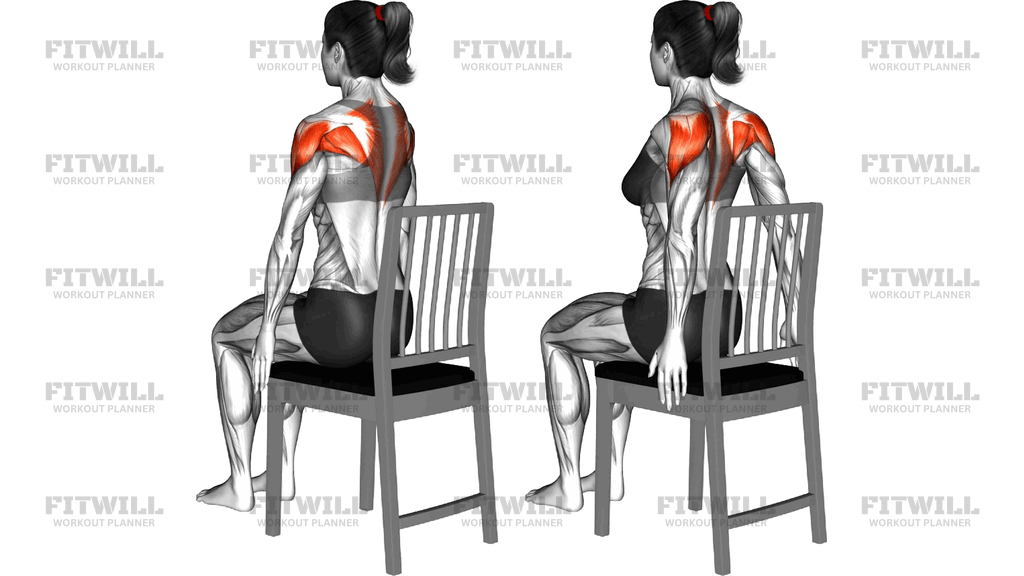
Instructions
- Sit on the front half of a sturdy chair with your feet flat on the floor about hip-width apart and your knees bent roughly 90 degrees.
- Rest your hands on the seat surface beside or slightly behind your hips, fingers facing forward, with only light contact — no hard gripping.
- Sit tall and lift your chest so your spine is long; tilt your pelvis slightly forward instead of slumping back onto your tailbone.
- Draw your shoulder blades down and back toward your spine, as if pinching something between them, and let your upper arms drift a few inches behind your torso.
- Pause for a beat at the peak of the squeeze, keeping your shoulders away from your ears.
- Release only halfway forward so your shoulder blades stay partially engaged, then pulse straight back into the squeeze — this halfway reset is what makes it a pulse row.
- Exhale as you squeeze the blades together and inhale as you release halfway forward.
- Keep your neck relaxed and your gaze level; your head should not jut forward as your arms move back.
- Complete your reps, then roll your shoulders gently and reset your seated posture before starting the next set.
Tips & Tricks
- If you cannot feel your shoulder blades working, exaggerate the cue of sliding them into your back pockets — most people lift their shoulders instead of retracting them.
- Do not press down hard through your hands; the chair is a reference point, and pushing into it shifts the work toward your triceps and takes it away from your upper back.
- Watch for a shrinking chest as fatigue sets in — when your shoulders round forward between pulses, the range has collapsed and it is time to rest.
- Keep the pulses small and rhythmic; swinging your arms several inches back and forth turns this into a momentum exercise instead of a scapular squeeze.
- If the edge of the chair digs into your thighs or your lower back tires, shorten the set rather than slumping to compensate.
- A kitchen chair without armrests works best — armrests block the path of your elbows as they travel behind your torso.
- Try closing your eyes for a few reps; the Sitting Pulse Row On A Chair is as much about learning to feel the retraction as it is about strength.
- Pair it with a doorway chest stretch in the same session, since tight chest muscles fight against the retraction you are training.
Frequently Asked Questions
What muscles does the Sitting Pulse Row On A Chair work?
The primary muscles are the rhomboids and middle trapezius, which pull your shoulder blades toward your spine. The rear deltoids and lower traps assist, with light support from the lats and biceps.
Is the Sitting Pulse Row On A Chair suitable for complete beginners?
Yes, it is one of the most beginner-friendly back exercises because there is no external load and the seated position removes balance demands. It is an excellent way to learn what a shoulder blade squeeze feels like before adding weight to rows.
Why do the hands rest on the chair seat instead of holding a weight?
The chair gives your arms a fixed reference point so you can isolate the retraction at the shoulder blades. The movement is driven by pulling the blades back, not by pressing or lifting with the arms.
How is a pulse different from a full row?
In a pulse you release only halfway between repetitions, keeping constant tension in the upper back instead of returning to a fully relaxed position. This builds endurance in the postural muscles that hold your shoulders back during the day.
My shoulders creep up toward my ears during the Sitting Pulse Row On A Chair. How do I fix that?
That is upper trap takeover, the most common mistake in this movement. Actively think about drawing the blades down toward your back pockets rather than straight back, and reduce the speed until the shrug disappears.
How many reps and sets should I do?
Start with 2 to 3 sets of 12 to 20 slow pulses, resting about 45 seconds between sets. Because the load is your body weight, higher repetitions with a strong squeeze work better than low reps.
Can I do this exercise if I have shoulder discomfort?
The small, unloaded range is generally gentle on the shoulders, but you should keep the pulses within a pain-free arc and stop if you feel pinching. Check with a qualified professional if discomfort persists.
What can I use instead of a chair?
A bench, sturdy ottoman, or the edge of a bed without armrests works the same way. The only requirements are a stable, armrest-free surface at roughly knee height.
Will the Sitting Pulse Row On A Chair improve my posture?
It strengthens the muscles responsible for pulling the shoulder blades back, which supports a more upright seated and standing posture. For the best results, combine it with chest stretching and regular breaks from sitting.