Sitting Alternating Row On A Chair
The Sitting Alternating Row On A Chair is a bodyweight rowing drill performed while seated sideways on an ordinary chair, straddling it so you face the backrest. Because there is no actual resistance to hold, your hands mimic the grip of a rowing handle as you pull one elbow back at a time, as if tugging an invisible rope toward your ribs. The left arm extends forward while the right pulls, then the arms trade roles, creating a continuous alternating rhythm that keeps your upper back working on both sides of the body.
This movement is a good fit for people who spend long hours at a desk, beginners building baseline back strength, and anyone who wants a low-friction way to reactivate the muscles between the shoulder blades during a workday or warm-up. Since it requires nothing more than a sturdy chair, it works well in an office, hotel room, or living room where no bands or cables are available.
The main work happens in the rhomboids and middle trapezius, which squeeze the shoulder blade back and in toward the spine on each pull. The lats, rear shoulders, and biceps assist as the elbow drives past the torso, while the core stabilizes your seated posture and prevents the trunk from twisting with each row. Because you are seated with feet on the floor, the legs are mostly passive, making this a focused upper-back exercise rather than a full-body one.
Setup matters more than it might seem. Sitting astride the chair with the backrest in front of you gives your knees something to brace against and locks your pelvis into a stable, upright position, which makes it much harder to lean back and cheat the row. Feet planted flat, ribs stacked over the pelvis, and shoulders pulled gently down away from the ears create the foundation every repetition should return to.
To execute it well, extend both arms forward at chest height, then row one elbow straight back until the hand arrives beside your lower ribs, squeezing the shoulder blade before extending the arm again as the opposite arm pulls. The motion should feel like a deliberate tug, not a rushed swing. Keep the torso square to the backrest so the movement stays in the arms and upper back rather than turning into a spinal rotation.
Use this exercise as an activation drill before heavier pulling work, as a posture reset between long stretches of sitting, or as a high-repetition finisher when equipment is unavailable. If you feel it mostly in your neck or the tops of your shoulders, you are shrugging — consciously lower the working shoulder and let the shoulder blade do the pulling instead. Anyone with an acute shoulder or neck issue should get clearance before adding repeated rowing motions, and the movement should always stay within a pain-free range.
Fitwill
Log Workouts, Track Progress & Build Strength.
Achieve more with Fitwill: explore over 9600 exercises with images and videos, access built-in and custom workouts, perfect for both gym and home sessions, and see real results.
Start your journey. Download today!




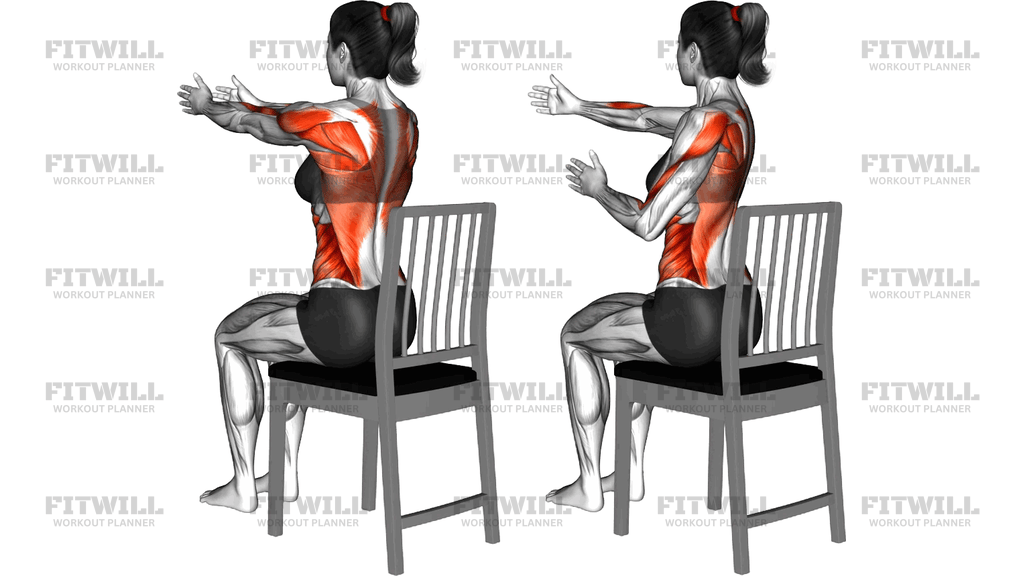
Instructions
- Sit sideways on a sturdy chair and straddle it so you face the backrest, with one thigh on each side of the seat.
- Plant both feet flat on the floor, sit tall on your sit bones, and let your knees rest lightly against the sides of the backrest or seat for a stable brace.
- Extend both arms straight forward at chest height, palms facing each other, as if gripping an imaginary handle or rope.
- Draw your shoulders down away from your ears and brace your stomach lightly to keep your ribs stacked over your pelvis.
- Pull one elbow straight back toward your hip until your hand arrives beside your lower ribs, squeezing the shoulder blade in toward the spine at the end of the pull.
- Keep your torso square to the chair backrest — do not let your chest or shoulders twist with the rowing arm.
- Extend that arm forward again under control while the opposite arm begins its pull, keeping the two arms trading roles in a smooth alternating rhythm.
- Exhale as you pull the elbow back and inhale as the arm extends forward.
- Complete all repetitions on the alternating pattern, then rest, shake out your shoulders, and reset your seated posture before the next set.
Tips & Tricks
- The most common cheat is leaning the torso backward as the elbow pulls — straddle the chair firmly and think of driving your chest slightly toward the backrest to stay upright.
- If you feel the work creeping into your neck, you are likely shrugging; actively press the working shoulder down before starting each pull so the rhomboids, not the upper traps, lead the movement.
- Row to your ribs, not your armpit — bringing the hand all the way beside your lower torso encourages the shoulder blade to retract fully instead of leaving the pull half-finished.
- Keep the non-working arm from drooping; holding it actively extended forward keeps tension on the opposite side of your upper back and doubles the postural benefit.
- Slow the return phase down. Because there is no actual load, the only resistance is the control you create, so a deliberate two-count on the way forward makes the drill noticeably harder.
- Grip your hands lightly as if loosely holding a rope — clenching the fists hard recruits the forearms and neck and distracts from the upper-back focus.
- Watch for the chest opening and closing with each rep; if your shoulders rotate toward the pulling arm, shorten the range slightly until you can keep the torso square.
- For a progression, pause for one to two seconds with the hand at your ribs and squeeze the shoulder blade before extending, or slow every rep to a four-second tempo.
Frequently Asked Questions
What muscles does the Sitting Alternating Row On A Chair work?
The primary muscles are the rhomboids and middle trapezius between the shoulder blades, with the lats, rear shoulders, and biceps assisting on each pull. Your core also works to keep the torso upright and square to the chair.
Why sit straddling the chair facing the backrest instead of sitting normally?
Facing the backrest gives your knees a brace and locks your pelvis upright, which stops you from leaning back to fake the pull. It keeps the row honest and puts the work in your upper back rather than your lower back.
Is the Sitting Alternating Row On A Chair suitable for complete beginners?
Yes, it is one of the safest ways to learn the rowing pattern because there is no external load and the seated position removes balance demands. Focus on squeezing the shoulder blade fully on each rep before adding speed or volume.
Can I actually build strength with no weight or band, just mimicking the pull?
You will get meaningful activation and endurance in the upper back, especially at slow tempos and long pauses, but it will not replace loaded rows for maximum strength. Treat it as an activation and posture drill, or add a band later for progressive resistance.
Why do I feel this exercise in my neck instead of my back?
That usually means you are shrugging, so the upper traps take over for the rhomboids. Press your shoulders down before each pull, keep your hands lightly closed, and reduce the range until the squeeze between the shoulder blades is the sensation you feel most.
Should my torso twist as each arm rows back?
No — the alternating pattern invites rotation, but your chest should stay square to the chair backrest throughout. If you notice your shoulders rotating, slow down and shorten the pull until you can control the arm without twisting the trunk.
What can I use instead if I do not have a suitable chair?
Any stable seat works, including a bench or the edge of a sturdy ottoman, as long as you can sit tall with feet flat. You can also perform the same alternating pull seated on the floor with legs crossed, though you lose the knee brace against the backrest.
How many repetitions should I do?
For activation or a desk break, 10 to 15 pulls per side with a controlled tempo works well. If you are using it as a finisher, extend to 20 or more per side and add a two-second squeeze at the ribs on each rep.
Is the Sitting Alternating Row On A Chair safe after a shoulder injury?
The movement is gentle, but any recent or ongoing shoulder or neck issue should be cleared by a qualified professional first. Once approved, start with a small pain-free range and stop if you feel pinching rather than muscular effort.