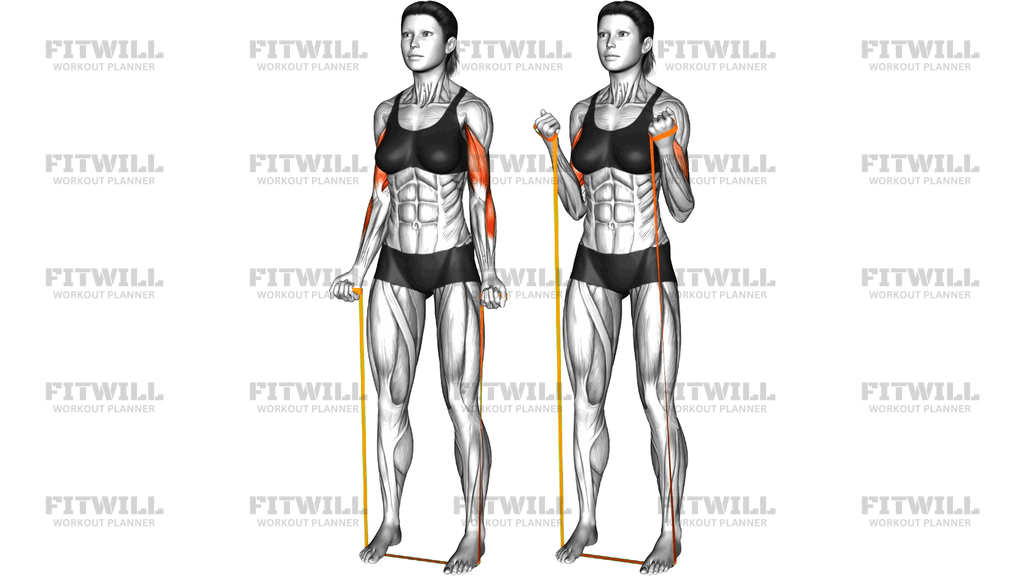
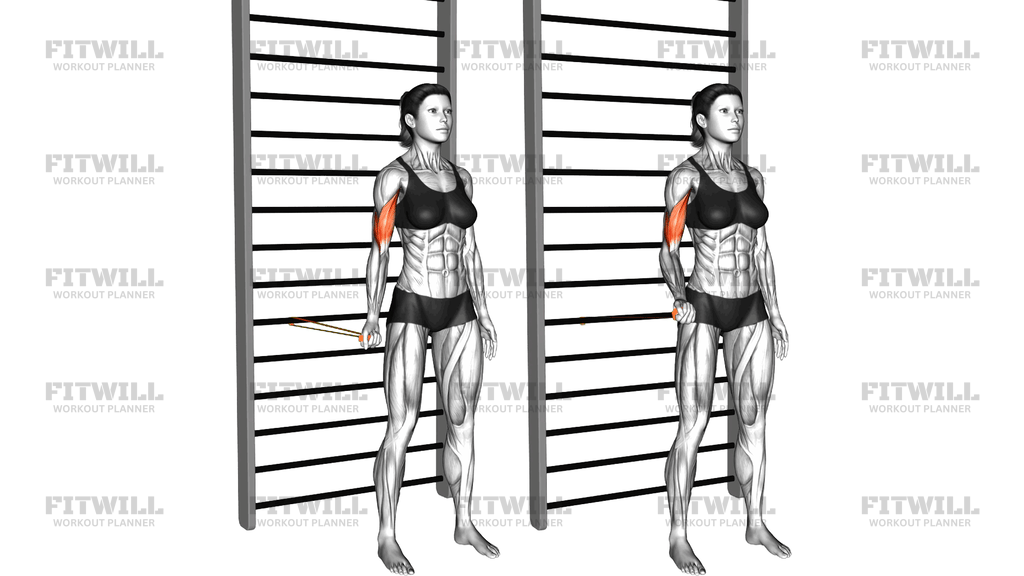
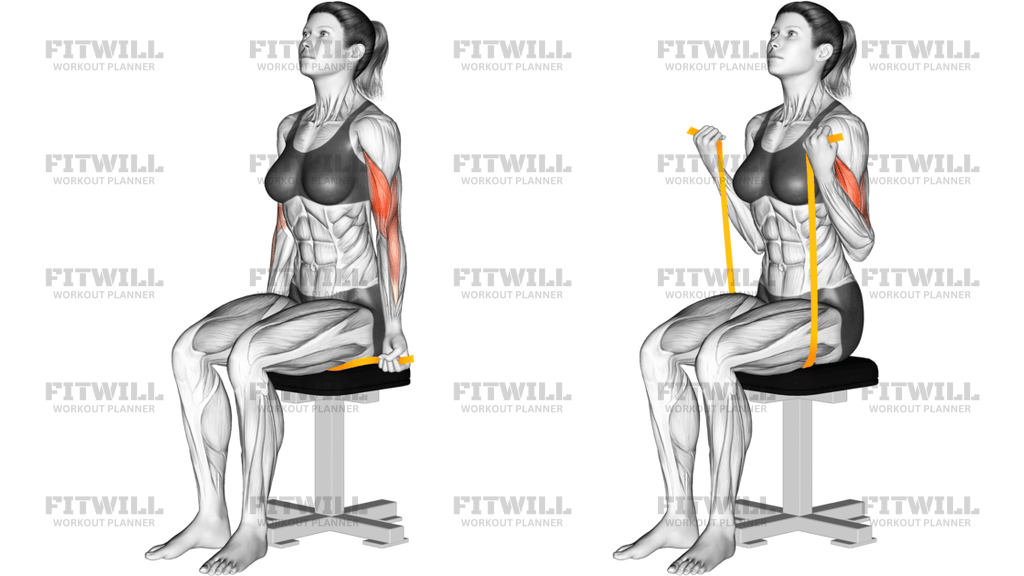
Resistance Band Concentration Curl
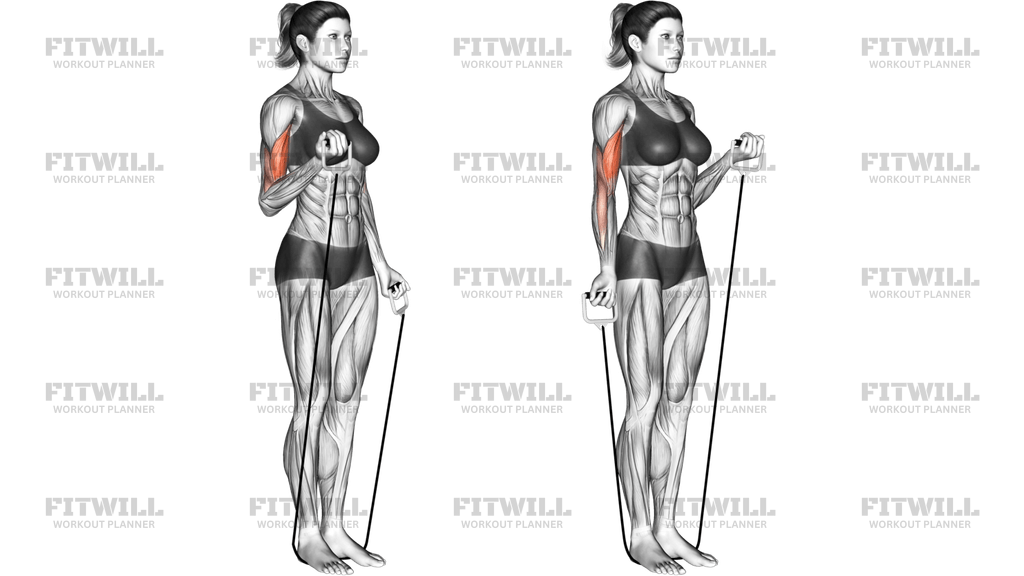
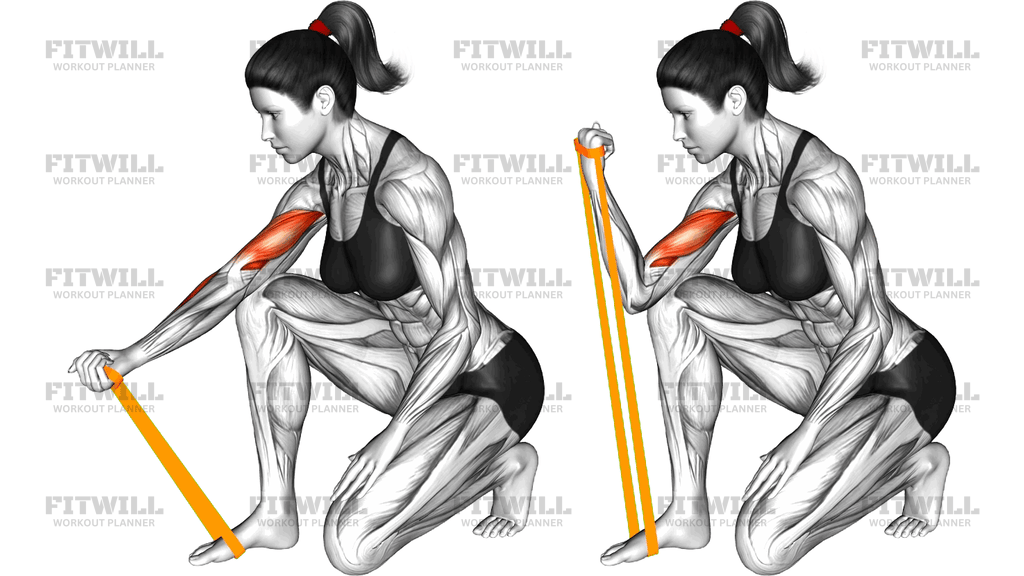
The Resistance Band Concentration Curl is a single-arm biceps exercise performed in a half-kneeling position, with the band anchored under your front foot and your working elbow braced against the inside of your thigh. This setup locks the upper arm in place, which is the whole point of the concentration style: the biceps do the work without help from momentum or body English. It is one of the most strict ways to train the biceps with nothing more than a single loop band.
Because the anchor point sits low at your front foot, the tension curve differs from a dumbbell curl. The band is slackest at the bottom and pulls hardest near the top of the curl, so you get peak resistance right where the biceps is close to full contraction. Lifters who struggle to feel their biceps working with free weights often find this version clicks immediately, because the band keeps pulling them into a strong squeeze at the top instead of letting tension fade.
The half-kneeling stance does more than provide an anchor. With one knee down and the torso leaned slightly over the working arm, your back stays long and your shoulder stays quiet, so the movement happens almost entirely at the elbow joint. That makes this a good pick for beginners learning what a strict curl feels like, for anyone training at home with limited equipment, and for lifters who want a focused finisher after heavier pulling or curling work.
The main muscles at work are the biceps brachii on the front of the upper arm, with the brachialis underneath and the brachioradialis in the forearm contributing as the elbow flexes. Your grip and forearm muscles work to hold the band securely, and the braced leg, hips, and core stay engaged just enough to keep your torso from twisting as you pull.
To execute it well, keep the working elbow planted against the thigh from start to finish. Curl the hand up toward the same-side shoulder, squeeze hard at the top, then lower slowly until the arm is nearly straight and the band is still under light tension. The slower you let the band pull your hand back down, the more you will get out of each rep.
A few practical points keep this safe and effective. Anchor the band firmly under the midfoot so it cannot slip out during the set, choose a band tension you can control for strict reps, and stop if you feel any sharp discomfort at the elbow or wrist. Keep the neck relaxed and breathe steadily rather than holding your breath during the curl.
[ Workout Log & Planner ]
Put your next workout in Fitwill
Keep your plan and training log ready when you are.


Instructions
- Kneel on your right knee with your left foot flat on the floor in front of you, knee bent to roughly 90 degrees.
- Anchor one end of the resistance band under your left foot, holding the other end in your left hand, and lean your torso slightly forward over that thigh.
- Rest the back of your left upper arm against the inside of your left thigh so the elbow sits just above the knee and hangs fully straight.
- Set your free hand on your right thigh for balance and brace your trunk so your torso stays square and still.
- Exhale and curl the handle up toward your left shoulder by bending only the elbow, keeping the upper arm glued to the thigh.
- Pause at the top and squeeze the biceps hard while the band tension is greatest.
- Inhale and lower the hand back down slowly, resisting the band until the arm is nearly straight but the band still has slight tension.
- Complete all repetitions on one side, then switch the anchor to the other foot and curl with the opposite arm.
- Between sets, release the band carefully from under the foot rather than letting it snap free.
Tips & Tricks
- The most common fault is letting the elbow drift forward off the thigh, which turns the rep into a loose front-raise. Check that the upper arm stays pressed against the leg on every rep.
- If the band slips off the foot mid-set, anchor it under the arch of the foot, where pressure from your body weight holds it most securely.
- Swinging the torso to start the curl means the band is too heavy. Either step to a lighter band or choke up on the band to shorten it and reduce tension.
- Do not curl the hand across the body toward the opposite shoulder. Pull it straight up toward the same-side shoulder so the elbow stays stacked.
- Stop just short of fully locking the arm out at the bottom. Letting the band yank the arm into full extension removes tension and can jar the elbow.
- The top of this curl is where the band resists hardest, so treat the squeeze there as the main working portion rather than rushing through it.
- Keep the neck neutral and look at the floor a foot or two ahead rather than craning up, since the forward-leaning position invites neck strain.
- If your wrist bends back at the top, grip with the band running along the inside of the hand and keep the knuckles facing up through the path.
- Control the lowering phase for two to three seconds. The band pulls the arm down quickly if you let go too fast, which wastes half the rep.
Frequently Asked Questions
What muscles does the Resistance Band Concentration Curl work?
It primarily targets the biceps brachii, with the brachialis and brachioradialis assisting as the elbow flexes. The forearm muscles also work to maintain your grip on the band.
Why is the band anchored under the front foot in the Resistance Band Concentration Curl?
The foot acts as a stable, low anchor point, which lets you lean over the working arm and brace the elbow against the thigh. That fixed anchor keeps constant tension and prevents you from using body sway to move the band.
Is the Resistance Band Concentration Curl good for beginners?
Yes. The kneeling setup enforces strict form naturally because the elbow is pinned to the thigh, making it hard to cheat. Start with a light band and focus on feeling the biceps shorten and lengthen through each rep.
How does this band version differ from a dumbbell concentration curl?
The band is easiest at the bottom and hardest near the top, while a dumbbell is hardest mid-range. This means you get strong resistance during the peak contraction, so emphasize a deliberate squeeze at the top of every rep.
What is the most common mistake in the Resistance Band Concentration Curl?
Letting the elbow float away from the thigh or swinging the torso to help the hand up. Both shifts reduce biceps work. If you need to swing, the band is too heavy, so switch to lighter tension.
How many sets and reps should I do?
Two to four sets of 10 to 15 reps per arm works well for most lifters. Because band tension climbs steeply near the top, choose a band that lets you complete strict reps with the elbow still braced.
Can I do the Resistance Band Concentration Curl without kneeling?
You can sit on a bench with the band under your foot instead, which closely mirrors the classic concentration curl setup. The key elements to preserve are the low anchor, the forward lean, and the elbow braced against the leg.
Where should I place the band under my foot?
Anchor it under the arch or midfoot rather than the toes. The arch keeps the band secure under your body weight and reduces the chance of it sliding out mid-rep.
Is it safe to straighten the arm fully at the bottom of each rep?
Full extension is fine if you lower with control, but letting the band snap the arm into lockout can be jarring on the elbow. Stop just short of complete lockout so the band still carries light tension throughout.