Resistance Band Drag Curl
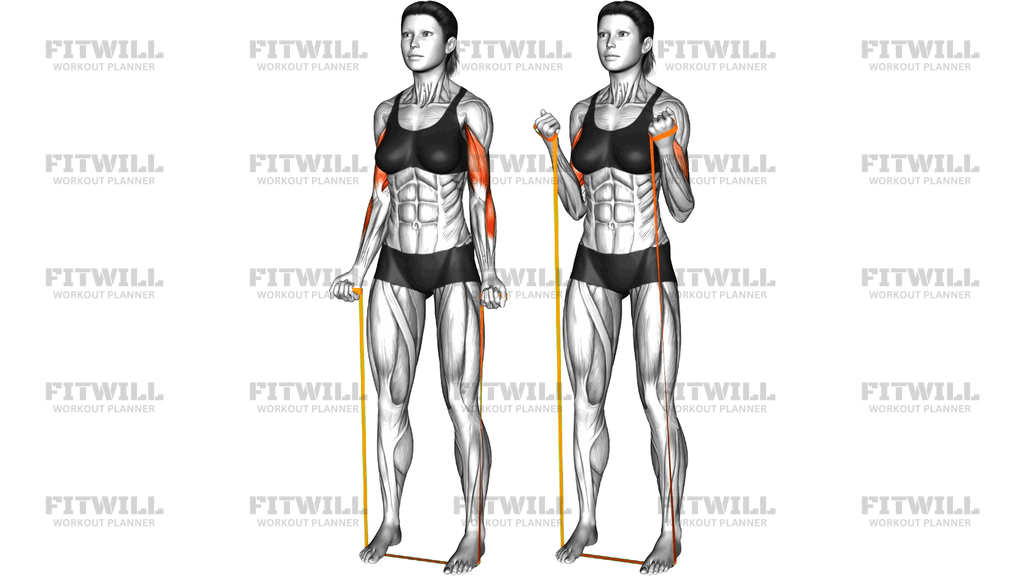
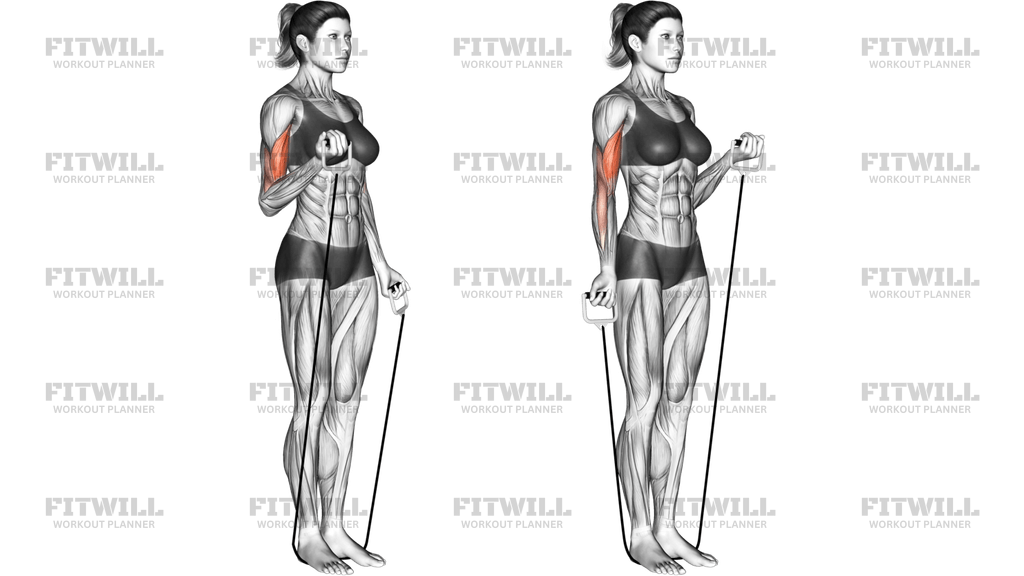
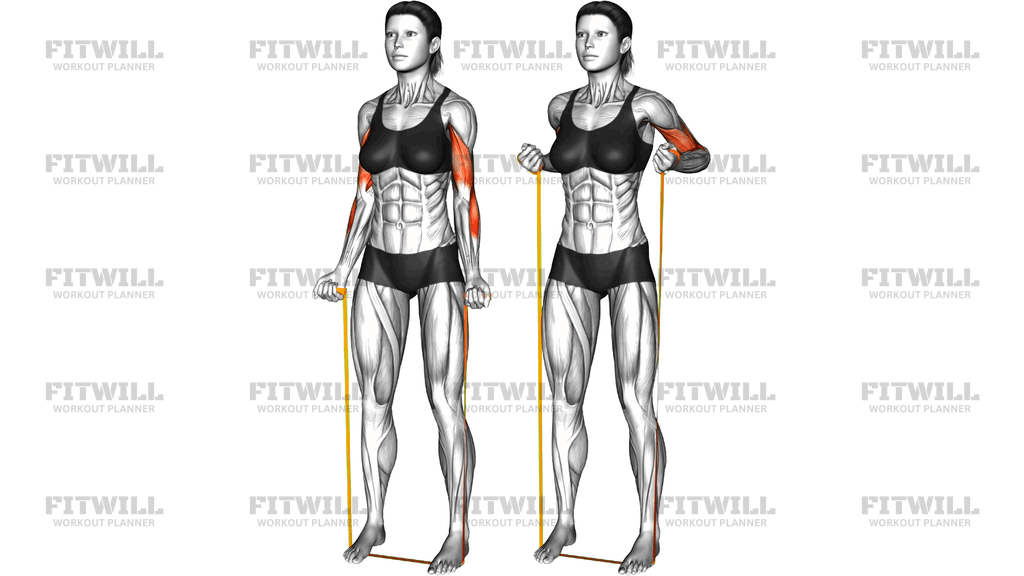
The Resistance Band Drag Curl is a standing biceps exercise where you anchor a resistance band under both feet and pull the handles upward by driving your elbows behind your torso, letting the band literally drag up along the front of your body. Unlike a standard curl where the elbows stay pinned at your sides and the hands swing forward, the drag curl deliberately moves the elbows backward, which strips away most of the front-shoulder assistance and forces the biceps to do the work on their own.
This movement is especially useful for people whose biceps get overshadowed by their front delts during regular curls. If you tend to swing the weight, lean back, or feel your shoulders doing the pulling, the drag curl is one of the cleanest ways to relearn what a true biceps contraction feels like. Because the band provides smooth, joint-friendly tension and the standing position requires only balance and posture rather than heavy loading, it suits beginners learning arm training as well as experienced lifters looking for a high-quality burnout or a travel-friendly arm session.
The primary muscles worked are the biceps brachii on the front of the upper arm, with strong contribution from the brachialis and brachioradialis. The forearms and grip work to hold the handles, and the core stabilizes your upright stance as the band pulls you forward at the bottom of each rep. The highlighted area in the demonstration reflects this focus: the tension sits squarely on the upper arm, not the shoulders or back.
Setup matters more here than in most curl variations. The band must be secured evenly under both feet with matched lengths on each side, and your stance should be solid enough that the band cannot slip. Stand tall with your chest up and shoulders back; if you slouch, the band will pull your torso forward and the elbow path will drift. The signature element is the elbow position — they travel slightly behind the midline of your body as you pull, so the handles ride up close to your sides like a sled on rails.
To execute well, pull your elbows straight back and up rather than curling your hands forward, and keep raising until the handles reach roughly hip or lower-abdominal height and your biceps are fully shortened. Pause for a beat at the top, then lower with control, letting the band drag back down the same path. The tempo on the way down is where much of the muscle-building value lives, so resist the urge to let the band snap your arms back to the start.
Common uses for the Resistance Band Drag Curl include finishing a pull or arm workout, improving mind-muscle connection with the biceps, training through shoulder discomfort that regular curls aggravate, and adding arm volume without free weights. Keep the reps slow and deliberate, avoid shrugging your shoulders toward your ears, and choose a band tension that lets you complete every rep with your elbows staying behind you rather than drifting forward.
[ Workout Log & Planner ]
Put your next workout in Fitwill
Keep your plan and training log ready when you are.


Instructions
- Anchor the middle of a resistance band under both feet, standing with your feet hip-width apart so the band is trapped securely beneath your heels and midfoot.
- Grip a handle in each hand with palms facing forward, arms fully extended at your sides, and adjust your grip so both sides of the band have equal slack.
- Stand tall with your chest lifted, shoulders pulled back and down, and your core braced to stop the band from pulling your torso forward.
- Start the pull by driving your elbows straight back behind the line of your torso instead of lifting your hands forward.
- Let the band drag up along the front of your body, keeping the handles close to your sides and your palms facing up throughout.
- Continue until your hands reach around hip to lower-abdomen height and your biceps are fully squeezed; your elbows should finish well behind your ribs.
- Hold the top position for one second and consciously tighten your biceps before lowering.
- Reverse the path slowly, guiding the band back down your torso until your arms are fully extended and tension remains on the biceps.
- Exhale as you pull up and inhale as you lower, keeping your breathing steady and your ribs from flaring.
- Complete your reps, then step one foot off the band carefully to release the tension before letting go of the handles.
Tips & Tricks
- If your elbows drift forward and the exercise turns into a regular curl, cue yourself to touch the handles to your thighs on the way up — the contact point keeps the drag path honest.
- The most common mistake is standing with the band too far forward on your feet; center it under your midfoot so it cannot roll off your heel mid-set.
- Shrugging your shoulders as you pull means the band tension is too high or you are rushing; drop to a lighter band and let the elbows do the traveling.
- Keep your wrists straight and in line with your forearms. Bending the wrists back to chase height does nothing for the biceps and strains the forearm flexors.
- Because the resistance peaks at the top with a band, pause there for a full second rather than bouncing — that is where the biceps are shortest and weakest, so the pause earns its keep.
- If one side rises before the other, your band is unevenly anchored under your feet. Reset your stance and check the lengths before continuing.
- Lean your upper back against a wall if you find yourself swaying; the wall blocks body English and isolates the elbow movement.
- Use a slower lowering phase of two to three seconds. The band's tension drops quickly on the way down, so controlled lowering keeps the biceps working longer.
- For a deeper contraction at the top, think about pulling your elbows toward the ceiling behind you rather than pulling the handles up.
Frequently Asked Questions
What muscles does the Resistance Band Drag Curl work?
The biceps brachii is the primary muscle, with the brachialis and brachioradialis assisting and the forearms and grip working to hold the handles. The core stabilizes your torso against the band's pull.
How is a drag curl different from a regular resistance band curl?
In a regular curl your elbows stay pinned at your sides and your hands arc forward, which lets the front shoulders contribute. In the drag curl your elbows travel backward behind your torso, so the band drags up your body and the biceps work almost alone.
Why do my elbows need to go behind my body during the Resistance Band Drag Curl?
Moving the elbows back places the shoulder in a position where it cannot assist the pull, which shifts the load almost entirely onto the biceps. If your elbows drift forward, the set quietly becomes a standard curl.
Is the Resistance Band Drag Curl good for beginners?
Yes. The band provides smooth tension, the standing setup is simple, and the movement teaches a strong mind-muscle connection with the biceps. Start with a light band and focus on the elbow path before adding tension.
How high should my hands travel at the top of the Resistance Band Drag Curl?
Only to around hip or lower-abdomen height. Because the elbows move backward, the hands do not rise as high as in a normal curl — chasing extra height usually means the shoulders or wrists take over.
Can I do the Resistance Band Drag Curl if standard curls bother my shoulders?
Often yes, since the backward elbow position keeps the shoulders out of the movement, but stop if you feel pain and check with a qualified professional. Never push through sharp or pinching discomfort.
What should I do if the band slips off my feet during the set?
Place the band under the middle of both feet rather than the heels or toes, and keep your weight evenly distributed. If it still slips, switch to a shorter or wider band that sits with more friction under your stance.
What can I substitute for the Resistance Band Drag Curl?
A cable drag curl with handles at a low pulley works the same elbow-behind-the-torso path, or you can perform the barbell drag curl version with lighter weight. Both keep the same emphasis on the biceps over the shoulders.
How many reps and sets should I do?
Because the movement is strict and the tension is continuous, moderate ranges work well — around 3 sets of 10 to 15 reps with a one-second pause at the top and a slow lowering phase.