Dumbbell Lying Front Raise
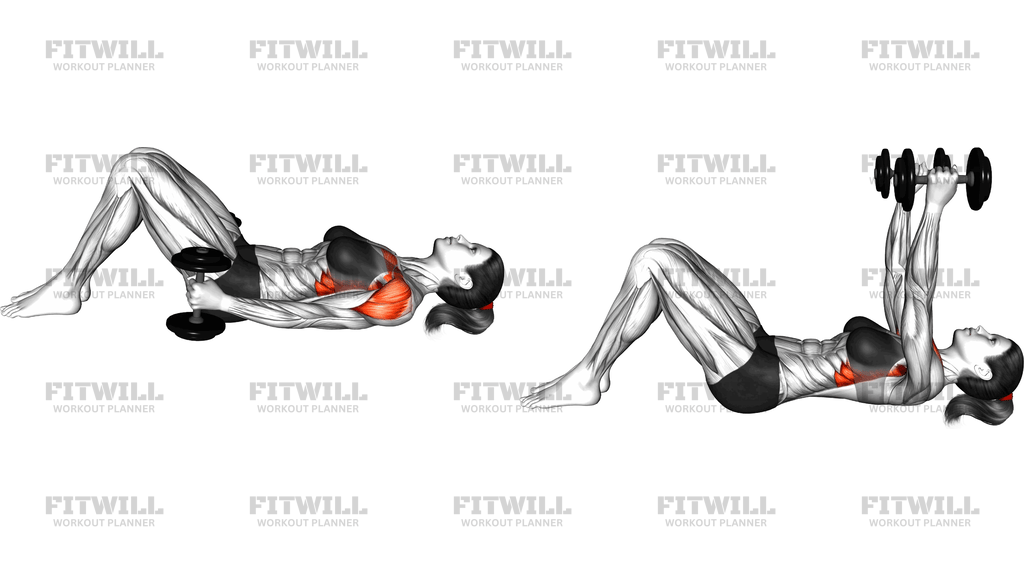
The Dumbbell Lying Front Raise is a shoulder isolation exercise performed face up on the floor with a dumbbell in each hand. Instead of standing and fighting gravity through a long lever arm, you lie on your back with knees bent and feet flat, holding the dumbbells against the front of your hips, then raise both straight arms up until the weights point toward the ceiling above your chest. Because the floor supports your entire torso, your lower back stays protected and all of your attention can go to the front of the shoulders doing the lifting.
The main muscle at work is the anterior deltoid, the front portion of the shoulder that lifts the arm forward. As the arms travel up from the thighs toward vertical, the clavicular head of the chest and the side delts assist, and the upper traps help stabilize the shoulder girdle. This forward-flexion pattern mirrors everyday movements like placing a box on a high shelf, so it carries over well outside the gym.
The floor-based setup is what separates this version from a standing front raise. With your back flat against the ground, you cannot arch or lean back to cheat the weight up, which is one of the most common faults in standing raises. The floor also gives you a clear reference for keeping your ribs down and your core quietly braced, making the movement easier to learn and control. That makes it a good fit for beginners who are still finding the mind-muscle connection in their shoulders, and for lifters who want strict delt work without lower-back strain.
To perform it well, keep the raise a strict arc: arms stay almost straight with only a soft elbow bend, and the dumbbells travel in line with the shoulders rather than drifting out to the sides. Lift only until the arms are roughly vertical over the chest. Because the resistance direction changes once your arms pass overhead height, raising beyond vertical adds little for the delts and can pull the shoulder into an awkward position.
Use light to moderate dumbbells and higher reps, typically 10 to 20 per set. This is a small muscle doing a small arc of work, so heavy loads tend to turn the movement into a press or a swing. The Dumbbell Lying Front Raise works well as a finishing movement after presses, as a warm-up activation drill before upper-body training, or as a low-back-friendly option for anyone who finds standing raises uncomfortable.
Fitwill
Log Workouts, Track Progress & Build Strength.
Achieve more with Fitwill: explore over 9600 exercises with images and videos, access built-in and custom workouts, perfect for both gym and home sessions, and see real results.
Start your journey. Download today!




Instructions
- Lie flat on your back on the floor with your knees bent and feet planted hip-width apart.
- Hold a dumbbell in each hand with a neutral grip, palms facing your thighs, and rest the dumbbells on the front of your hips so your arms are straight and relaxed.
- Draw your ribs down, gently brace your abdominal muscles, and press your lower back lightly toward the floor.
- On an exhale, raise both dumbbells straight up in front of you, keeping a slight bend in the elbows and letting the backs of your hands rotate toward the ceiling as you lift.
- Continue the arc until your arms are vertical and the dumbbells are directly above your upper chest or shoulder line.
- Pause briefly at the top and feel the contraction across the front of both shoulders.
- Inhale and lower the dumbbells slowly back along the same path until they touch or nearly touch your hips.
- Reset your brace without letting your lower back arch, then begin the next rep.
- Keep your head resting on the floor and your neck relaxed throughout the set.
Tips & Tricks
- The most common cheat is bouncing the dumbbells off the hips at the bottom to start each rep; instead, lower them under control and pause for a beat before the next lift.
- If the dumbbells drift out wide toward the sides, imagine drawing two parallel lines up toward the ceiling so each arm stays in line with its own shoulder.
- Bending the elbows more as the weight gets heavy turns this into a partial press; keep the arm angle fixed from bottom to top to keep the front delts doing the work.
- Lifting far past vertical toward the face mostly shifts tension off the delts, so stop the arc when the dumbbells are stacked over the chest.
- Keep the wrists straight and firm; letting them cock backward under load irritates the wrists and blunts the shoulder contraction.
- If your lower back feels any strain, bend the knees more and plant the feet closer to your body, which flattens the pelvis against the floor.
- Choose a weight you can lift smoothly for at least 10 reps; the delts respond better here to strict, moderate loads than to grinding heavies.
- Squeeze the dumbbells firmly the entire time—a relaxed grip often leads to a loose, wobbly arm path.
- Try one arm at a time if both-dumbbell reps let your stronger side dominate; the free hand on your working shoulder helps you feel the delt firing.
Frequently Asked Questions
Which muscles does the Dumbbell Lying Front Raise work?
The anterior deltoid at the front of each shoulder is the prime mover. The clavicular head of the chest and the side delts assist, while the upper traps help stabilize the shoulder blades.
Why do this lying on the floor instead of standing?
The floor blocks the backward lean and lower-back arch that people often use to cheat a standing front raise. It also removes stress from the lumbar spine, letting you focus purely on the shoulders.
Is the Dumbbell Lying Front Raise good for beginners?
Yes. The supported position and short range make it one of the easiest front-raise variations to learn, since there is less to coordinate and the floor gives immediate feedback if you arch or swing.
How high should I raise the dumbbells at the top?
Lift until your arms are roughly vertical, with the dumbbells stacked over your upper chest. Going further toward or past your face adds little for the delts and can put the shoulder in an awkward position.
How heavy should the dumbbells be?
Start lighter than you would for presses—most lifters do well with 10 to 20 controlled reps per set. If you have to bend your elbows or bounce off your hips, the weight is too heavy.
Can I substitute this with a standing front raise?
You can, but expect more lower-back involvement and a greater temptation to swing. If your back is sensitive or your form breaks down standing, the lying version is usually the better choice.
My elbows bend as I get tired—how do I fix that?
Lock in a small, fixed elbow bend before the first rep and think of your arms as a rigid lever pivoting only at the shoulder. Drop to a lighter dumbbell rather than letting the elbows creep in.
Where should this exercise fit into my workout?
It works best near the end of an upper-body or shoulder session, after heavier presses, or as a light activation drill at the start. One to three sets of 10 to 20 reps is typical.
Is it safe for my shoulders and lower back?
For most people, yes—the floor supports the spine and the arc stays within a comfortable range. Stop short of any pinching sensation at the front of the shoulder and avoid lifting beyond vertical if you have a history of shoulder irritation.