Resitance Band Standing Serratus Push
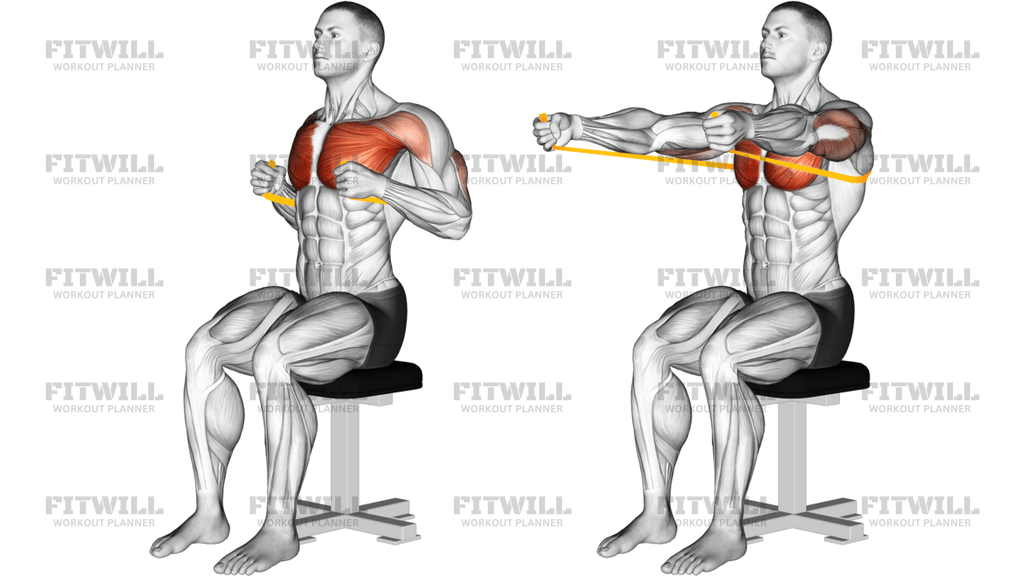
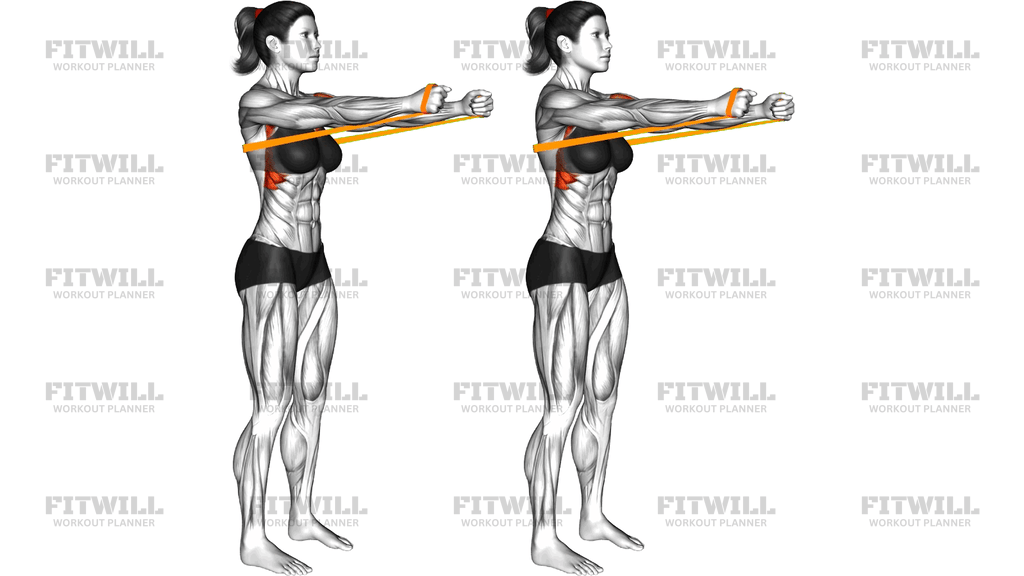
The Resistance Band Standing Serratus Push is a shoulder girdle exercise that targets the serratus anterior, the sawtooth-shaped muscle that wraps around the upper ribs and pulls the shoulder blade forward around the ribcage. You anchor a resistance band behind your upper back, hold the ends in both hands, and press your arms forward at chest height. Instead of stopping when the arms are straight, you keep reaching, letting the shoulder blades spread apart and push the upper back slightly wider. That final reaching motion is what makes this a serratus exercise rather than a standard press.
This movement is especially useful for people who struggle with shoulder blade control. Overhead lifters, boxers, swimmers, and anyone doing push-ups or presses all rely on the serratus anterior to keep the shoulder blade flat against the ribs and rotated upward as the arm moves. When this muscle is weak or underused, the shoulder blade tends to wing out or the upper traps take over and shrug, which often shows up as pinching or discomfort during pressing. Because the band provides a smooth, joint-friendly resistance, this is a common rehab and prehab choice as well as a warm-up drill before upper body training.
The setup matters more here than in most band exercises. The band should sit across your upper back at roughly shoulder blade height, with even tension in both sides. If the band sits too low near the waist, you turn the movement into a chest press; too high toward the neck and it becomes uncomfortable and pulls you off balance. Your arms stay extended and level with your shoulders throughout, so the resistance line matches the direction your fists travel.
Execution is simple but easy to rush. Stand tall with soft knees and a braced core, arms straight out in front of you, fists gripping the band. Push your hands forward an extra few inches by spreading your shoulder blades apart, letting your upper back round slightly. Hold the forward reach for a beat, then slowly let the band draw your hands back toward your chest until you feel the muscles between your shoulder blades engage. The range is small — often just a few inches of hand travel — so progress comes from control and tension, not big movement.
A helpful mental cue is to push the floor away from you with your fists, or to try and make your fists meet an imaginary object slightly beyond arm's length. Avoid shrugging your shoulders toward your ears as you press; the serratus does its work low on the ribcage, and shrugging shifts the effort to the upper traps. Keep the neck long and relaxed throughout.
Practically, this exercise fits well as two to three sets of ten to fifteen slow reps before pressing days, between sets of push-ups to reinforce scapular position, or as a standalone corrective drill. Choose a light band at first. Because the serratus is a smaller stabilizing muscle, heavy tension usually just recruits bigger muscles and defeats the purpose of the movement.
[ Workout Log & Planner ]
Put your next workout in Fitwill
Keep your plan and training log ready when you are.


Instructions
- Stand with your feet about hip-width apart and drape a resistance band across your upper back so it sits at shoulder blade height, with one end of the loop in each hand.
- Extend both arms straight out in front of your chest at shoulder height, palms facing down or slightly inward, and take up the slack in the band until you feel light tension pulling your hands back toward your chest.
- Stand tall, soften your knees slightly, and brace your abdominal muscles so your lower back does not arch as you press.
- Push your hands forward as far as you comfortably can, spreading your shoulder blades apart and letting your upper back round gently at the end of the reach.
- Pause for one to two seconds at the forward position with your arms fully extended and shoulder blades protracted.
- Slowly let the band pull your hands back toward your chest, allowing your shoulder blades to squeeze together as your fists approach your body.
- Breathe out as you press forward and breathe in as your hands return.
- Keep your shoulders down and away from your ears for the entire set; if they creep up, reduce the band tension.
- Complete your reps, then release one hand from the band first and let the other side come back slowly rather than letting go of both ends at once.
- Rest briefly between sets and reset the band position on your upper back before starting the next set.
Tips & Tricks
- A common mistake is turning this into a bench press pattern by bending the elbows as you push — keep the arms locked out so the motion comes purely from the shoulder blades.
- If your upper traps burn instead of the area around your ribs and armpit, you are shrugging. Lower the band one level of tension and consciously press your shoulders down before each rep.
- The useful range on this drill is short. If your hands travel a foot back and forth, the band is probably too heavy and your chest and arms are doing the work.
- Think of pushing your fists through a wall just past arm's length rather than pressing straight out — that cue naturally lengthens the reach and fires the serratus.
- Keep the band level across your back. If one side sags lower than the other, your hands will drift and one shoulder blade will do more work than the other.
- Do not let your lower back arch as you press forward; brace your core and tuck your ribs slightly so the rounding happens in your upper back, not your spine.
- Light and slow beats heavy and fast here. A band that lets you pause cleanly for two seconds at full reach will train the serratus better than one that snaps your hands back.
- If you feel a pinch at the front of the shoulder, check that your arms are truly at shoulder height and your wrists are not collapsing backward.
- When releasing the band, always let one hand go at a time while keeping tension on the other side — snapping band ends can strike you in the face or chest.
Frequently Asked Questions
What muscles does the Resistance Band Standing Serratus Push work?
The primary muscle is the serratus anterior, which pulls your shoulder blades forward around your ribcage. The front delts and chest assist the forward press, while the muscles between the shoulder blades work as you control the band on the way back.
Why does the band sit across my upper back instead of under my feet?
Positioning the band behind your upper back lets the resistance pull your hands straight backward while your arms stay at shoulder height, which matches the exact direction the serratus pushes. Anchoring it under your feet would turn the exercise into a front raise instead.
Is the Resistance Band Standing Serratus Push suitable for beginners?
Yes, it is one of the most beginner-friendly shoulder girdle drills because the range is small and the resistance is easily adjusted. Start with a light band and focus on feeling your shoulder blades spread apart rather than moving your hands a long distance.
How is this different from a regular band chest press?
A chest press ends when your arms reach full extension. The serratus push continues past that point, adding an extra reach where your shoulder blades spread and your upper back rounds slightly forward.
Why do I feel this in my traps instead of around my ribs?
That usually means you are shrugging your shoulders toward your ears as you press. Relax your neck, press your shoulders down, and use a lighter band so the smaller serratus muscle can do the job.
How many reps and sets should I do?
Two to three sets of ten to fifteen slow repetitions with a one to two second pause at full reach works well. It is often used as a warm-up before pressing or push-up workouts rather than as a heavy strength lift.
Can the Resistance Band Standing Serratus Push help with scapular winging?
It is a common drill for building serratus anterior strength, which is central to keeping the shoulder blade flat against the ribs. If you have noticeable winging or shoulder pain, work with a qualified professional to confirm the cause before self-treating.
What can I substitute if I do not have a resistance band?
You can do wall pushes or standard push-up plus reps, where you push all the way up and round your upper back at the top. The band version is convenient because the load can be tuned precisely and you stay standing.
Should my elbows stay straight the whole time?
Yes, keeping the arms extended keeps the resistance line consistent and forces the movement to come from the shoulder blades. Bending the elbows shifts work into the chest and arms and reduces the serratus focus.
How do I know I am using the correct band tension?
You should be able to reach fully forward, pause without shrugging, and return slowly without the band yanking your hands back. If any of those break down, step down to a lighter band.