Cat Cow Lookback
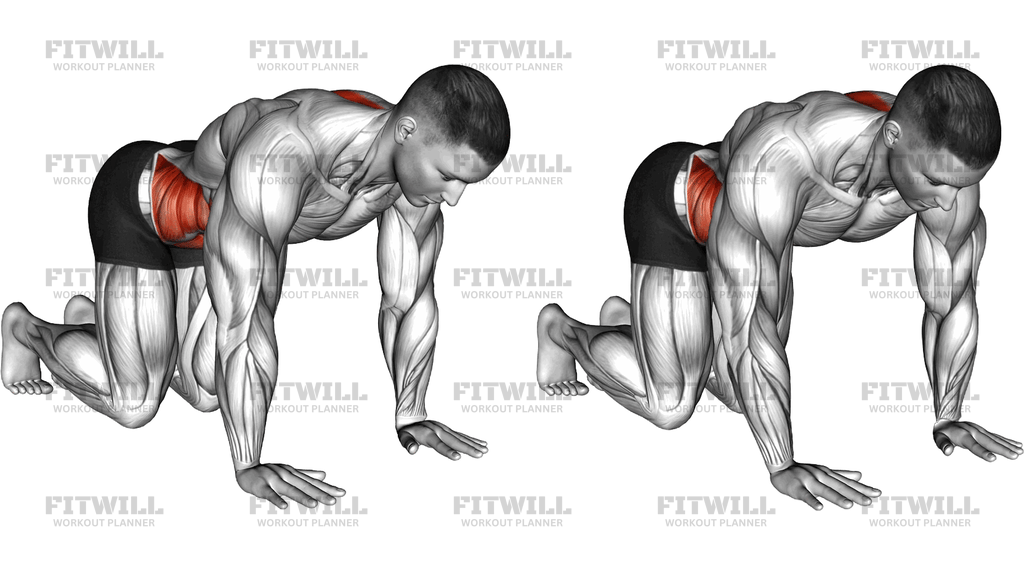
The Cat Cow Lookback is a quadruped mobility drill that combines the classic spinal flexion and extension of the cat-cow stretch with an active turn of the head and upper back to look over one shoulder. You stay on your hands and knees the entire time, so the movement asks very little of your strength and a great deal of your spinal control. The added lookback introduces gentle rotation through the thoracic spine and cervical spine, which the standard cat-cow never touches.
This variation is useful for anyone who sits for long hours, feels stiff first thing in the morning, or warms up before training that involves rotation, such as throwing, golf, or striking sports. Because you are supported on all fours, the spine is unloaded, which makes it a comfortable way to restore segmental movement in the lower back and mid back without compression. The obliques and the deep muscles along the spine work isometrically to guide and control each phase rather than to produce force.
Setup matters more than most people expect. Hands should sit directly under the shoulders, knees directly under the hips, with the spine in a neutral starting position and the gaze down. If your hands drift forward or your hips sit behind your heels, the ribs tilt and the flexion-extension arc becomes a hip rock instead of a spinal movement. Keeping the weight evenly spread across both palms and both shins gives you a stable base so the rotation travels through the spine rather than collapsing into one shoulder.
To execute it well, move one vertebra at a time. As you round upward into the cat position, let the head drop and then continue the curve by turning to look back toward one hip, as if trying to see behind yourself. Flow into the cow position by dropping the belly, lifting the chest, and returning the head to neutral before repeating on the other side. The motion should feel like a wave traveling along the spine, smooth and continuous rather than jerky or forced.
A common use case is as a first movement in a warm-up, done for five to eight cycles per side, or as a desk-break reset during the workday. Move within a pain-free range, keep the tempo slow enough that you can coordinate breath with motion, and never crank the neck to force a bigger lookback. If turning the head feels pinching or dizzy, reduce the rotation and simply let the eyes lead the turn.
[ Workout Log & Planner ]
Put your next workout in Fitwill
Keep your plan and training log ready when you are.


Instructions
- Kneel on an exercise mat and place your hands on the floor directly under your shoulders with fingers spread and knees directly under your hips.
- Set your shins parallel on the floor and let the tops of your feet rest flat, then find a neutral spine with your gaze down between your hands.
- Spread your weight evenly across both palms and both knees and lightly brace your core so your torso does not sag before you start moving.
- Exhale and round your spine upward toward the ceiling, tucking your tailbone and letting your head drop so the back of the neck lengthens.
- Continue the round by slowly turning your head to look back over one shoulder toward that hip, letting the upper back rotate a few extra degrees.
- Pause briefly at the end of the lookback, then rotate your head back to center as you begin to reverse the curve.
- Inhale and drop your belly toward the floor, lifting your chest and tailbone into the cow position while your head returns to neutral, eyes forward and slightly up.
- Flow directly back into the rounded cat position on your next exhale and look back over the opposite shoulder.
- Keep breathing steadily throughout, matching the round-and-lookback to your exhale and the belly-drop to your inhale.
- Continue alternating sides for 5 to 10 full cycles per side, then rest on your heels briefly before your next set.
Tips & Tricks
- A frequent mistake is yanking the neck to look further back; the head should arrive last, after the ribs have already rotated, so the turn stays smooth.
- If your hips sway sideways every time you look back, press the working knee a little firmer into the mat to anchor the pelvis and let the rotation come from the ribs.
- Keep your elbows soft but not bent; locking the arms straight and rigid stops the shoulder blades from gliding during the cat phase.
- Avoid letting the weight roll back toward the heels as you round, which turns the drill into a hip hinge and takes the load off the spine.
- If the floor irritates your knees, fold the mat double under them rather than shifting your knees back to escape the discomfort.
- Move slower than feels necessary; most people rush cat-cow and end up swinging through the range instead of articulating the spine.
- Do not hold your breath at the end of the lookback, even though the position invites it; keep the exhale going until you start reversing.
- If one side feels noticeably tighter, spend an extra cycle or two looking back over that shoulder instead of forcing a symmetric count.
Frequently Asked Questions
What muscles does the Cat Cow Lookback work?
It primarily mobilizes the spine while the obliques and the deep muscles along the back, such as the erector spinae, control the rounded and extended positions. The added lookback brings the neck rotators and upper back into the movement.
Is the Cat Cow Lookback suitable for beginners?
Yes, the hands-and-knees position is very low demand and easy to modify. Beginners should start with a smaller lookback and a shorter range of spinal rounding before gradually increasing both.
Why does the Cat Cow Lookback include looking over the shoulder instead of staying neutral?
The standard cat-cow only moves the spine forward and backward. Turning to look back adds gentle rotation through the neck and upper back, which helps loosen stiffness from prolonged sitting or one-sided activities.
Should my hands be directly under my shoulders during the Cat Cow Lookback?
Yes. Stacking hands under shoulders and knees under hips keeps the spine neutral at the start and ensures the rounding and extension travel through the back rather than through a shifting torso.
How many reps of the Cat Cow Lookback should I do?
Five to ten slow cycles per side works well as a warm-up or desk-break reset. Quality of motion matters far more than rep count here.
My neck feels pinched when I look back. What should I change?
Reduce the rotation and let your eyes lead the turn instead of forcing the chin toward the shoulder. If discomfort persists, keep the head neutral and simply perform the cat-cow portion until your neck tolerates more.
Can I do the Cat Cow Lookback without an exercise mat?
Yes, on carpet or any padded surface. A mat simply cushions the knees and gives the hands a non-slip surface, which helps when you press into the floor during each phase.
When is the best time to use the Cat Cow Lookback in a workout?
It fits well at the very start of a warm-up, before any loading, because it restores spinal motion and primes rotation. It also works as a standalone mobility break during long periods of sitting.
Is it safe to do the Cat Cow Lookback with lower back discomfort?
The unloaded all-fours position is generally gentle on the lower back, but move within a comfortable range and avoid forcing either end of the curve. If any position reproduces sharp or radiating symptoms, stop and consult a qualified professional.