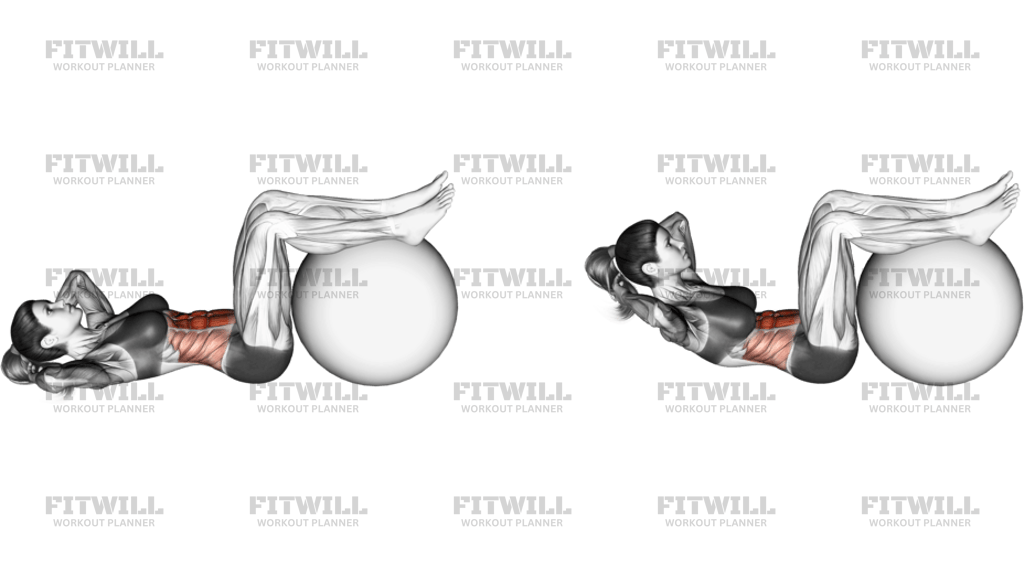
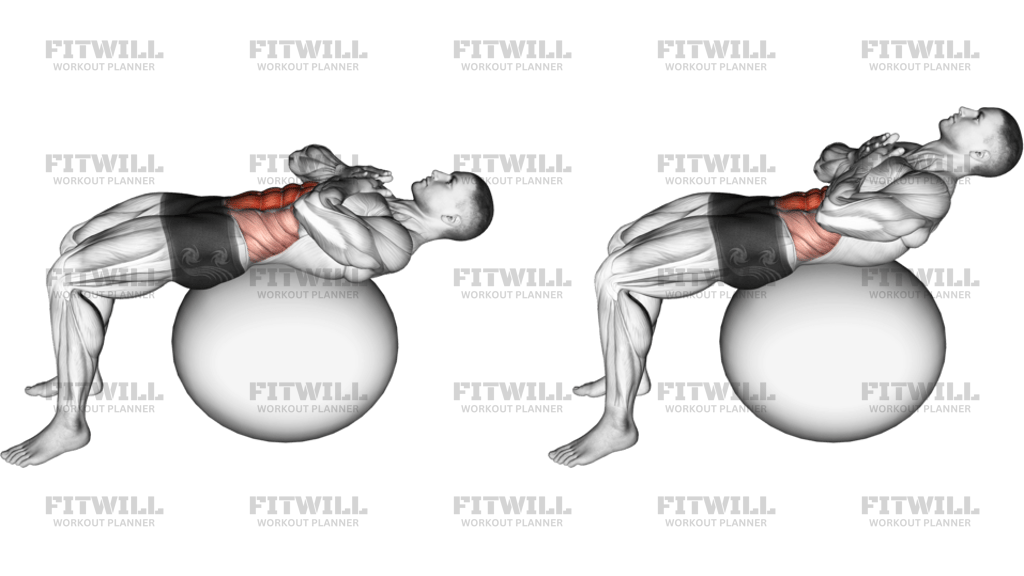
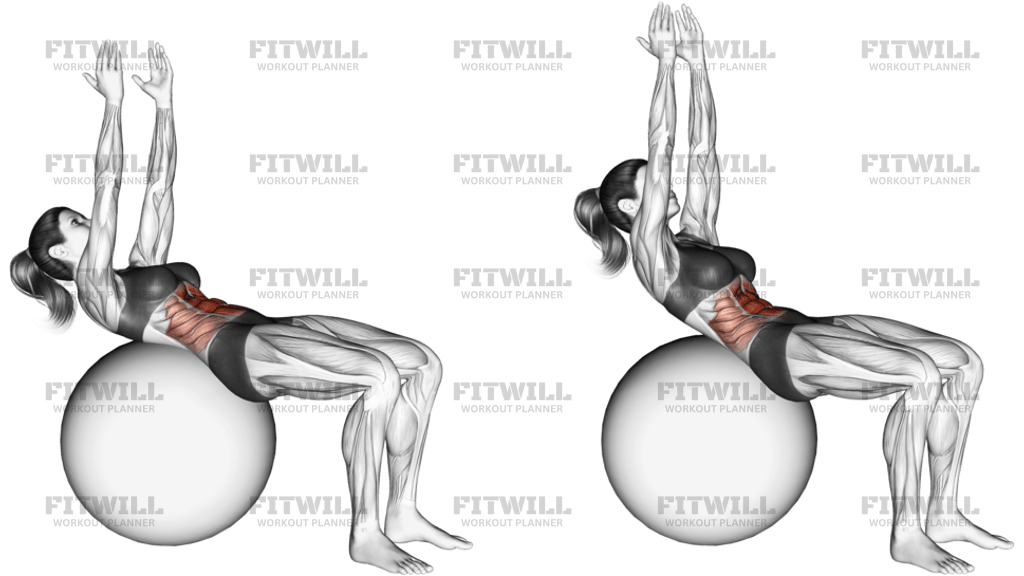
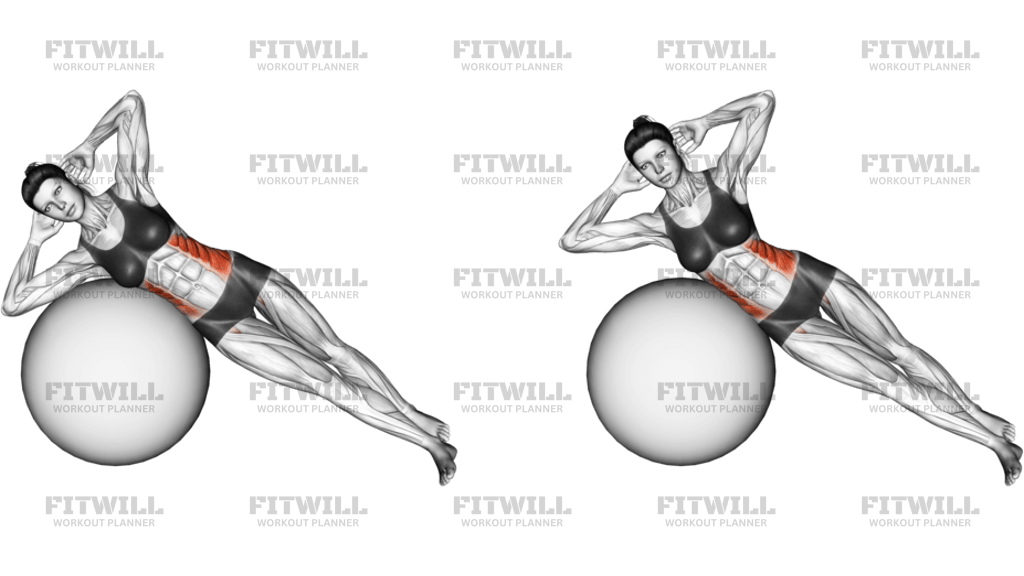
Roll And Side Twist On Stabilitity Ball
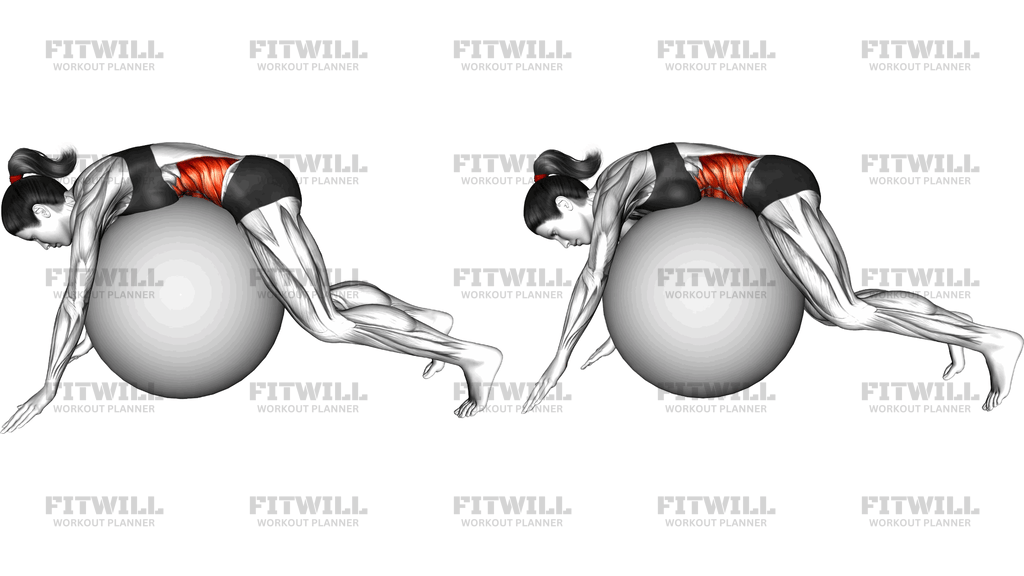
Roll And Side Twist On Stability Ball is an advanced core drill that combines a forward roll over the ball with a controlled rotation of the hips. You begin kneeling with the ball hugged against your chest, roll forward until your thighs or shins rest on top of the ball and your hands take your weight on the floor, then sweep your hips from side to side so your legs rotate around the ball. The combination of an unstable base, a long lever (your legs), and rotation makes this one of the more demanding ways to train the obliques and deep trunk muscles.
The main work comes from the obliques on the side you are lowering toward and the opposite side that controls the return. Because your hands are planted and your shoulders carry load, the deltoids, chest, and scapular stabilizers work isometrically the whole time. The deep core, including the transverse abdominis, has to stay braced to stop your lower back from sagging while the legs move off the midline.
Setup matters more here than in most ab exercises. The spot where your legs contact the ball, roughly at the thighs or shins, acts as a pivot point. Too close to the knees and the twist becomes easier; too close to the hips and the leverage gets very aggressive. The ball should be inflated firmly enough that it holds its shape under your bodyweight but soft enough that it grips the floor without rolling away from you.
To execute it well, keep your elbows relatively straight, shoulders stacked over your wrists, and your neck relaxed so your head hangs between your arms rather than craning up. Initiate the twist from the hips, not by pushing through one hand. The legs should travel together as one unit, brushing through the center between each side rather than swinging with momentum.
This drill suits people who already have a solid plank and some ball experience, since the pike-like position puts real load through the shoulders. It fits well into core circuits, athletic rotation work, and Pilates-style stability training. Common use cases include improving rotational control for racket and throwing sports and building tolerance for anti-extension under load.
For safety, practice the roll-into-position part on its own before adding the twist, and keep the ball away from sharp edges or slippery floors. If your lower back arches or your wrists ache, shorten the range, move the ball closer to your knees, or regress to a simple ball knee tuck until the hold feels solid.
[ Workout Log & Planner ]
Put your next workout in Fitwill
Keep your plan and training log ready when you are.


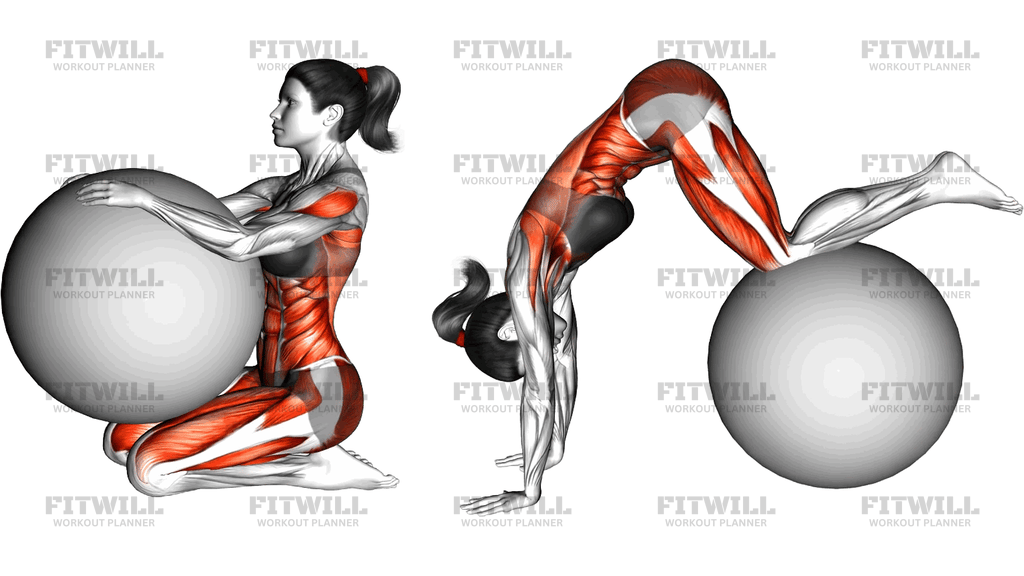
Instructions
- Kneel on the floor facing the stability ball and hug it against your chest with both arms, wrists relaxed over the top of the ball.
- Roll the ball forward slowly as your chest lowers toward it, letting your body travel over the ball until your thighs or shins are resting on its top and your palms are flat on the floor under your shoulders.
- Walk your hands out slightly if needed so your shoulders sit directly over your wrists and your body forms a straight, angled line from head to hips.
- Brace your abdominal wall as if bracing for a light push, squeeze your glutes slightly, and let your head hang neutral between your arms.
- Keeping your legs straight and together, rotate your hips to one side so your legs roll across the top of the ball toward the floor on that side.
- Pause briefly at the end of the twist, feeling the obliques on the working side hold the position without letting your lower back sag.
- Roll the legs back through center, stopping for a moment in the middle before rotating to the opposite side.
- Exhale as you twist to each side and inhale as you return through the middle, keeping the breathing steady rather than holding it.
- After your final repetition, walk your hands back or roll the ball toward you until your knees reach the floor, then sit back on your heels to reset before the next set.
Tips & Tricks
- The most common mistake is turning this into a leg swing: if your legs are falling side to side with momentum, slow the tempo down and pause for one full second in the center between twists.
- If your lower back arches as soon as your legs leave the midline, the ball is probably too far toward your hips. Slide it back toward your knees to shorten the lever until you can hold a straight line.
- Press the floor away with your fingertips and spread your fingers wide to protect the wrists, since the shoulders carry your weight for the entire set.
- Keep your hips at roughly the same height throughout the twist. Dropping one hip toward the floor turns the drill into a lazy roll instead of a controlled rotation.
- Bare feet or thin-soled shoes give you better feedback on the ball; bulky trainers can make the legs slip during the twist.
- Practice getting into and out of the pike position over the ball several times before adding any rotation, especially if you are new to ball work.
- Use a wall or spotter nearby for your first few sessions, because the ball can roll out from under you if the twist gets too aggressive.
- A firm ball gives you more control in the twist, while an underinflated ball sinks and makes balancing harder, so check the inflation before you start.
- If one side feels noticeably weaker or wobblier, add an extra repetition or two on that side rather than skipping it.
Frequently Asked Questions
Which muscles does Roll And Side Twist On Stability Ball work the most?
The obliques do the main work during the twist, with the abs and deep core bracing to keep your trunk from sagging. Your shoulders, chest, and scapular stabilizers hold you up isometrically the entire time.
Where should my legs rest on the stability ball during the twist?
Your thighs or shins should rest on top of the ball as the pivot point. Legs closer to the knees make the movement easier, while legs closer to the hips dramatically increase the difficulty of both the twist and the hold.
Is Roll And Side Twist On Stability Ball suitable for beginners?
It is better treated as an intermediate or advanced drill because the hands take your full weight in a pike-like position. Beginners should build up with ball knee tucks and standard planks first, then practice only the roll-into-position phase before adding the side twist.
How do I get onto the ball safely at the start of the movement?
Kneel facing the ball, hug it against your chest, and roll it forward slowly so your body travels over it until your hands reach the floor. Practicing this entry and exit on its own is worth doing before you attempt any twists.
Why do my shoulders fatigue before my obliques in this exercise?
Your shoulders bear your bodyweight in a loaded plank position for the whole set, so they often give out first. Strengthening your plank and pike holds separately will let you focus on the rotation instead of just surviving the support position.
What is the most common mistake with this movement?
Swinging the legs side to side with momentum instead of rotating the hips under control. Slow the tempo, pause in the center between sides, and think about the legs rolling across the ball rather than dropping.
What can I substitute if the Roll And Side Twist On Stability Ball is too hard?
Ball knee tucks, ball pike holds, or standing cable woodchops train similar qualities with less demand on the shoulders. Once those feel solid, move the ball closer to your knees for an easier version of the twist.
How many repetitions and sets should I do?
Two to three sets of six to ten twists per side works well, focusing on clean, controlled rotations. Stop the set as soon as your hips start to sag, since form breaks quickly under fatigue in this position.
Can I hurt my lower back doing this exercise?
The risk comes from letting the lower back arch or sag while the legs rotate away from the midline. Keep the glutes engaged, brace the trunk, and shorten the range or reposition the ball if you feel any strain in your lower back.
What kind of floor and ball setup works best?
Use a firm, properly inflated ball on a non-slippery floor such as rubber gym flooring or a yoga mat. The ball needs enough grip to stay planted while your hips rotate over it.