Lying Crossover Stretch
The Lying Crossover Stretch is a supine rotational stretch performed on a mat or other comfortable floor surface. You lie flat on your back with your arms spread out to the sides in a T position, then lift one straight leg and carry it across the midline of your body toward the opposite side. The torso stays anchored to the floor while the leg travels, which creates a rotational pull through the side of the waist, the hip, and the lower back on the working side.
This stretch primarily targets the obliques, the muscles running along the sides of your abdomen that are responsible for trunk rotation and lateral flexion. Because the straight leg crosses the body, it also lengthens the glutes and the deep rotators of the hip, and it places a gentle stretch on the lower back musculature and the tissues along the outer hip. People who sit for long hours, rotate poorly, or feel stiff through the waist and hips after training tend to notice the restriction this stretch addresses almost immediately.
Setup matters more than most people expect. Your shoulders should stay in contact with the floor and your arms act as the stabilizing frame for the whole stretch. If the shoulder on the working side lifts off the ground, you have simply carried the rotation too far and the tension shifts away from the waist and hip into the shoulder and neck. Keeping the leg long and the movement slow is what turns this from a casual leg swing into a genuine, targeted stretch.
To execute it well, move the leg across the body with control and stop where you feel a clear, tolerable stretch along the side of your trunk and into the hip. Breathe steadily and let each exhale soften the tension slightly rather than forcing the leg closer to the floor. The range of motion will differ from person to person depending on hip structure and rotational mobility, so the goal is your own stretch sensation, not touching the foot down at any cost.
The Lying Crossover Stretch fits naturally into cooldowns after core work, running, cycling, or any lower body session, and it is a common fixture in general mobility routines. It is low load, requires nothing but floor space, and is suitable for most trainees. The main practical cautions are simple: keep the movement pain free, avoid twisting aggressively if you have an irritated lower back, and always control the leg back to the middle instead of letting it swing or drop.
Fitwill
Log Workouts, Track Progress & Build Strength.
Achieve more with Fitwill: explore over 9600 exercises with images and videos, access built-in and custom workouts, perfect for both gym and home sessions, and see real results.
Start your journey. Download today!




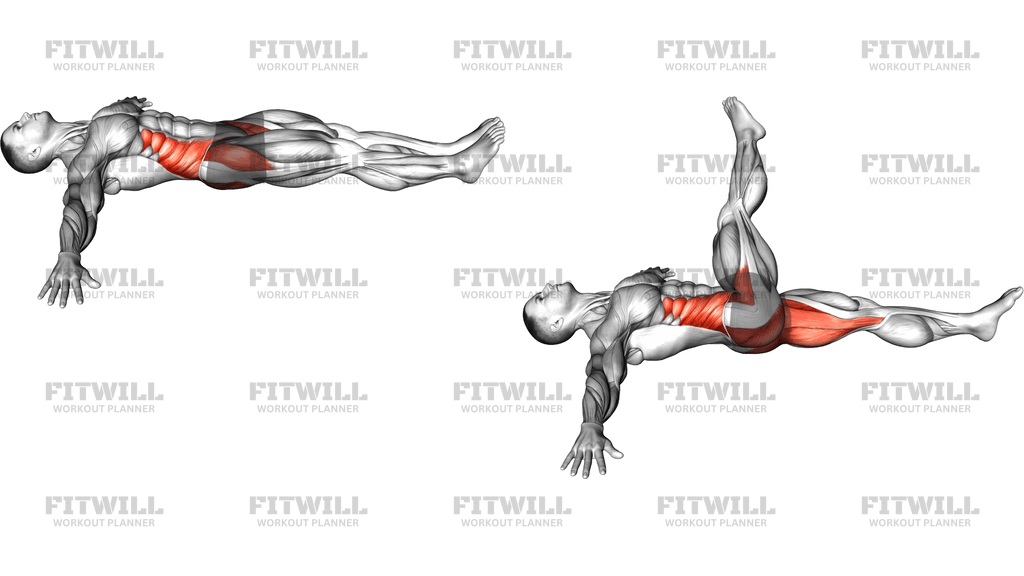
Instructions
- Lie flat on your back on an exercise mat with both legs extended straight and your head resting comfortably on the floor.
- Spread both arms out to your sides at shoulder height, palms facing down, forming a T shape with your torso.
- Press your shoulders lightly into the floor and brace your core gently to anchor your upper body before moving.
- Keep both legs straight and lift one leg up toward the ceiling until the hip is roughly flexed to ninety degrees.
- From that vertical position, slowly carry the raised leg across the midline of your body toward the opposite side, rotating through the hip and waist.
- Continue until you feel a firm but comfortable stretch along the side of your waist, the outer hip, and the lower back of the lifting leg.
- Hold the end position for twenty to forty seconds, keeping the opposite shoulder and both arms in contact with the floor.
- Breathe slowly and deeply, letting each exhale relax the waist and hip a little more without pushing harder into the twist.
- Reverse the path slowly, bringing the leg back up over your body to the vertical position, then lower it to the floor beside the other leg.
- Reset your posture, then repeat the same sequence on the opposite leg.
Tips & Tricks
- The most common mistake is letting the shoulder on the stretching side peel off the floor as the leg crosses over. If this happens, reduce the crossing range until the shoulder stays down; the stretch should be felt in the waist, not the shoulder.
- Keep the moving leg straight and long. Bending the knee shortens the lever and steals stretch from the obliques and outer hip.
- Do not yank the leg toward the floor with your hand or arm. Let gravity and your own control take you to the end range; pulling adds strain without extra benefit.
- If you feel the stretch mostly in your lower back rather than the side of your waist, reduce the rotation slightly and think about lengthening the leg away from your head as it crosses.
- Start with a smaller angle of leg raise if the full vertical position pulls uncomfortably at the hamstrings. A slightly lower start still loads the same rotational tissues.
- Exhale into the hold. Holding your breath tends to tense the very muscles you are trying to lengthen.
- Both hips should stay reasonably level. Rocking the whole pelvis sideways turns the stretch into a general twist and blurs where the tension lands.
- Keep your head relaxed and facing the ceiling. Craning the neck to watch the moving foot adds unnecessary tension through the upper spine.
- Ease out of the stretch rather than snapping the leg back. A controlled return keeps the lower back happy and makes the second side feel better.
- If you have a history of lower back sensitivity, start with a shorter hold and a smaller crossing angle, and progress only as the movement stays comfortable.
Frequently Asked Questions
What muscles does the Lying Crossover Stretch target?
It primarily targets the obliques along the sides of your waist, with strong involvement of the glutes and deep hip rotators of the moving leg. The lower back muscles and hip flexors also receive a gentle lengthening effect.
Should my leg stay straight during the Lying Crossover Stretch?
Yes, keeping the leg straight maintains a longer lever and places more stretch on the obliques and outer hip. Bending the knee is a valid regression if the straight-leg position feels too intense, but expect a lighter stretch.
Why do my shoulders lift off the floor when I cross my leg over?
That usually means you have taken the rotation past your available hip and trunk mobility, so your body compensates through the shoulder. Reduce the crossing angle until the shoulder stays down and rebuild range gradually over time.
How long should I hold the Lying Crossover Stretch?
Twenty to forty seconds per side works well for a cooldown or mobility routine. If you are very tight through the waist, two or three shorter holds per side are often more comfortable than one long hold.
Is the Lying Crossover Stretch good for beginners?
Yes, it requires no equipment beyond a mat and no strength, so beginners can perform it easily. The only learning point is moving slowly and respecting the range where the shoulder stays grounded and the stretch feels like tension, not pain.
Can I do the Lying Crossover Stretch if my lower back hurts?
Rotational stretches can aggravate some lower back conditions, so move into it gradually with a smaller range and stop short of any discomfort. If the twist provokes symptoms, skip it and consult a qualified professional for alternatives.
When is the best time to use the Lying Crossover Stretch?
It fits best as a cooldown after core training, running, or lower body sessions, or as part of a standalone mobility routine. Long static holds are generally less useful as a warm-up immediately before heavy lifting.
What can I use if I do not have an exercise mat?
Any firm, comfortable surface works, such as a carpeted floor, a folded towel, or a stretch of grass. You only need enough padding to lie on your back and arms comfortably for the duration of the hold.
How do I know if I am feeling the stretch in the right place?
You should sense a clear pull along the side of your waist and into the hip and glute of the leg you are crossing over. If the sensation lands in your lower back or shoulder joint instead, ease back and adjust the angle of the leg.
How far should my leg cross during the Lying Crossover Stretch?
Far enough that you feel a definite stretch through the waist and hip, which may or may not be all the way to the floor. Hip structure varies between people, so chase the stretch sensation rather than the floor.