Standing Archer Alternate Arm Row
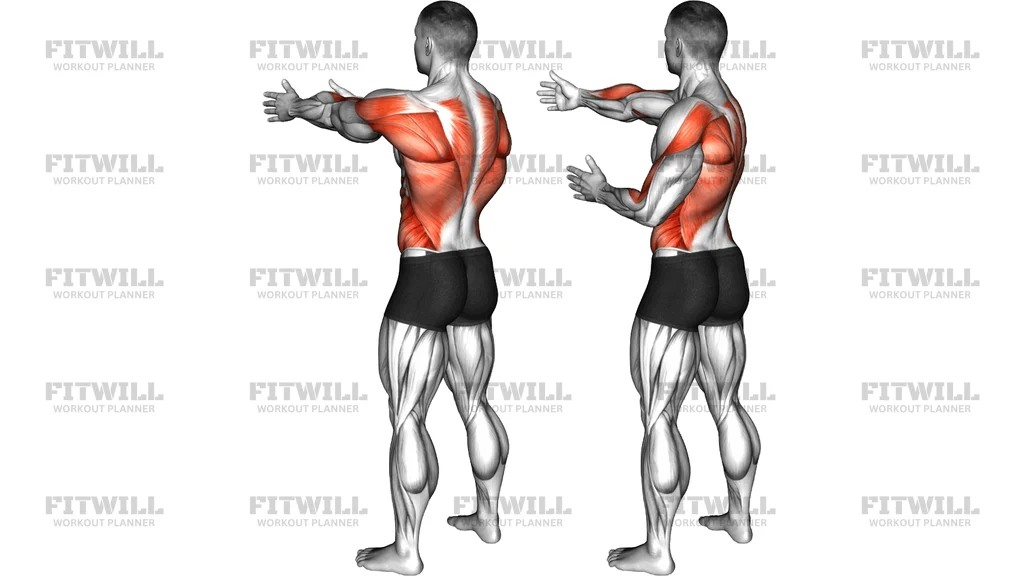
The Standing Archer Alternate Arm Row is a bodyweight movement that mimics the draw of an archer's bow: one arm stays extended straight out in front of your chest while the other pulls its elbow back in a rowing motion, then the two arms switch roles. It is performed standing with a staggered or split stance, and because there is no external load, the entire challenge comes from controlling your scapular movement and keeping your torso square while the arms work asymmetrically.
This exercise earns its place in warm-ups, posture-focused sessions, and upper back activation work. If you spend long hours at a desk, the drawing motion directly targets the muscles that hold your shoulder blades back and down - the rhomboids, mid traps, and rear delts - which are often weak and lengthened in people whose shoulders drift forward. It is also a useful teaching tool before loaded rows, because it lets you feel what a proper scapular retraction is supposed to feel like without a dumbbell or cable masking the movement.
The setup matters more than it might seem. Stand with your feet in a comfortable split stance, brace your core, and keep your chest facing forward the whole time. The extended arm acts as a reference point: if your torso starts twisting toward the rowing side, the extended hand will drift across your midline, and that drift is your signal that you are borrowing momentum from the trunk instead of working the shoulder blades. Because the arms alternate, you also train each side independently, which makes it easier to notice and correct a weaker or lazier side.
Execution is deliberate rather than fast. From both arms extended at shoulder height, draw one elbow straight back until your hand is beside your lower ribs, squeezing the shoulder blade toward the spine at the end point. Extend that arm forward again, then immediately repeat with the other side. Keep the pulling hand traveling in a straight horizontal line, keep the shoulders down away from the ears, and breathe steadily - exhale as you pull, inhale as you extend.
You can perform the Standing Archer Alternate Arm Row anywhere with no equipment, which makes it a practical choice for travel workouts, desk breaks, and the first block of an upper body day. A reasonable starting dose is two to three sets of eight to twelve draws per side, moving slowly enough that you can feel the shoulder blade glide. There is no heavy load to worry about, but pace still matters: rushing turns a precise upper back exercise into an arm-swinging exercise, so treat control as the main indicator of quality.
[ Workout Log & Planner ]
Put your next workout in Fitwill
Keep your plan and training log ready when you are.


Instructions
- Stand tall with your feet in a staggered stance, one foot slightly ahead of the other, and soften your knees a little so you are not locked out.
- Raise both arms straight out in front of your chest at shoulder height, hands open, elbows fully extended, like an archer sighting down an arrow.
- Brace your abdominal muscles and keep your chest and shoulders squared to the front so your torso does not rotate during the set.
- Pull your right elbow straight back until your right hand ends up beside your lower ribs, keeping the elbow at shoulder height as it travels.
- Squeeze your right shoulder blade toward your spine at the back of the row, then extend the right arm forward until it returns to the starting line.
- Repeat the same drawing motion with your left arm, pulling the elbow back to the ribs while the right arm stays extended forward.
- Continue alternating arms for the desired number of repetitions, with each hand tracing a straight horizontal line at shoulder height.
- Exhale as you draw the elbow back and inhale as you extend the arm forward again.
- Between sets, lower your arms, shake them out, and reset your stance and brace before the next set.
Tips & Tricks
- If your extended hand keeps drifting across your chest, you are twisting your torso - narrow the range of the row until you can keep the extended arm steady, then build the range back up.
- Keep the rowing elbow level with the shoulder rather than letting it drop toward your hip; a low elbow shifts the work away from the upper back and into the lats.
- Do not shrug the rowing shoulder up toward your ear as you pull - think of pressing the shoulder blade down and back instead of lifting it.
- Slow the return phase down; most people snap the arm forward quickly and skip the eccentric control that makes the mid-back work.
- If your shoulders fatigue before your upper back does, reduce the total reps per set rather than shortening the elbow travel.
- A split stance gives you more stability than a narrow parallel stance, so if you feel wobbly, widen the front-to-back distance between your feet.
- Imagine drawing a bowstring to the bottom of your ribs - this cue keeps the hand path straight and the elbow high.
- Avoid holding your breath during the alternation; the steady exhale on each draw helps keep your core braced without tensing your neck.
- If you feel pinching at the front of the rowing shoulder, reduce how far the elbow travels back and keep the motion in front of your ribcage.
Frequently Asked Questions
What muscles does the Standing Archer Alternate Arm Row work?
The primary work comes from the rhomboids and mid traps of the upper back, which pull the shoulder blade back on each draw. The rear delts and biceps assist, and your core works to keep the torso from rotating as the arms alternate.
Is the Standing Archer Alternate Arm Row a good exercise for beginners?
Yes, it is very beginner friendly because there is no external load and the range is easy to adjust. Beginners should move slowly and focus on feeling the shoulder blade glide rather than counting speed.
Why does one arm stay extended in the Standing Archer Alternate Arm Row?
The extended arm acts as a built-in form check: if your torso rotates during the row, the extended hand drifts off its line. It also keeps both sides of the upper body active and mimics the asymmetry of an archer drawing a bow.
How many reps should I do per set?
Start with eight to twelve draws per side for two to three sets. Since the load is low, quality of the shoulder blade squeeze matters more than hitting a high rep count.
Can I use the Standing Archer Alternate Arm Row as a warm-up before lifting?
It works well as the first movement of an upper body day, especially before rows, pull-ups, or presses. A lighter set of ten per side is enough to wake up the mid-back and grove the scapular retraction pattern.
My shoulders rise toward my ears when I row - how do I fix that?
That is upper trap takeover, a very common fault in this exercise. Cue yourself to draw the shoulder blade down and back toward your opposite back pocket, and slightly shorten the rowing range until the shrug disappears.
What can I substitute if the standing position is uncomfortable?
The same archer draw pattern can be done seated on a bench or with your back braced against a wall to reduce balance demands. Keep the same arm path and the same rule about not letting the torso rotate.
Should my feet be in a specific stance for this exercise?
A staggered stance with one foot slightly forward is the standard setup because it gives you a stable base without locking the knees. A wider front-to-back split helps if you feel unsteady while the arms alternate.
Is it safe for people with shoulder discomfort?
Because it is load-free and self-paced, many people with cranky shoulders tolerate it well, but stop if you feel sharp pain or pinching. Reduce the backward travel of the elbow first, and consult a professional if the discomfort persists.