Lying Crossed Legs Twist
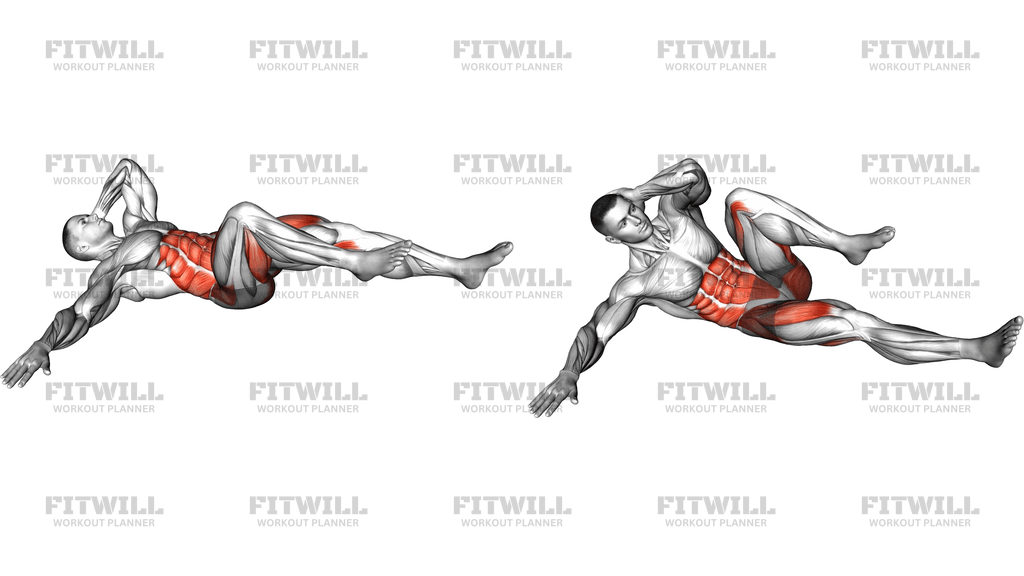
The Lying Crossed Legs Twist is a body-weight core exercise performed on your back on the floor or a mat. You lie flat with your arms spread out to the sides, bend your knees, cross one leg over the other at the ankles, and then rotate your hips so your crossed knees travel down toward the floor on one side, return to center, and repeat on the other side. The crossed-ankle position locks the legs together as a single unit, which forces the rotation to come from your spine and pelvis rather than from one leg drifting independently.
The main workload lands on the obliques, the muscles running along the sides of your waist that are responsible for trunk rotation. As your knees lower to one side, the obliques on the opposite side lengthen under control, and then they contract to bring the legs back through center. The deep abdominal muscles and the smaller muscles around the lower spine work throughout to keep your shoulders and upper back pressed into the floor, and the glutes and outer hips help guide the legs down and lift them back up.
This movement is useful for anyone who wants rotational control through the trunk: desk workers who feel stiff through the midsection, lifters who want the obliques to contribute to a stable torso under load, and athletes in sports that involve swinging, throwing, or changing direction. Because it is done lying down with the upper body supported, it places very little demand on balance, making it easier to focus purely on the rotation itself.
Setup matters more than it looks. Where your arms are placed and how firmly your shoulders stay anchored determine how much rotation you can actually get from your waist. If your shoulders peel off the floor as the knees drop, the twist is leaking into the upper body and the obliques are no longer doing the work. Keep the knees stacked over the hips at the start and let the pelvis do the rotating, rather than letting the legs swing like a pendulum from a static torso.
To execute it well, move slowly enough that you can feel the waist doing the work at every point in the arc. Lower the knees to a point where you feel a strong rotational pull along the side of your waist but your opposite shoulder is still in contact with the floor, pause briefly, then draw the legs back to center with a deliberate contraction rather than momentum. Work both sides for equal reps or alternate side to side, and treat the range of motion as something that improves gradually as your hips and waist loosen up.
A note on safety: keep the movement smooth and avoid cranking the knees aggressively toward the floor, especially if you have a history of lower back sensitivity. A smaller, controlled range is always the better choice, and if the rotation produces any sharp or radiating sensation in the back, stop and reduce the range or switch to a gentler variation with the feet flat on the floor.
[ Workout Log & Planner ]
Put your next workout in Fitwill
Keep your plan and training log ready when you are.


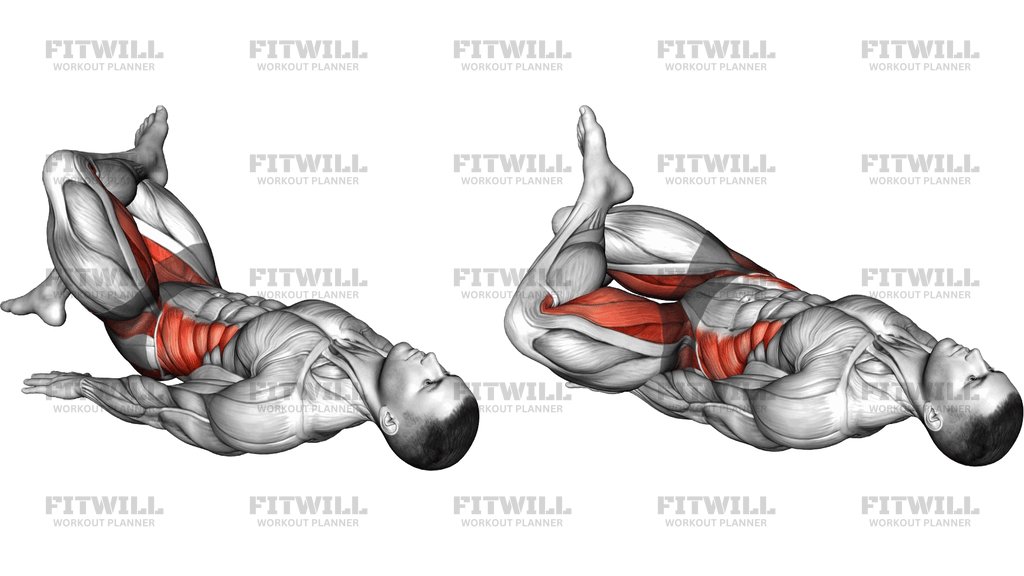
Instructions
- Lie flat on your back on a mat or the floor with your legs extended, then bend both knees to roughly 90 degrees so your feet are off the floor.
- Cross one ankle over the other and let the legs stay in contact with each other so they move as a single unit.
- Spread your arms straight out to the sides at shoulder height with your palms facing down, and press your shoulders and upper back firmly into the floor.
- Stack your knees directly over your hips and brace your midsection lightly before the movement begins.
- Keeping the knees bent and the ankles crossed, rotate your hips and lower back to lower your knees down toward the floor on one side.
- Stop when you feel a strong pull along the side of your waist or your opposite shoulder begins to lift, and hold that end position briefly.
- Exhale as you contract through your waist to draw the knees back up to the stacked starting position over your hips.
- Either repeat on the same side for your planned reps or rotate straight through center and lower toward the opposite side.
- Breathe steadily throughout, inhaling on the way down and exhaling as you return to center.
- Finish the set by bringing both feet back to the floor, uncrossing the ankles, and switching which leg is on top for the next set.
Tips & Tricks
- The most common mistake is letting the opposite shoulder peel off the floor as the knees descend. The moment a shoulder lifts, the twist has gone as far as your waist can control; shorten the range and rebuild it over time.
- Do not let the top foot slide against the bottom ankle. If the legs separate mid-rep, the rotation is no longer forced through the pelvis and lower back, so squeeze the ankles together for the whole set.
- Keep the knees at hip height and stacked over the hips at the start. Letting the knees drift toward your chest before rotating changes the angle and turns the drill into more of a hip stretch than a waist exercise.
- Press the palms into the floor lightly for stability, but do not use them to lever the torso back against the rotation. The arms are anchors, not the motor.
- If your hips feel jammed or the knees will not travel far, bend the knees a little less. A shallower knee angle often gives a freer rotation than forcing a deep 90-degree bend.
- Avoid bouncing at the bottom of the twist. The stretch position along the waist is where the muscles lengthen, so a brief pause there is worth more than a fast, swinging rep.
- Move noticeably slower than feels natural on the return. Most people rush the pull back to center, which lets momentum do the work the obliques should be doing.
- If your lower back feels pinched rather than stretched, place a small folded towel under the side of the pelvis that lifts, or reduce the descent until the rotation sits in the waist instead of the spine.
- Swap which leg is crossed on top between sets so both hips get the same rotational demand rather than always twisting off the same side.
Frequently Asked Questions
What muscles does the Lying Crossed Legs Twist work?
The primary muscles are the obliques on the sides of your waist, which control the rotation and pull the legs back to center. Your deep abdominals, lower back stabilizers, glutes, and outer hips assist throughout the movement.
Why cross the legs at the ankles for this twist?
Crossing the ankles locks the two legs into one unit, so the rotation has to come from your pelvis and lower spine instead of the legs moving independently. This makes the obliques do the actual work.
Is the Lying Crossed Legs Twist suitable for beginners?
Yes. Because you are lying down with your upper body supported, balance is not a factor and the range can easily be shortened. Beginners should simply lower the knees less deeply and prioritize keeping both shoulders on the floor.
Why do my shoulders keep lifting off the floor when I lower my knees?
That means you are rotating past the range your waist can control, so the upper body is following the legs. Stop the descent earlier, and over time the mobility will improve and the range will grow naturally.
How is this different from a standing torso twist or a Russian twist?
Lying on your back removes gravity's pull on the upright torso and supports your upper body, so the rotation happens against the floor with less loading. It is generally gentler on the lower back than seated or weighted rotational work.
Can I do the Lying Crossed Legs Twist every day?
Light, controlled reps are generally fine to do frequently, especially as a warm-up or cooldown. If you train it hard enough to feel your waist the next day, give the muscles a normal recovery day before another demanding session.
Should I hold a stretch at the bottom of each rep?
A short pause of one to two seconds at the lowest point is helpful because it teaches control at the end range and lets you feel the waist lengthen. Do not force a long static hold by pushing the knees down with your leg.
What can I use instead if my hips are too tight for the crossed-leg version?
Do the same rotation with the knees simply bent and held together without crossing the ankles. Once the hips loosen up, add the cross to lock the legs together again.
Is it normal to feel this more in my lower back than my waist?
A mild stretching sensation through the lower back is common, but sharp discomfort is not. Slow the movement down, reduce how far the knees travel, and make sure the pelvis is rotating rather than the legs swinging from a fixed torso.
How many reps and sets should I do?
Start with 8 to 12 controlled reps per side for 2 to 3 sets, resting briefly between sides. Because the emphasis is control and rotation quality, slow reps with a full pause at center beat high-speed repetitions.