Lying Upper Body Superman Row
The Lying Upper Body Superman Row combines two familiar bodyweight patterns into one movement. You start in the classic superman position, lying face down with your arms stretched overhead and your chest, arms, and legs lifted off the floor. From there, instead of just holding, you pull your elbows down toward your ribs in a rowing motion, squeezing your shoulder blades together before reaching back out to the long position. It is essentially a reverse snow angel with a deliberate pull at the end.
This exercise is useful for anyone who spends a lot of time sitting, because the muscles that hold your shoulders back and up, the lats, mid traps, and rhomboids, tend to get long and weak in a desk posture. It also works the erector spinae along the spine isometrically, since your whole upper body has to stay lifted while the arms move. Because there is no equipment involved, you can drop it into a warm-up, a home workout, or a finisher at the gym without any setup.
The setup matters more than people expect. Lying flat on your stomach with your legs long and your arms reaching overhead puts you at your weakest mechanical position for rowing, which is exactly why the movement is valuable. The chest stays glued to the floor through the pull, and only the arms and shoulders travel. If your chest pops up or your lower back arches hard to help, the work shifts away from the upper back and into the spine.
To execute it well, think of the arms doing the moving while everything from hips to head stays quiet. Reach long first, then sweep the elbows down and slightly back until your hands are roughly level with your chest, pausing for a beat to feel the squeeze between the shoulder blades. The return should be slow and smooth, resisting gravity as the arms stretch back overhead. Breathing is simple: exhale as you pull, inhale as you reach.
Most people use this as a higher-rep, low-load exercise. Sets of eight to fifteen controlled reps work well, either as activation before pressing or pulling workouts, or as a standalone strength move in minimal-equipment programs. Since the resistance is only your bodyweight and gravity, progress comes from tightening the pause, slowing the tempo, and keeping the lift in your chest and legs consistent rather than from adding load.
A few practical points will keep it comfortable. Keep your neck in line with your spine by looking at the floor rather than craning up, and stop each rep just short of the point where your lower back starts to grip. If your shoulders feel pinched at the top reach, lower your arms a few degrees out to the sides and work within that angle.
[ Workout Log & Planner ]
Put your next workout in Fitwill
Keep your plan and training log ready when you are.


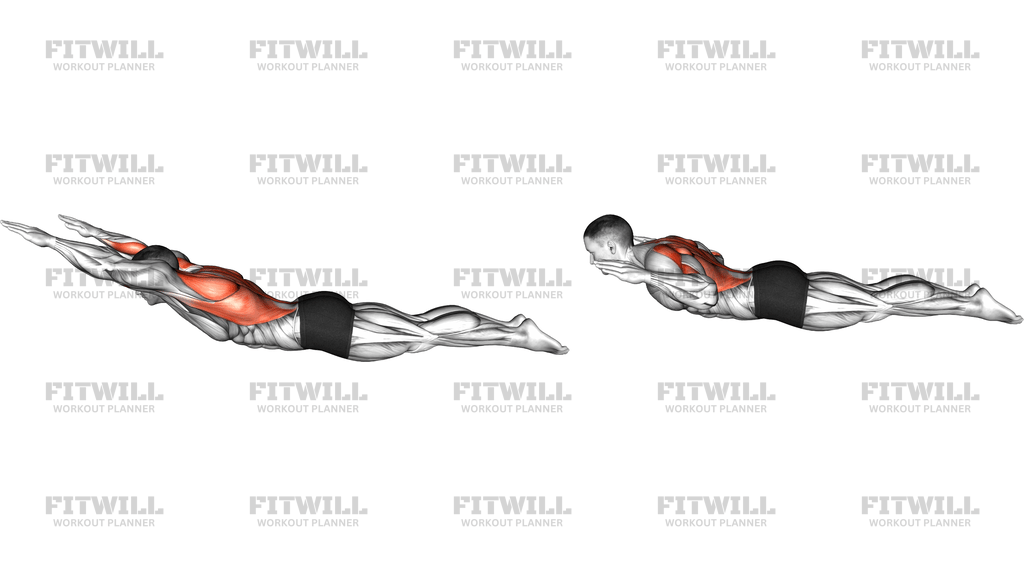
Instructions
- Lie face down on an exercise mat or the floor with your legs extended straight behind you and the tops of your feet resting on the ground.
- Extend both arms straight overhead so they form a long line with your torso, palms facing down, and lift your chest and arms a few inches off the floor.
- Lift your thighs slightly off the floor as well so your body forms a shallow, even arch from head to heels.
- Brace your midsection gently and keep your neck neutral by looking at the floor a few inches in front of you.
- Exhale as you bend your elbows and pull them down toward your ribs, sweeping your hands alongside your torso until they are near chest level.
- Squeeze your shoulder blades together at the bottom of the pull and hold that position for a one-count while your chest stays lifted.
- Inhale as you slowly extend your arms back to the overhead reach position, controlling the return instead of letting gravity drop your arms.
- Keep your hips, legs, and chest in the same lifted position throughout, letting only the arms and shoulders travel.
- Complete your repetitions, then lower your chest, arms, and legs to the floor and rest before the next set.
Tips & Tricks
- The most common mistake is turning this into a lower back exercise by arching harder each time you pull. Keep the arch constant, and if your lower back starts working overtime, reduce how high your legs are lifted.
- If your elbows flare wide like wings during the pull, your lats and rhomboids stop doing the work. Drive the elbows down close to your sides so your hands travel along your ribs.
- Do not rush the reach-out phase. The return to the overhead position is where many people lose tension; take two to three seconds to extend your arms fully.
- Keep your chin slightly tucked. Lifting your head to look forward strains the neck and usually coincides with the chest dropping.
- Shrugging your shoulders toward your ears during the pull is a sign the upper traps are taking over. Think about pulling your elbows toward your back pockets instead.
- Start with a smaller lift if your shoulders complain at the fully extended position. A slightly lower arm angle still trains the same muscles with less joint stress.
- Chest and leg height should stay identical from the first rep to the last. If they fade as the set goes on, end the set rather than grinding out reps with a collapsing position.
- For a harder version without adding equipment, pause for two to three seconds at the elbow-tucked position each rep instead of increasing speed or reps.
Frequently Asked Questions
Which muscles does the Lying Upper Body Superman Row work?
The main movers are the lats, rhomboids, and mid traps, which pull the elbows down and squeeze the shoulder blades. The lower back and glutes work isometrically to hold your chest and legs off the floor.
How is this different from a regular superman hold?
A regular superman is a static hold or a lift-and-lower of the whole body. The Lying Upper Body Superman Row adds a rowing arm pattern on top, so your upper back and lats get dynamic work while your spine muscles hold the position.
Is the Lying Upper Body Superman Row good for beginners?
Yes, it is bodyweight-only and low load, so most beginners can learn it safely. Start with eight to ten reps and keep the lift modest until the coordination of holding the arch while rowing feels natural.
Why should my chest stay on the floor while my arms move?
Keeping the chest fixed means the rowing force comes from your shoulders and upper back rather than from arching your spine harder. It also makes the muscle squeeze at the elbow-tucked position much easier to feel.
Can I do the Lying Upper Body Superman Row if my lower back gets sore?
Mild muscle fatigue is normal, but sharp or lingering discomfort is a signal to scale back. Try lifting only your chest and arms while keeping your legs down, and reduce the range until you can pull without straining.
How many reps and sets should I do?
Eight to fifteen slow reps for two to three sets covers most goals. Because the resistance is light, quality of the squeeze and control of the return matter far more than the total number of reps.
What can I use instead if lying face down is uncomfortable?
A prone row over a bench, a resistance band row, or a bent-over row with light dumbbells train a similar pulling pattern. These remove the face-down floor position while still targeting the lats and upper back.
Should my hands touch the floor between reps?
No, your arms, chest, and legs should stay suspended for the whole set. Letting your hands rest on the floor between reps removes the isometric work from your lower back and turns it into an arm-only movement.
How do I know if I am shrugging during the row?
If your shoulders creep up toward your ears as your elbows come down, your upper traps are dominating. Film a set from the side or have a partner watch, and cue your elbows to travel back and down rather than straight back.