Ring Front Lever
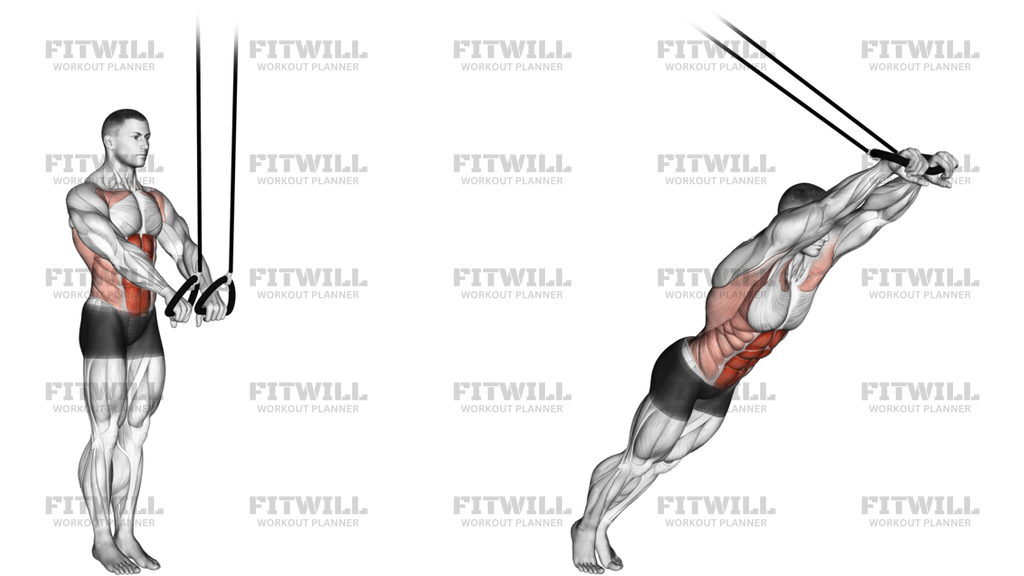
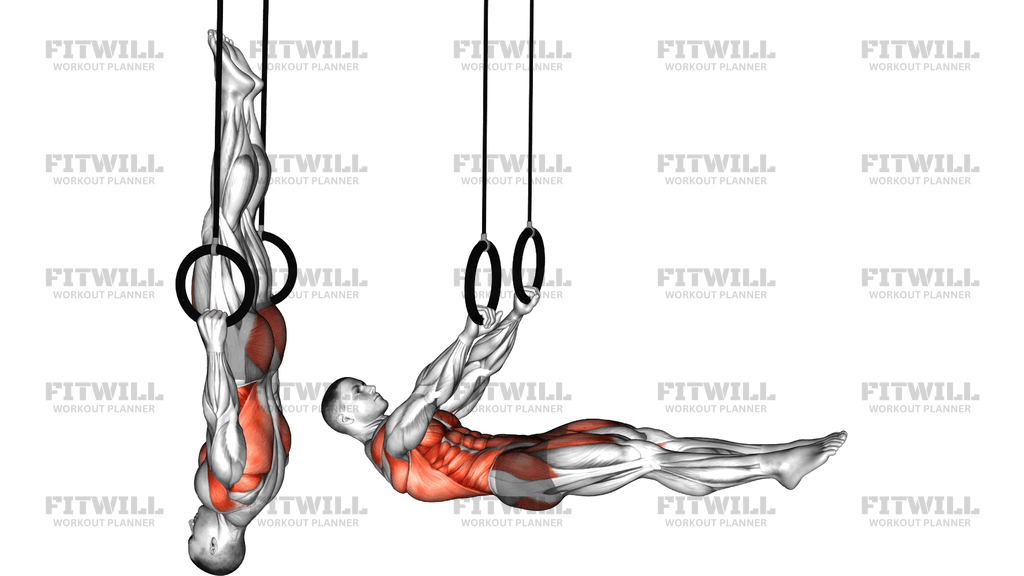
The Ring Front Lever is one of the most demanding static holds in calisthenics and gymnastics strength training. You hang from a pair of gymnastic rings with a straight-arm grip, then rotate your entire rigid body upward until it sits horizontally, facing the ceiling, held off the ground by nothing but your locked arms and stacked core. Unlike a bar version, the rings can shift and swing independently, which means every stabilizer from your wrists to your shoulders has to work overtime to keep you level.
This hold builds a rare combination of straight-arm pulling strength and full-body tension. The lats, front shoulders, and upper back control the position of the arms and shoulder girdle, while the abs, hip flexors, glutes, and lower back lock the trunk into a solid plank-like line. Because the lever arm runs the entire length of your body, the load on these muscles is enormous even though you are only lifting your own body weight.
The Ring Front Lever suits intermediate and advanced trainees who already own a solid hanging and core foundation, ideally a comfortable back lever and controlled front lever tuck or advanced tuck holds. Gymnasts, calisthenics athletes, and strength enthusiasts use it both as a skill and as a maximal static strength benchmark. It also carries over well to pull-ups, rows, and muscle-ups, since the scapular depression and straight-arm control it demands appear in all of those movements.
Setup quality decides everything here. Adjust the rings to roughly hip height so you can set your grip while seated or lying beneath them, and make sure the straps are even and the anchor point is solid. Because the rings move, small asymmetries in grip width or strap length will show up immediately as a tilt or a swing once you load the hold, so take a moment before every attempt to square yourself up.
Execution is about tension, not effort flailing. Squeeze the rings, pull them slightly down toward your hips, brace your midsection, and rotate the body up as one rigid piece. At the top, your body should form a flat horizontal line, hips open rather than piked, legs together, head neutral between the arms. Hold for time, breathe shallowly and steadily, and lower back to the hang under control instead of dropping out of the position.
Treat this as a low-repetition, high-quality strength skill. Short sets of three to eight seconds with full rest between efforts build the position far better than grinding out long, sagging holds. Stop the set the moment your hips drop or your lower back starts to arch, and scale to an easier progression, such as a tuck or one-leg variation, whenever the full lever is out of reach.
[ Workout Log & Planner ]
Put your next workout in Fitwill
Keep your plan and training log ready when you are.


Instructions
- Set a pair of gymnastic rings at about hip height from a secure anchor and check that both straps are the same length with the buckles or cam locks fully closed.
- Sit or lie beneath the rings, take an overhand grip roughly shoulder-width apart, and rotate the rings slightly outward so the backs of your hands face the floor when loaded.
- From the hanging position, pull your shoulder blades down and together so your shoulders sit away from your ears and your arms stay fully straight.
- Brace your abs and squeeze your glutes and thighs together to turn the whole body into one rigid plank before any rotation starts.
- Pull the rings down toward your hips and lift your legs as one piece, keeping knees locked and toes pointed, until your body reaches a horizontal line facing the ceiling.
- At the top position, keep hips extended rather than piked, stack your body directly over the anchor line, and hold your head neutral between your arms rather than craning forward.
- Hold the static position for a set count of three to eight seconds while breathing shallowly and evenly through your nose.
- To finish, reverse the path under control: lower the legs and torso back down as one piece until you return to a dead hang.
- Exhale after lowering, shake out the grip, and reset your shoulder position before starting the next hold.
- Stop the set immediately if your hips sag below your shoulders, your lower back arches, or the rings start to swing out of line.
Tips & Tricks
- Hips dropping is the most common fault. Fix it by squeezing the glutes harder and pulling the rings slightly toward your hips rather than pushing them away, which shortens the lever your core has to hold.
- Bent elbows quietly steal tension from the lats and shift load to the joints. Lock the arms out and think about pressing the rings down while your body rises, not pulling with the biceps.
- If the rings twist or drift apart mid-hold, your grip width is uneven or your straps are different lengths. Squaring the setup before you load saves the rep.
- Turn the rings slightly outward and keep that rotation through the hold. Rings left facing straight ahead are harder to stabilize and encourage shoulder internal rotation under load.
- Avoid craning the chin toward the chest to spot your body line. Keep the head neutral between the arms; the ceiling-facing position should be felt through the lats and abs, not seen.
- Piking at the hips makes the hold look horizontal while doing far less work. Film from the side occasionally to check that your hips, knees, and shoulders truly align.
- Full rest between holds matters. Two to three minutes of recovery keeps the hold crisp, while short rests turn a strength skill into a sloppy endurance set.
- If you can only manage a few seconds of full Ring Front Lever, spend most of your volume on advanced tuck or single-leg variations and use full attempts sparingly as test sets.
Frequently Asked Questions
Which muscles does the Ring Front Lever work the most?
The primary work comes from the lats, front shoulders, and upper back, which control the straight arms and depressed shoulder blades. The abs, hip flexors, glutes, and lower back hold the trunk rigid, and the forearms handle the grip on the rings.
Is the Ring Front Lever harder than the bar version?
Yes, for most people it is. The rings move independently, so your shoulders, grip, and core must stabilize in every direction while holding the same horizontal body position.
Can beginners train the Ring Front Lever?
Beginners should start with the foundation skills instead: hollow body holds, hanging knee raises, rows, and tuck front lever holds on rings or a bar. Jumping straight to the full lever usually produces a sagging, arched hold with little training value.
How high should I set the rings for the Ring Front Lever?
Set them around hip height so you can grip them while seated or lying underneath and still clear the floor at the horizontal position. Too high makes mounting awkward; too low risks your feet or hips touching down.
Why do my hips drop during the hold?
Dropping hips usually mean the glutes and abs are not fully engaged, or the hold is simply beyond your current strength. Squeeze the glutes hard, pull the rings slightly toward your hips, and if the hips still sag, drop to a tuck or one-leg variation.
How long should I hold the Ring Front Lever?
Quality sets of three to eight seconds with full rest between attempts build strength best. Once you can hold a clean, flat position for around ten to fifteen seconds, progress to a harder variation rather than chasing longer times.
What can I use instead of rings for the Front Lever?
A fixed pull-up bar works well and is slightly easier because it removes the instability. Resistance bands looped under the hips or legs, or a partner supporting the legs, also reduce load while you learn the body position.
Should my elbows be straight in the Ring Front Lever?
Yes, the arms stay fully locked throughout the hold. Bent elbows turn it into a pulling exercise and place extra stress on the elbow joints instead of building the straight-arm strength the movement is known for.
Is the Ring Front Lever safe for the shoulders and elbows?
It is generally safe when built up gradually with straight arms, active shoulders, and progressive variations. Warm up the shoulders and elbows thoroughly, avoid max attempts on cold tissue, and back off if you feel joint pain rather than muscle effort.