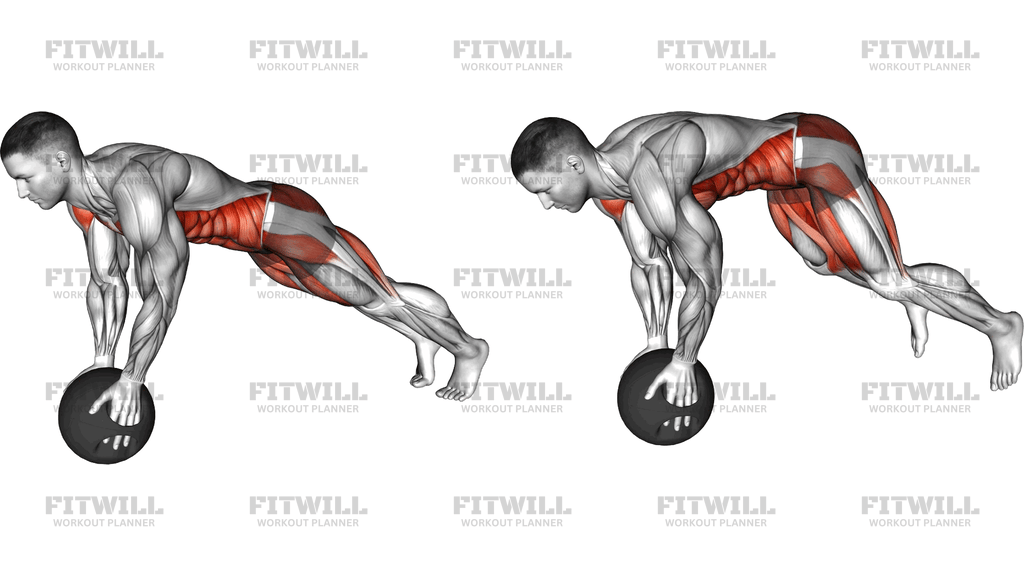
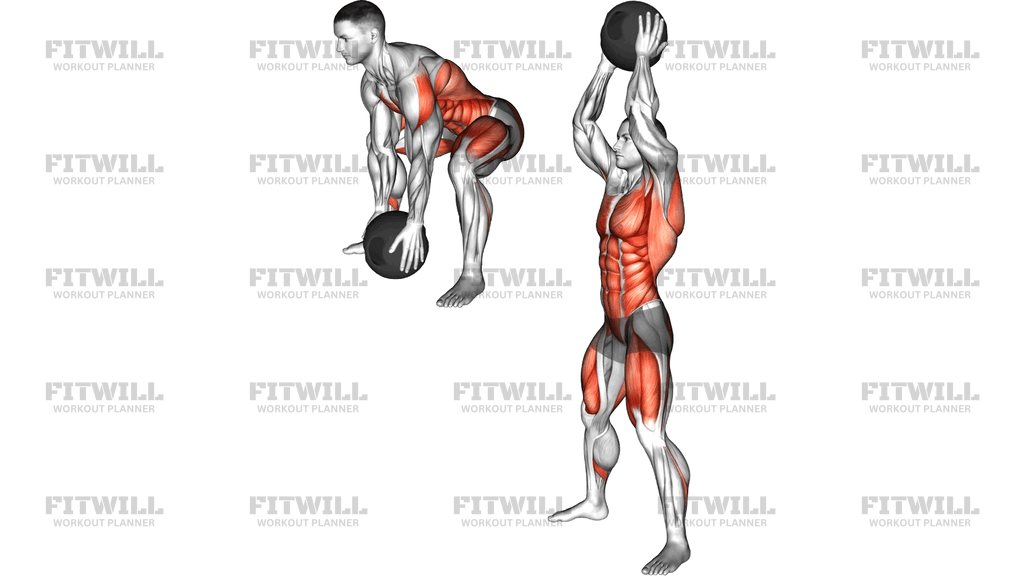
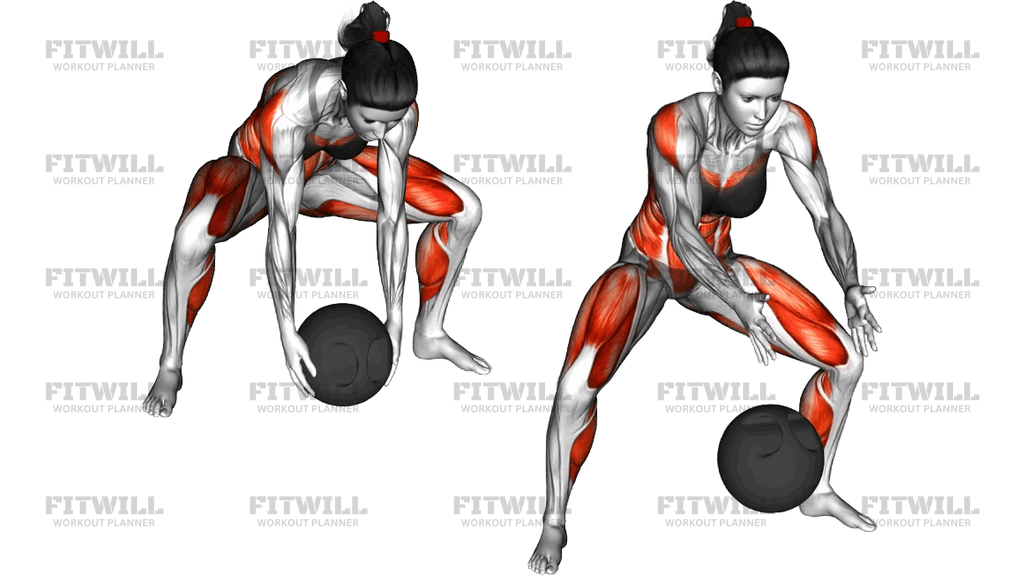
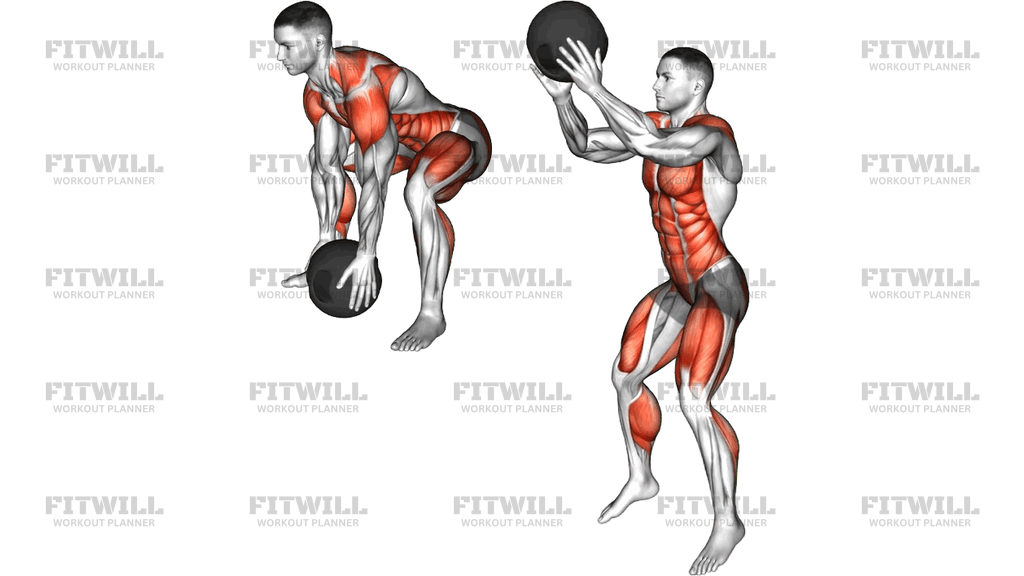
Medicine Ball Kneeling Glute Press
The Medicine Ball Kneeling Glute Press is a quadruped exercise in which you trap a medicine ball in the crease behind one knee and drive that bent leg up and back toward the ceiling. The ball has to stay pinched between your thigh and calf the entire time, which forces you to squeeze the hamstrings and glutes together rather than just swinging the leg. That squeezing action is what separates this from a standard kneeling kickback — the ball turns the movement into an active press instead of a loose leg swing.
This exercise is especially useful for anyone who struggles to feel their glutes working during hip extension. Because the working knee stays bent, the hamstrings are shortened and contribute less, so the gluteus maximus has to handle most of the lifting. It is a popular choice in glute-focused sessions, warm-up routines before squats or deadlifts, and rehabilitation-style programming where light, joint-friendly hip extension is the goal. Since you only need a medicine ball and floor space, it also works well for home training.
Your setup determines everything here. Hands should be stacked under the shoulders and the supporting knee under the hips, with a neutral spine before the leg even moves. If your torso collapses or twists, the ball slips and the work leaks into the lower back. Keeping the ribcage down and the core braced lets the glute do its job in isolation, which is exactly the point of the movement.
To execute it well, squeeze the ball firmly behind your knee, then press the whole leg upward by shortening the front of the hip and driving the thigh toward the ceiling. Think about leading with the back of the thigh and the heel, not by arching the lower back. Pause briefly at the top when the thigh is roughly level with or slightly above your torso, then lower with control so the ball stays locked in place. The tempo should be deliberate — this is a squeeze-and-press, not a bounce.
A common use case is as the first glute activation drill of a lower-body day, done for two to three sets of ten to fifteen reps per side. It also fits into circuit training as a low-impact hip exercise. Keep the ball weight modest: most people do better with a light ball they can crush hard than a heavy one they barely hold, because the quality of the squeeze drives the muscle work.
For safety, keep the movement within a range where your lower back stays neutral, and stop if you feel the work shifting into your lumbar spine. If the ball keeps sliding out, press harder with the knee rather than lifting higher. A folded mat under the supporting knee makes the position comfortable enough to hold for every rep.
[ Workout Log & Planner ]
Put your next workout in Fitwill
Keep your plan and training log ready when you are.


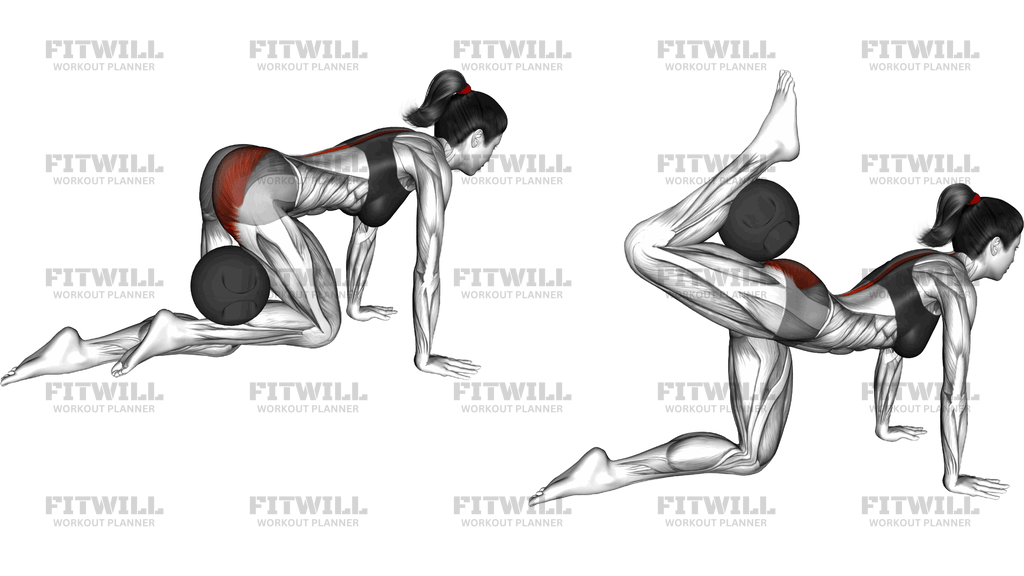
Instructions
- Place a medicine ball on the floor and kneel on all fours on an exercise mat, with your hands stacked directly under your shoulders and one knee directly under your hip.
- Trap the ball in the crease behind the knee of your working leg by bending that knee to about 90 degrees and clamping your thigh and calf against it.
- Set your spine in a neutral position, pull your ribs down, and brace your core as if bracing for a light push to the ribs.
- Keep the supporting knee planted under the hip and your gaze down at the floor so your neck stays in line with your spine.
- Squeeze the ball hard with your leg and press your bent knee up toward the ceiling, leading with the back of your thigh and heel.
- Stop when your thigh is level with or slightly above your torso, and hold the top position for one to two seconds without arching your lower back.
- Lower your knee under control until the leg returns near the floor, keeping constant pressure on the ball the whole way down.
- Exhale as you press the leg up, inhale as you lower it back down.
- Complete all reps on one side, then reposition the ball behind the opposite knee and repeat, resetting your brace before each new set.
Tips & Tricks
- If the medicine ball keeps slipping out from behind your knee, the problem is usually a soft squeeze — clamp down before you start lifting, not during.
- Lifting the knee higher by arching your lower back is the most common fault here; cut the range back until your torso stays completely still.
- Avoid letting your hips rotate open toward the working side — square your pelvis to the floor so the glute extends the hip instead of twisting it.
- Choose a lighter ball than you think you need; a ball you can crush fully beats a heavy one you merely hold, because the squeeze drives the glute contraction.
- Keep the working knee bent around 90 degrees throughout — straightening the leg turns this into a kickback and brings the hamstrings back into the lift.
- If your supporting knee aches on a hard floor, fold a mat under it; discomfort there will make you shift your hips and lose the press position.
- Deliberately pause at the top for a second or two — most of the muscle-building value of this drill lives in that held squeeze, not the movement itself.
- Move slower than feels natural; the short range means momentum does the work for you if you rush the reps.
- Use this as a pre-workout activation drill before squats or deadlifts with just one or two light sets rather than training it to fatigue first.
Frequently Asked Questions
What muscles does the Medicine Ball Kneeling Glute Press work?
The gluteus maximus is the primary muscle, doing most of the hip extension. The hamstrings assist, and your core and lower back stabilizers work to keep your torso from twisting as the leg presses up.
Why does the medicine ball go behind the knee instead of the ankle?
Trapping the ball in the knee crease forces you to actively squeeze your thigh and calf together, which keeps the knee bent and shifts the lifting demand onto the glute. With the ball at the ankle, the movement becomes a looser kickback with more hamstring involvement.
Is the Medicine Ball Kneeling Glute Press good for beginners?
Yes, it is a good beginner glute exercise because the quadruped position is stable, the range is short, and a light ball keeps the load low. Beginners should focus on keeping the pelvis square and the spine neutral before worrying about how high the knee lifts.
How heavy should the medicine ball be?
Pick a ball light enough that you can clamp it firmly behind your knee for every rep, typically a light medicine ball in the two to six kilogram range. If the ball slips or you arch your back to lift it, go lighter.
Why do I feel this in my lower back instead of my glutes?
That usually means your lower back is arching to lift the knee higher, or your hips are twisting open. Reduce the range, re-brace your core with the ribs pulled down, and focus on pressing the heel toward the ceiling rather than lifting the knee as far as possible.
How many sets and reps should I do?
Two to three sets of ten to fifteen controlled reps per side works well, whether for glute activation before a lower-body session or as a focused exercise in its own right. Rest about thirty to forty-five seconds between sets.
Can I do the Medicine Ball Kneeling Glute Press without a medicine ball?
Yes. A small stability ball, a rolled towel wedged behind the knee, or simply a deliberate knee squeeze with no object all work. The key element is the active squeeze behind the knee, not the ball itself.
Should the working knee stay bent during the whole rep?
Yes, keep the knee bent at roughly 90 degrees from start to finish. Straightening the leg mid-rep releases the ball and changes the exercise into a kneeling kickback with a different muscle emphasis.
Is it safe for people with knee discomfort?
The pressure behind the working knee is generally light, but the supporting knee bears weight on the floor for the whole set, so pad it with a mat. If pressing the ball causes pain inside the knee joint, stop and use a bodyweight glute kickback instead.