Medicine Ball Plank Jack
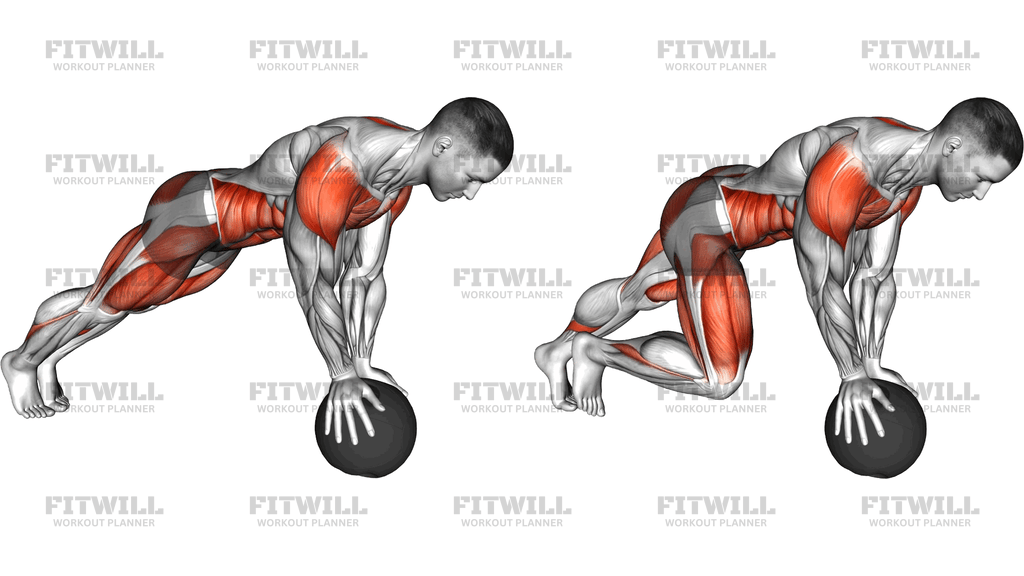
The Medicine Ball Plank Jack is a dynamic core exercise that combines an unstable, elevated plank position with a rhythmic jumping jack leg pattern. Both hands rest on top of a medicine ball while your feet support you on the floor, so every jack you perform forces your trunk, shoulders, and hips to work together to stay balanced. The ball creates two challenges at once: it raises your upper body slightly, and it rolls if your weight shifts unevenly, which demands constant small corrections from your abs and shoulder stabilizers.
This movement suits intermediate exercisers who already hold a solid straight-arm plank and want to add speed, coordination, and anti-rotation work to their routine. Because the legs jump out and in repeatedly, it also raises your heart rate quickly, making it a natural fit for circuits, metabolic finishers, and sport-specific conditioning where you need to brace your midsection while your limbs move.
The primary work comes from the abs and deep core, which must keep your ribs down and your hips level as your feet strike the floor wider and narrower. Your shoulders and chest stabilize the plank position on top of the ball, your glutes lock the pelvis in place, and your hip flexors and adductors control the leg action. The wobbling surface also recruits the smaller stabilizing muscles around the wrists and shoulder blades far more than a flat-floor plank would.
Setup quality determines everything here. Place the medicine ball on a non-slip surface and grip it on both sides with your hands roughly under your shoulders, fingers spread for control. Start with your feet together in a straight-arm plank, body forming one line from head to heels before you attempt the first jump. A ball that is too soft or too small will be unstable under your hands; a firm, moderately sized ball gives you a predictable platform.
To execute the jack, brace your abs, then hop both feet out to a wide stance and land softly on the balls of your feet, keeping your hips at plank height. Jump your feet back together and continue at a steady, controlled rhythm. The most common breakdown is the hips sagging or piking as fatigue sets in, which shifts stress to the lower back, so stop the set when your line breaks rather than grinding out extra reps with poor form.
[ Workout Log & Planner ]
Put your next workout in Fitwill
Keep your plan and training log ready when you are.


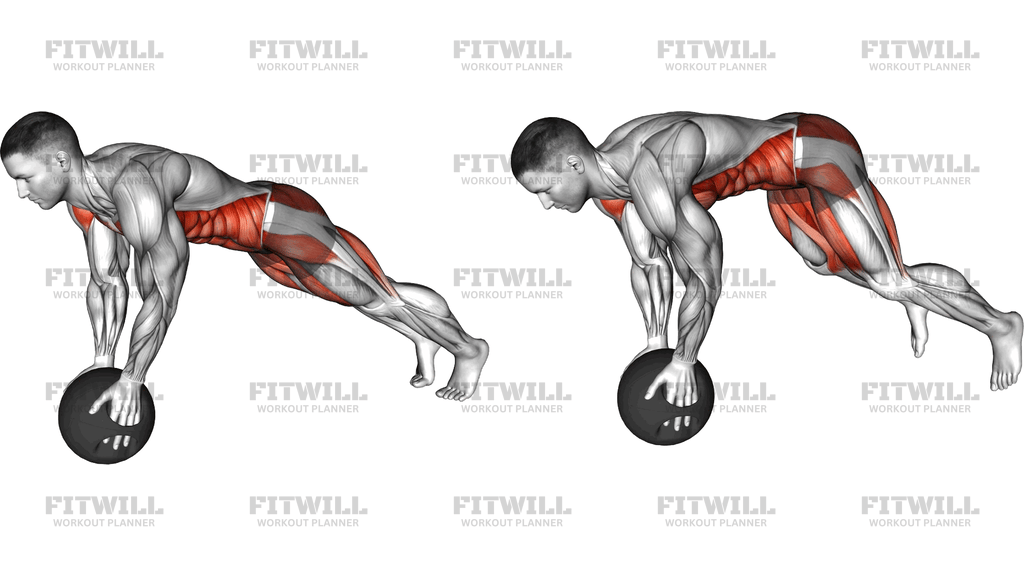
Instructions
- Place a firm medicine ball on the floor and kneel behind it with your hands resting on top, gripping the sides of the ball with fingers spread.
- Walk your feet back until your body forms a straight line from head to heels, feet together, shoulders stacked directly over your hands on the ball.
- Squeeze your glutes, brace your abs as if bracing for a light punch, and press the ball down slightly to engage your chest and shoulder stabilizers.
- Keeping your hips at plank height, jump both feet out wide at the same time, landing softly on the balls of your feet with toes turned slightly out.
- Without letting your hips rise or sag, immediately jump your feet back together to the starting stance, keeping the landing quiet and controlled.
- Continue the out-and-in jumping rhythm at a pace you can maintain while your trunk stays completely still and the ball stays steady under your hands.
- Exhale sharply on each jump out and inhale as your feet come back in, keeping the breathing rhythm tied to the leg action.
- Keep your gaze slightly forward and down so your neck stays in line with your spine rather than craning up to check the ball.
- When you finish the set, step your feet in one at a time, lower your knees to the floor, and roll the ball away before standing up.
Tips & Tricks
- If the ball rolls forward on your first few jacks, your weight is drifting toward your toes; shift slightly more weight back over your hands and re-grip the sides of the ball.
- Loud, heavy landings usually mean your glutes have switched off and your lower back is absorbing the impact; squeeze your glutes and aim for quiet landings on the balls of your feet.
- Hips that pike upward are a sign the core is fatiguing or the jumps are too wide; narrow the jack width and slow the tempo before your form gives out entirely.
- Start with a heavier, firm medicine ball rather than a soft or bouncy one; a wobbly ball under your hands multiplies the stability demand faster than your core may be ready for.
- Place the ball on a mat or rubber flooring if your gym surface is slick, since a sliding ball mid-jack is the main safety risk of this setup.
- If your wrists complain from the extended position on the ball, warm them up first with circles and gentle extensions, or shorten the set duration instead of resting on locked elbows.
- Do this exercise early in a core session while you are fresh; performing it after heavy pressing or long planks makes the shoulder stabilization on the ball much harder to control.
- Count reps in pairs, one out-and-in cycle equals one rep, and build volume gradually from around 10 reps before adding speed.
- Film yourself from the side once in a while; from your own viewpoint the plank line feels straight even when your hips have started to sag.
Frequently Asked Questions
What muscles does the Medicine Ball Plank Jack work?
The abs and deep core do most of the work to hold your trunk still while your legs jump. Your shoulders, chest, and glutes stabilize the plank position, and the hip flexors and adductors drive and control the leg action.
Why use a medicine ball instead of doing plank jacks on the floor?
The ball elevates your hands and adds an unstable surface, so your wrist, shoulder, and core stabilizers must make constant corrections that a flat-floor plank jack does not require. It also changes the plank angle slightly, reducing wrist extension compared with a floor plank.
Is the Medicine Ball Plank Jack suitable for beginners?
Beginners should first master a 30-60 second straight-arm plank on the floor and standard plank jacks before adding the ball. Once both feel solid, start with slow, small jacks on a large, firm ball.
What size or type of medicine ball works best?
A firm, non-bouncy ball roughly 30-45 cm in diameter works well, since it gives a stable platform and leaves room for your fingers to grip the sides. Very soft or small balls wobble excessively under your hands.
How do I stop my hips from sagging during the jacks?
Squeeze your glutes and brace your abs before the first jump, and keep each jack narrow enough that you can control the landing. If your hips drop anyway, end the set; sagging hips shift the load to your lower back.
My wrists hurt when my hands are on the ball. What should I do?
Warm up your wrists with circles and gentle stretches before the exercise, spread your fingers and grip the sides of the ball rather than resting flat on top, and shorten your sets. If discomfort continues, use a lower unstable option like a BOSU ball platform or flat-floor plank jacks.
Can I substitute the Medicine Ball Plank Jack with something else?
Yes. Standard plank jacks on the floor, mountain climbers with hands on a stability ball, or a plank shoulder tap all train similar core stability with less balance demand. Choose the floor version first if the ball feels too unstable.
How many reps and sets should I do?
Start with 2-3 sets of 8-12 controlled out-and-in cycles, resting about 45-60 seconds between sets. Prioritize a steady trunk position over speed, then add reps or tempo as your control improves.
Is this exercise safe for my lower back?
It is generally well tolerated when your hips stay level and your abs stay braced, since the core is doing the stabilizing. If you feel strain in your lower back, reduce the jump width, slow down, or regress to floor plank jacks and rebuild the position first.
Should my feet land wide on every jump or can I do smaller hops?
Smaller hops are a smart progression and still train the same stability demand. Widen the jack only when you can land quietly with your hips at plank height throughout the entire set.