Medicine Ball Slam (Version 2)
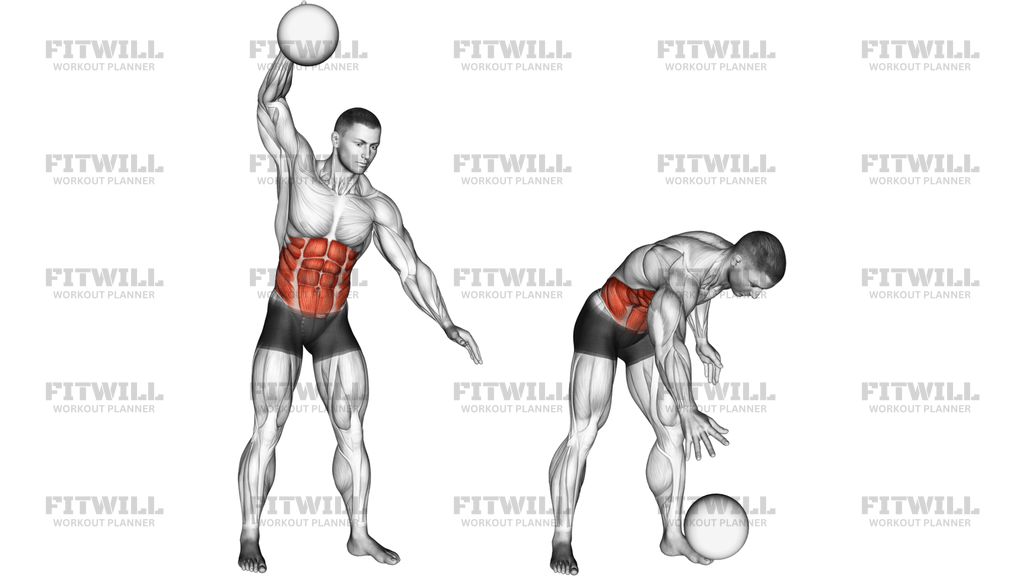
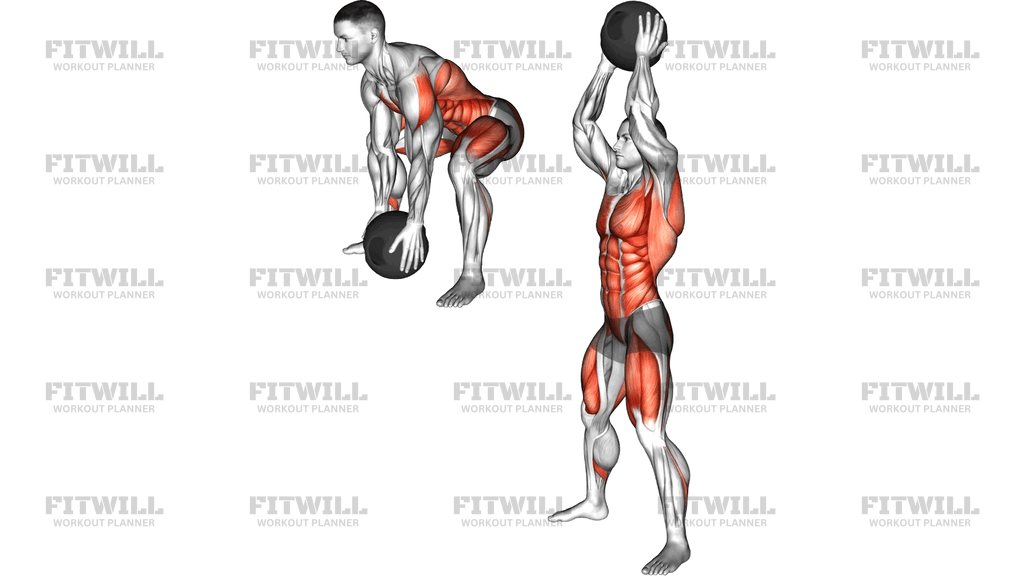
The Medicine Ball Slam (Version 2) is an explosive full-body movement where you lift a medicine ball from the floor all the way overhead, then drive it back down into the ground with maximum intent. Unlike the standard version that starts with the ball already overhead, this variation begins from a bent-over position, so every rep includes a powerful pull from the floor before the slam itself. That makes it a two-phase exercise: an explosive scoop to overhead, followed by a hard, deliberate throw into the floor.
Because the movement chains the legs, hips, trunk, and arms together in one continuous effort, it works as a genuine power developer rather than an isolated core exercise. Your abs and obliques brace and flex hard as you slam, your lats and shoulders accelerate the ball downward, and your glutes and quads drive the upward phase from the bent-over start. Grip and forearm strength get worked too, since you have to hold onto a bouncing, dead-weight ball through both phases.
This version suits anyone who wants conditioning and power in a single movement: general trainees looking for an efficient core finisher, athletes building rotational and overhead power, and anyone using circuits or intervals who needs a high-output, low-skill option. It also teaches you to brace under speed, which carries over to lifting, throwing, and sprinting mechanics.
Setup matters more than most people expect. Use a slam ball or a medicine ball rated for slamming rather than a bouncy rubber ball, and choose a weight you can accelerate all the way through the throw. Stand on a flat, non-slip surface with enough ceiling clearance to reach full extension overhead. A ball that is too heavy turns the slam into a slow, spine-loaded grind, while one that is too light removes the training stimulus almost entirely.
To execute it well, hinge down and grip the ball firmly on the floor, then pull it overhead in one fluid motion as you stand tall onto your toes. Without pausing, slam the ball down in front of you, hinging at the hips and letting your abs, not your lower back, do the braking. Keep your ribs stacked over your pelvis throughout, and avoid rounding your back as you reach for the ball on the floor.
The most common mistakes are throwing with the arms only, slamming too close to the feet, and letting the lower back round at the bottom of the reset. Treat every rep as one crisp, athletic action: scoop, extend, slam, reset. Done that way, the Medicine Ball Slam (Version 2) delivers power, core strength, and a serious conditioning effect in a very short window of work.
[ Workout Log & Planner ]
Put your next workout in Fitwill
Keep your plan and training log ready when you are.


Instructions
- Place a slam-appropriate medicine ball on the floor between your feet, which should be set about shoulder-width apart on a flat, non-slip surface.
- Push your hips back and hinge forward with a flat back until you can grip the ball firmly on both sides with your hands roughly at its widest point.
- Take a breath and brace your core before you lift, keeping your chest taller than your hips and your weight balanced through your whole foot.
- Pull the ball upward in one fluid motion, extending your hips, knees, and ankles so you finish standing tall with the ball held overhead and arms fully extended.
- Without pausing at the top, slam the ball down forcefully into the floor about a foot in front of your toes, hinging at the hips as your arms drive downward.
- Exhale sharply as you slam, letting your abs contract hard to finish the throw rather than letting your lower back collapse forward.
- Follow the ball's path with your hands and body, catching or controlling it after the bounce without rounding your back.
- Reset your grip and your brace, then hinge down cleanly to start the next rep, keeping the lift and slam connected but never rushed.
- Breathe in during the lift to overhead, exhale hard on the slam, and reset your breathing before each new rep.
- Complete your set with controlled effort throughout, stopping when you can no longer slam with full speed and intent.
Tips & Tricks
- Choose a ball you can accelerate; if the slam looks like a slow lowering, the weight is too heavy for power work.
- Slam the ball in front of your toes, not straight down between your feet, so the bounce does not come back into your shins or face.
- Do not lift the ball overhead with your arms alone; drive through the floor with your hips and legs and let your arms guide the ball.
- Watch for lower back rounding on the reset, which usually happens when fatigue sets in; hinge with a braced spine or end the set early.
- Ribs over pelvis: arching backward at the overhead position shifts the load away from your abs and onto your lumbar spine.
- Use your whole body on the descent by hinging aggressively, rather than doing a stiff-armed push-down that limits power and stresses the shoulders.
- Full extension matters; rising onto the balls of your feet at the top signals complete hip and knee drive before the slam.
- Keep a firm grip through the bounce, since a loose hold on a rebounding ball is the most common way to take a hit during this exercise.
- If your gym floor is not suitable for slamming, use a sturdy tire or a thick plyo box surface as your target instead of skipping the movement.
Frequently Asked Questions
What muscles does the Medicine Ball Slam (Version 2) work?
The primary movers are your abs, especially the rectus abdominis and obliques, which contract hard to slam and decelerate the ball. Your lats and shoulders drive the throw, while glutes, quads, and lower back power the lift from the floor to overhead.
How is Version 2 different from a standard Medicine Ball Slam?
Version 2 starts with the ball on the floor, so each rep adds an explosive scoop from a bent-over position to full overhead extension before the slam. The standard version typically starts with the ball already raised overhead.
What kind of medicine ball should I use for slams?
Use a slam ball or a non-bouncy medicine ball designed to be thrown into the floor. A highly elastic rebounder ball can bounce unpredictably and come back toward you, which is a safety problem at speed.
Is the Medicine Ball Slam (Version 2) suitable for beginners?
Yes, as long as you start with a light ball and focus on the hip hinge and bracing before adding speed. Beginners often benefit most from practicing the scoop-to-overhead portion slowly, then adding the slam once the pattern feels natural.
Why does my lower back ache after doing this exercise?
Lower back discomfort usually comes from rounding forward as you reach for the ball or slamming with a collapsed torso instead of braced abs. Hinge at the hips with a flat back, keep your ribs stacked, and let your abdominal muscles finish each slam.
How heavy should the medicine ball be?
Pick a weight you can slam with real speed for your full set, often somewhere between 4 and 12 kg depending on your training background. If the throw slows to a grind, the ball is too heavy for the power and conditioning effect this exercise is meant to produce.
Can I substitute the Medicine Ball Slam (Version 2) if I have no floor space to throw into?
A sturdy tire, a heavy sandbag drop, or a kneeling overhead ball throw against a reinforced wall can work as substitutes. Avoid slamming on fragile flooring or onto a surface that will make the ball rebound erratically.
Should I catch the ball on the bounce or reset from the floor each rep?
In this version, letting the ball settle and resetting your grip from the floor keeps the movement honest and reduces the chance of a rebound catching you. If you do absorb the bounce, stay hinged with a braced spine and soft knees as you control it.
How should I program this exercise in a workout?
It works well as a power primer at the start of a session or as a high-intensity finisher in circuits, typically in sets of 8 to 15 reps or timed intervals. Because it is explosive by nature, quality of each slam matters more than squeezing out extra fatigued reps.