Cable Lying Single Leg Curl
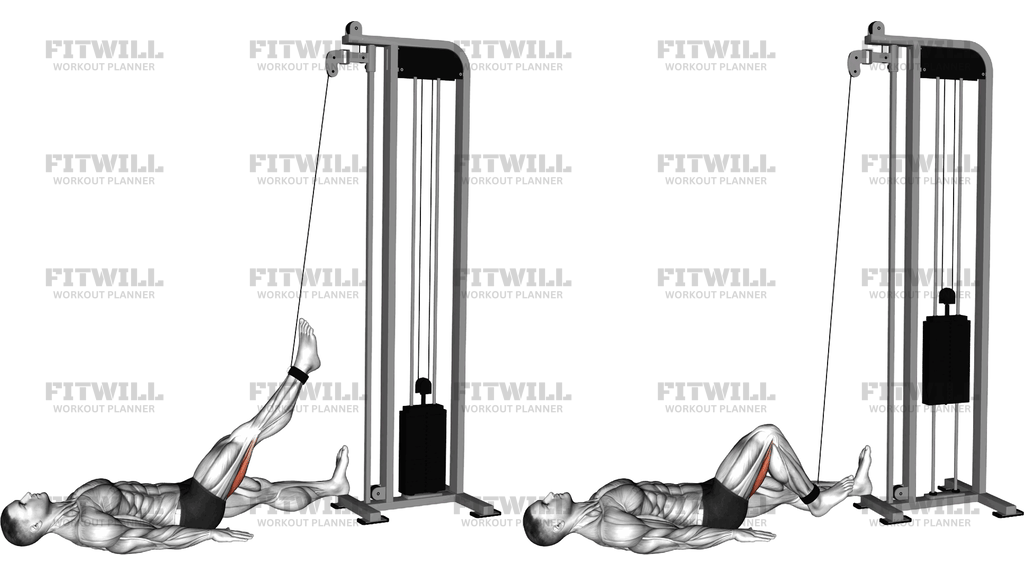
The Cable Lying Single Leg Curl is a unilateral hamstring isolation exercise performed on your back with an ankle strap attached to a low pulley. You lie face up on the floor with your head away from the machine and your working leg pointed roughly straight up toward the ceiling, then bend the knee to pull your heel down toward your glutes against the cable's resistance. Because the hip stays fixed and only the knee joint moves, the work is placed almost entirely on the hamstrings, which act as knee flexors in this position.
Training one leg at a time is the main selling point here. Most people carry a noticeable side-to-side imbalance in hamstring strength, and bilateral machine curls tend to hide it because the stronger leg quietly takes over. The single-leg format makes any asymmetry obvious and gives you a chance to fix it. It also lets you keep the load honest on each rep, since the cable stack provides smooth, even tension through the entire arc of the movement rather than only at the strongest angle.
Compared with a prone leg curl machine, this setup changes the resistance direction in a useful way. With your leg vertical and the cable pulling straight down, the tension peaks as your knee bends and your heel travels toward your hips, and the stretch at the top is gentle rather than aggressive. That makes it a good option for people who find prone curl machines uncomfortable on the lower back or who want a controlled way to rebuild knee flexion strength after time away from training.
Setup matters more than it looks. Your distance from the machine determines how much the cable angle fights you at the start, and a loose ankle strap will slide or pinch mid-rep. Lying flat with your lower back relaxed against the floor keeps the pelvis neutral so the hamstrings, not the hip flexors or lower back, do the work. The non-working leg stays extended on the floor as a reference point, which helps you keep the curling knee from drifting sideways.
Execute it by bending the knee under control, letting the heel travel toward your glutes, pausing briefly at the fully bent position, then resisting the cable as the leg straightens back toward vertical. The lowering half is where most of the muscle-building value sits, so don't let the stack yank your leg back up. Breathe out as you curl, in as you return, and complete all reps on one side before switching ankles.
This exercise fits well as an accessory after squats, deadlifts, or Romanian deadlifts, or as a focused hamstring finisher on a leg day when the curl machines are occupied. It also travels well: any functional trainer or low pulley with an ankle strap gives you everything you need, so it's a practical choice in busy or minimally equipped gyms.
[ Workout Log & Planner ]
Put your next workout in Fitwill
Keep your plan and training log ready when you are.


Instructions
- Clip an ankle strap around your working ankle and attach it to the low pulley of a cable machine, then set the stack to a light starting weight.
- Lie flat on your back on the floor or an exercise mat with your head away from the machine, so the cable runs from the pulley up along your working leg.
- Point the strapped leg straight up toward the ceiling with only a very slight bend in the knee, and keep your other leg extended on the floor beside it.
- Brace your core lightly and press your lower back toward the floor so your pelvis stays still throughout the set.
- Curl by bending your working knee, pulling your heel down toward your glutes against the cable's pull.
- Keep the thigh itself steady and vertical; only the knee joint should move as the shin travels through the arc.
- Pause for a beat at the fully bent position with the heel close to your glutes and squeeze the hamstring.
- Slowly resist the cable as you straighten the knee back up toward the starting position, stopping just short of letting the weight stack rest.
- Exhale as you curl the heel down, inhale as you extend back up.
- Finish all reps on one leg, then move the strap to the other ankle and match the repetition count on the second side.
Tips & Tricks
- If the strap slides down toward your foot during the set, move it higher on the calf-ankle line and cinch it snug; a loose strap shifts the pull off the tendon line and wastes tension.
- Watch the non-working knee for clues: if your curling knee starts drifting outward or inward, that's usually a sign the weight is too heavy or the strap has loosened.
- Don't let your hips lift or rock as the heel approaches your glutes. Once the pelvis tilts, the lower back takes over and the hamstring loses its isolation.
- Keep the tension on at the top. Letting the stack settle between reps removes the loaded stretch and turns the set into partial work.
- Start far lighter than you would on a seated or prone leg curl machine. The cable has no sticking points to hide behind, so the honest load is usually lower.
- If your working hamstring cramps near the knee, which is common in this vertical-leg position, lower the weight and shorten the range slightly for a few sessions.
- Control the lowering phase to roughly two to three seconds. Letting the cable snap the leg back up is the most common rep-ruining mistake in this exercise.
- A slight knee bend at the top of each rep protects the joint; fully slamming the knee straight against a loaded cable is unnecessary risk with no extra benefit.
- Place a folded towel or thin mat under your hips and shoulders if the bare floor makes the position uncomfortable, since any discomfort tends to make you fidget and break the brace.
Frequently Asked Questions
Which muscles does the Cable Lying Single Leg Curl work?
The hamstrings are the prime movers, working as knee flexors while the hip stays fixed. The calves and glutes play a small supporting role in stabilizing the leg and pelvis.
Why is the working leg pointed straight up instead of lying flat?
With the thigh vertical and the cable pulling straight down, the resistance is directed squarely at knee flexion, which isolates the hamstrings and keeps tension even through the whole range. It also avoids jamming the knee into full extension against a loaded cable.
Is the Cable Lying Single Leg Curl suitable for beginners?
Yes, as long as the weight starts light and the emphasis stays on slow, controlled reps. The floor-supported position is easy to hold and the movement pattern is simple to learn.
How close to the machine should I lie?
Far enough that the cable runs almost straight along your raised leg without slack or a sharp angle at the pulley. If the cable pulls your leg sideways at the start, shift your body a little until the line is vertical.
What's the most common mistake in this exercise?
Rushing the return and letting the stack pull the leg back up, which cuts the lowering phase short. A second frequent error is rocking the hips or arching the lower back to finish heavy reps.
Can I use the Cable Lying Single Leg Curl instead of a prone leg curl machine?
It can substitute well when the machine is busy or bothers your lower back. The peak tension point differs slightly, so rotating between the two gives your hamstrings a broader stimulus.
How many sets and reps should I do per leg?
Two to four sets of 10 to 15 reps per leg works well as an accessory movement. Because it's unilateral, always match the workload between sides.
Why does my hamstring cramp during this exercise?
The hamstrings work from a shortened position near the top of the curl, which makes cramping common when the muscle is weak in that range or the load is too high. Reduce the weight, limit the range slightly, and build up over a few sessions.
Is it safe for the knee to curl against a cable?
Yes, when the weight is controlled and you avoid snapping the knee into full extension under load. Keep the return slow, leave a tiny bend at the top, and stay within a range that feels comfortable for your joint.
Should I complete all reps on one leg before switching?
Yes, finishing the set on one side keeps tension on the working hamstring and makes it easier to count matched reps. Rest briefly, move the strap to the other ankle, then work the second leg.