Dumbbell Standing Neutral Grip Front Raises
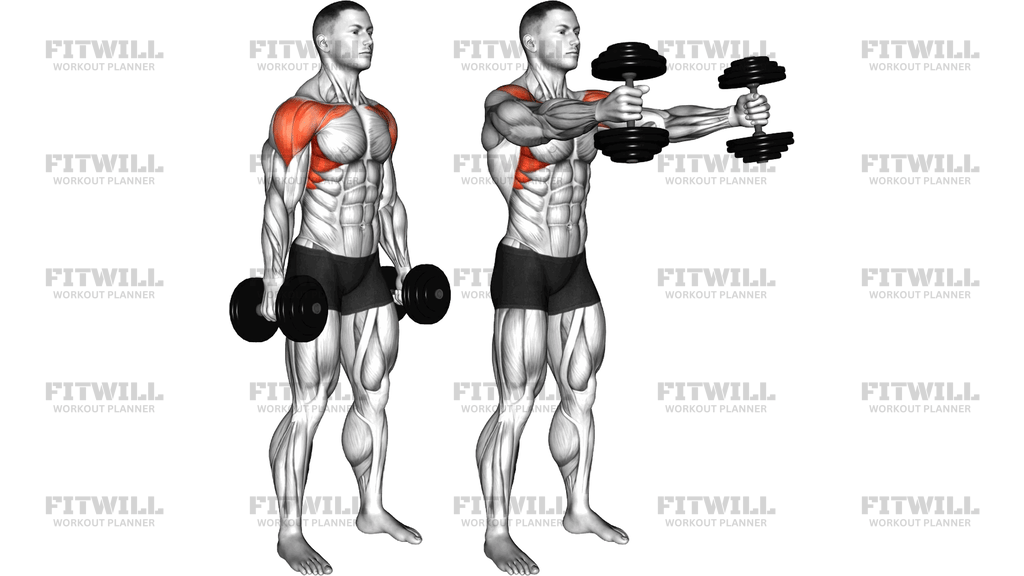
Dumbbell Standing Neutral Grip Front Raises are a straightforward shoulder isolation movement performed with a dumbbell in each hand, palms turned inward so they face each other throughout the lift. From a tall standing position, you raise both dumbbells straight out in front of your body to roughly shoulder height, then lower them back to your thighs under control. The neutral grip is the defining detail here: it sits the shoulder in a more comfortable internal rotation-friendly path than an overhand grip, which many lifters find smoother on the shoulder joint during straight-arm raising.
The main muscle at work is the anterior deltoid, the front portion of the shoulder that lifts the arm forward. Because the arms travel directly ahead of the torso, the clavicular head of the chest assists, and the upper traps help elevate the arm near the top. Your core and lower back work statically the entire time to keep your ribs down and your torso from leaning backward as the weight moves away from your body.
This exercise suits lifters who want to build front shoulder strength and size without loading the shoulder through a rotated position. It is common in physique-focused shoulder days, useful as a warm-up progression before pressing work when done with light dumbbells, and a good option for anyone who finds barbell front raises or overhand-grip variations uncomfortable. Because you are standing with both arms working together, it also exposes left-to-right strength differences quickly.
Setup matters more than it looks. Stand with feet about hip-width apart, dumbbells resting against the fronts of your thighs, and a neutral grip with elbows soft rather than locked. Brace your abdominals and keep your spine neutral before the first rep; if you start loose, the weight will pull your torso backward and turn a shoulder exercise into a low-back test.
Execute the raise by leading with the dumbbells straight up in front of your shoulders, stopping at or just below shoulder height where your arms are parallel to the floor. Pause briefly, then lower slowly back to your thighs. Keep the tempo honest on the way down — most of the cheating in this exercise happens on the return, when lifters let gravity win and the dumbbells drop. Choose a weight you can raise without swinging your hips; this movement rewards discipline far more than it rewards load.
[ Workout Log & Planner ]
Put your next workout in Fitwill
Keep your plan and training log ready when you are.


Instructions
- Stand upright with your feet about hip-width apart, holding a dumbbell in each hand with a neutral grip so your palms face your thighs.
- Let the dumbbells rest against the front of your thighs with your arms extended and elbows slightly soft, not locked.
- Draw your shoulder blades back and down, brace your abdominals, and keep your ribs stacked over your pelvis so your lower back is not arched.
- Inhale, then raise both dumbbells straight out in front of you, keeping your palms facing each other and the weights at shoulder width.
- Continue lifting until your arms are roughly parallel to the floor at shoulder height, with the dumbbells in front of your shoulders rather than above your head.
- Hold the top position for a brief pause without shrugging your shoulders toward your ears.
- Exhale and lower the dumbbells along the same straight path back to the starting position in front of your thighs, taking about twice as long as the lift.
- Stop the descent before the dumbbells swing or touch your legs, keeping light tension in the shoulders.
- Reset your brace and stance between reps if you feel your torso leaning back, then begin the next repetition.
Tips & Tricks
- If your torso rocks backward as the dumbbells rise, the weight is too heavy — drop to a load you can lift with your torso completely still.
- Keep the neutral grip honest: palms should stay facing each other the whole way up, not rotate toward the floor as you lift.
- Stop at shoulder height. Raising the dumbbells higher turns the finish into a trap shrug and pulls tension off the front delts.
- Keep a small bend in your elbows and hold it constant; flexing and extending the elbows turns the raise into a strange front-raise-plus-curl hybrid.
- Keep the dumbbells at shoulder width and travel. Letting them drift inward and clink at the top shortens the leverage and changes the line of pull.
- If your shoulders pinch or grind with a flat overhand front raise, this neutral grip often solves it — but if discomfort persists, reduce range rather than pushing through pain.
- Squeeze your glutes lightly to anchor your pelvis; this makes it much harder to arch your lower back during the lift.
- Use the lowering phase deliberately, around two to three seconds, since the front delts get a large share of their work eccentrically.
- For a warm-up, run one or two light sets of 12 to 15 reps before pressing day; for muscle building, stay in the 8 to 15 range with strict form.
Frequently Asked Questions
Which muscles do Dumbbell Standing Neutral Grip Front Raises work?
The front deltoid is the primary mover, with the clavicular head of the chest assisting as the arm travels forward. The upper traps contribute near the top, and your core stabilizes your torso throughout.
Why use a neutral grip instead of an overhand grip on front raises?
With palms facing each other, the shoulder is not forced into combined internal rotation and elevation, a position where some lifters feel pinching. Most people find the neutral path smoother and more comfortable for straight-arm raising.
Should I raise both dumbbells at the same time or alternate arms?
The standard version shown here raises both arms together, which doubles the demand on your core to stay upright. Alternating is a valid variation, but it changes the stability requirement and lets you rest one side while the other works.
How high should I lift the dumbbells?
Stop when your arms are parallel to the floor at shoulder height. Going higher shifts the work to your upper traps and reduces tension on the front delts without adding benefit.
Are Dumbbell Standing Neutral Grip Front Raises good for beginners?
Yes, the movement pattern is simple and the range is easy to control. Beginners should start with light dumbbells — often 5 to 10 pounds — and focus on keeping the torso completely still before adding load.
Why does my lower back feel this exercise?
The dumbbells pull forward away from your body, and if your core is loose your torso leans back to compensate, loading the lower back. Brace your abdominals, squeeze your glutes, and reduce the weight if you notice your chest lifting toward the ceiling.
What can I use if I do not have dumbbells?
A barbell plate held with both hands, a kettlebell held by the horns, or a resistance band anchored under your feet all replicate the forward raise. Cables also work well and keep tension at the bottom of the rep.
How is this different from a lateral raise?
A front raise lifts your arms directly ahead of your shoulders and targets the anterior deltoid, while a lateral raise moves your arms out to the sides and targets the side delts. They complement each other rather than replace one another.
Is it safe to do front raises every shoulder workout?
Your front delts already get heavy work from overhead and flat pressing, so two direct front raise sessions per week is plenty for most lifters. If your shoulders ache after pressing days, treat this as an accessory and keep the volume modest.