Bodyweight Standing Good Morning
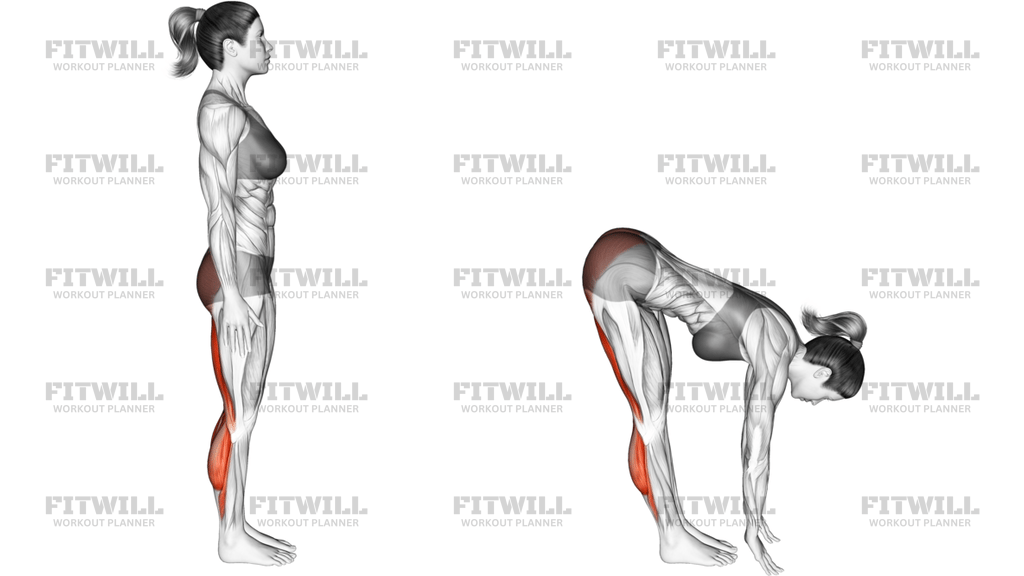
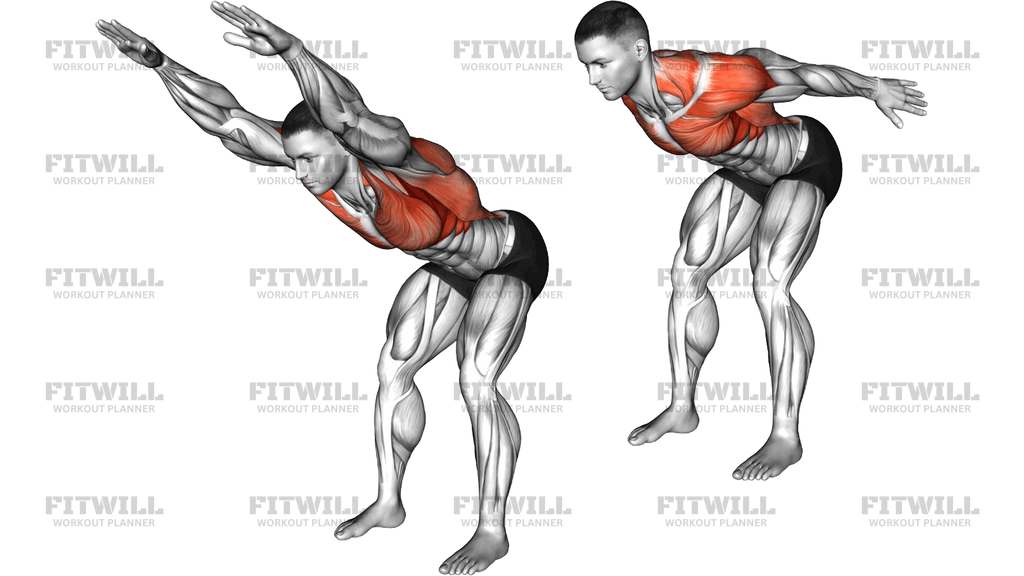
The Bodyweight Standing Good Morning is a hip hinge performed without any external load. You stand tall, place your hands on your lower back or hips for feedback, then push your hips backward and fold your torso forward until you feel a strong stretch through the hamstrings, before driving the hips forward to return upright. The name comes from the bowing motion, which resembles a polite greeting, and the bodyweight version keeps all the hinge benefits while removing the spinal load of the barbell variation.
This movement is useful for almost anyone who wants a stronger, healthier hip hinge. Beginners use it to learn the mechanics they will later apply to deadlifts, barbell good mornings, kettlebell swings, and bent-over rows. Desk workers with stiff hips and dormant glutes benefit from the repeated lengthening of the hamstrings. Lifters also use it as a low-fatigue warm-up or as a maintenance movement on days when heavy loading is not appropriate.
The primary work comes from the hamstrings and glutes, which control the descent and drive the return. The erector spinae in the lower back work isometrically to hold the spine in a neutral position as the torso tilts forward, which is what makes this a genuine back and posterior chain exercise rather than just a hamstring stretch. Because your hands rest on the lower back, you get instant tactile feedback about whether your spine is holding its shape.
Setup matters more than it looks. Feet about hip-width apart, weight spread across the whole foot, knees softly bent, and the pelvis in neutral all determine whether the hinge travels through the hips or leaks into the lumbar spine. A rounded back turns a good posterior chain exercise into unnecessary stress on the spinal discs, so the range should stop wherever your neutral spine ends.
To execute it well, brace the trunk, unhinge slightly at the knees, then push the hips straight back as if closing a door with your backside. Keep the chest proud and the neck in line with the spine as the torso leans forward, stopping around torso-parallel or earlier if your hamstrings or back limit you. Reverse the motion by pressing the hips forward and squeezing the glutes to finish standing tall, not by arching back past vertical.
In practice, treat the Bodyweight Standing Good Morning as a hinge drill, a warm-up primer, or a higher-rep posterior chain finisher. Common mistakes include rounding the lower back, squatting instead of hinging, craning the neck up, and bouncing at the bottom. Move deliberately, breathe out on the way up, and let flexibility, not ambition, set your depth.
[ Workout Log & Planner ]
Put your next workout in Fitwill
Keep your plan and training log ready when you are.


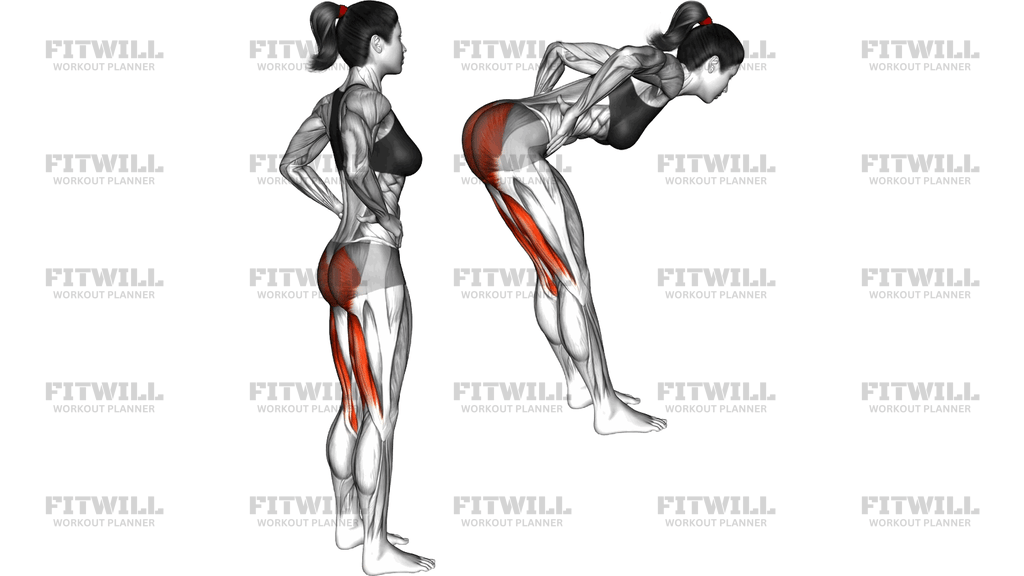
Instructions
- Stand with your feet about hip-width apart, toes pointing forward, and your weight balanced evenly across both feet.
- Place your hands on your lower back with your fingertips resting on either side of the spine, or on your hips if that feels more stable.
- Bend your knees slightly, brace your abdominal muscles, and gently draw your shoulder blades back so your spine starts in a tall, neutral position.
- Inhale, then push your hips straight back behind you while allowing your torso to lean forward from the hips.
- Keep your knees softly bent and your chest open as you lower your torso, maintaining the same neutral spine position you started with.
- Stop when your torso reaches roughly parallel to the floor or when you feel a firm stretch in your hamstrings and your back begins to round.
- Exhale and drive your hips forward, pushing through the floor to bring your torso back up to standing.
- Finish the rep by squeezing your glutes at the top without leaning backward past vertical.
- Reset your brace at the top, then repeat for the desired number of repetitions, keeping the tempo slow and controlled throughout.
Tips & Tricks
- If you are unsure whether you are hinging correctly, stand a few inches from a wall and reach your hips back to touch it — this keeps the hips traveling backward instead of the knees driving forward.
- Rounding in the lower back is the most common fault here; the moment your fingertips feel the spine flatten or round, that is your depth limit for the day.
- Do not turn this into a squat. If your knees keep bending deeper as you descend, reset with only a slight knee bend and focus purely on hip travel.
- Keep your neck in line with your spine. Craning up to look forward compresses the neck and usually rounds the upper back at the same time.
- A slight bend in the knees is correct, but the hips should travel the farthest. If your torso barely leans forward, you are moving through the knees, not the hips.
- Pause for a full second at the bottom instead of bouncing out of the stretch — the controlled stop builds hamstring and glute control better than speed.
- At the top, finish by squeezing the glutes to a tall stand, but do not hyperextend or thrust the hips past neutral.
- If your hamstrings limit you well before your torso is parallel, that is normal. The range improves gradually with consistent practice.
- Barefoot or in flat shoes works best, as cushioned running shoes can make balancing the hinge on your midfoot harder.
Frequently Asked Questions
What muscles does the Bodyweight Standing Good Morning work?
The hamstrings and glutes do most of the work, controlling the hinge and powering the return. The lower back muscles, mainly the erector spinae, hold the spine neutral isometrically throughout the movement.
Is the Bodyweight Standing Good Morning safe for beginners?
Yes, and it is actually one of the best ways for a beginner to learn the hip hinge before adding load. Start with a modest range and stop the moment your lower back starts to round.
How far forward should my torso go in the Bodyweight Standing Good Morning?
Aim for roughly torso-parallel to the floor, but only as far as you can keep a neutral spine and flat lower back. Depth is personal and depends on your hamstring flexibility.
Why do I put my hands on my lower back during this exercise?
Your hands act as a real-time feedback tool. They let you feel whether your spine stays neutral or starts to round as you hinge, which is hard to sense without them when you are learning.
How is this different from a Romanian deadlift?
Both are hip hinges, but the Bodyweight Standing Good Morning uses no load and places your hands on your back or hips for feedback instead of holding weight in front of your thighs. It is typically used as a learning drill, warm-up, or high-rep accessory.
Should my knees stay straight during the Bodyweight Standing Good Morning?
No, keep a soft, slight bend in the knees the whole time. Fully locked knees reduce your ability to sit the hips back and can strain the hamstrings at their attachment near the pelvis.
My lower back rounds at the bottom — how do I fix it?
Reduce your depth to the point just before the rounding starts, and keep bracing your abs as if bracing for a light push to the stomach. Over time your hamstring flexibility will improve and the range will grow without rounding.
Can I do the Bodyweight Standing Good Morning if I have lower back discomfort?
Check with a qualified professional first. If cleared, keep the range shallow, move slowly, and stop any rep where you feel anything more than muscle effort in the hamstrings and glutes.
How many reps should I do of this exercise?
Since there is no external load, it works well for 10 to 15 controlled repetitions as a warm-up hinge drill, or 15 to 20 slower reps as a posterior chain finisher.
What can I use instead if I cannot hinge comfortably while standing?
Try a hip hinge against a wall or a seated good morning on a bench, both of which reduce balance demands. Once the pattern feels natural, progress back to the standing version.