Cable Lying Bench Single Leg Curl
The Cable Lying Bench Single Leg Curl is a unilateral hamstring isolation exercise performed face down on a flat bench, with an ankle strap attached to the working leg and connected to the low pulley of a cable machine. Because the cable provides continuous tension through the entire range of motion, the hamstrings stay loaded even at the point where the leg is nearly straight, which is where many machine-based leg curls go slack.
This movement primarily targets the hamstrings, with the two knee-flexing heads doing most of the work as you pull your heel toward your glutes. The calves assist, especially the gastrocnemius, which crosses the knee joint, and the glutes work lightly to keep the hip pinned down against the pull of the cable. Working one leg at a time exposes and helps correct left-to-right strength differences, which is useful for runners, cyclists, and anyone rehabbing a minor imbalance.
The setup matters more than people expect. Your hips should rest right at the edge of the bench so the working leg can move freely through its full arc, and the non-working leg can bend with that foot on the floor for stability. Position the bench far enough from the pulley that the cable pulls your ankle back toward the machine, roughly in line with or slightly behind your hip. If you sit too close or too far, the resistance direction changes and the exercise stops feeling like a clean knee flexion.
To perform it well, think of driving the heel up and back in a smooth arc while keeping your hips and torso glued to the bench. The temptation is to lift the chest or rock the pelvis to cheat the weight up; resist that, because it shifts work away from the hamstrings. Pause briefly at the top, then lower with control, resisting the cable all the way back to a straight knee. The eccentric portion is where a lot of the hamstring development happens, so don't let the stack snap your leg down.
This exercise fits well as an accessory after squats or deadlifts, as a finishing movement on a leg day, or as a substitute when the lying leg curl machine at your gym is occupied. Since the ankle strap and cable allow a natural, unrestricted arc, many lifters find it more joint-friendly than fixed leg curl machines. Start lighter than you think you need, keep the reps strict, and build up gradually.
[ Workout Log & Planner ]
Put your next workout in Fitwill
Keep your plan and training log ready when you are.


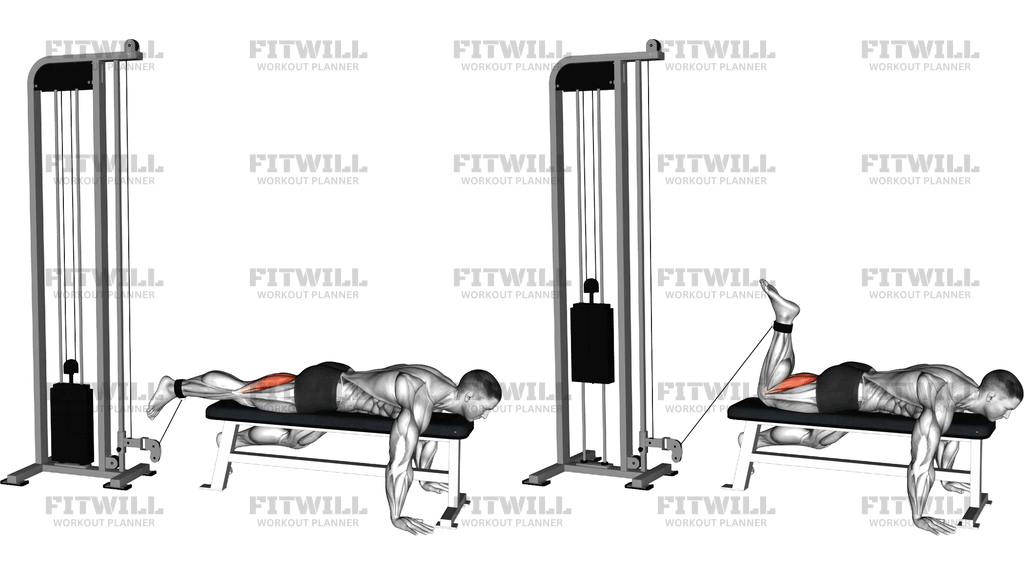
Instructions
- Attach an ankle strap to one leg and connect it to the low pulley of a cable machine.
- Place a flat bench so it faces away from the machine, far enough back that the cable pulls your ankle at a slight backward angle toward the pulley.
- Lie face down with your hips at the edge of the bench, your working leg extended straight off the end, and the other leg bent with its foot on the floor for support.
- Grip the sides of the bench or the bench legs with your hands and brace your core so your hips stay in contact with the pad.
- Exhale and curl your heel up toward your glutes in a smooth arc, keeping the knee pointing down into the bench.
- Squeeze the hamstring hard at the top and hold the contraction for a beat.
- Inhale and lower your leg slowly back to a straight knee, resisting the cable the entire way down.
- Complete all reps on one leg, then unclip and switch the strap to the other leg.
- Reset your hip position on the bench between sets so the cable angle stays consistent.
Tips & Tricks
- If your hip lifts off the bench as you curl, the weight is too heavy or you are initiating with the lower back instead of the hamstring. Drop the load and think about pressing the hip down into the pad.
- Keep the strap around the ankle, not the foot. A strap that sits across the arch turns the movement into a calf- or foot-driven pull and shortens the hamstring range.
- Avoid letting the knee drift forward off the bench at the top of the rep; that tilts the pelvis and steals tension from the hamstrings.
- Do not fully relax the leg at the bottom between reps. Stopping just short of total slack keeps the muscle under tension and protects the knee from a sudden jerk.
- Because each leg has its own cable path, check your distance from the pulley before every set. Even a small change in bench position noticeably alters where the resistance feels hardest.
- If your calf cramps, you are pointing the toes aggressively. Keep the ankle relatively neutral or slightly dorsiflexed so the hamstring does the curling.
- Use a slower lowering phase than lifting phase, aiming for roughly two to three seconds on the way down to load the eccentric properly.
- Curl the non-working foot into the floor for balance. A planted support leg stops the whole body from sliding toward the machine under cable tension.
Frequently Asked Questions
Which muscles does the Cable Lying Bench Single Leg Curl work?
The hamstrings are the prime movers, especially the biceps femoris on the outside of the thigh. The calves assist with knee flexion, and the glutes work isometrically to hold the hip down against the cable pull.
Why use an ankle strap and cable instead of a leg curl machine?
The cable keeps tension on the hamstring through the entire arc, including when the knee is nearly straight, and it lets the leg follow its natural curve rather than a fixed machine path. Many lifters find this more comfortable on the knee.
How should I position the bench relative to the cable machine?
Set the bench a short distance from the low pulley so the cable pulls your ankle slightly behind your hip. If the cable pulls too much toward your head or too far past your feet, adjust the bench position before adding weight.
Why do one leg at a time instead of both legs?
Single-leg work reveals side-to-side strength differences and forces each hamstring to do its full share of the work. It also makes it easier to focus on the feel of the contraction in one hamstring at a time.
What is the most common mistake in the Cable Lying Bench Single Leg Curl?
Hitching the hip off the bench to help lift the weight. This turns the exercise into a hip extension pattern and reduces hamstring tension, so keep the pelvis pinned to the pad and use a lighter load if needed.
Can beginners do this exercise?
Yes, as long as they start with a light weight stack selection and focus on controlling the lowering phase. The setup takes a little practice, but the movement pattern itself is simple and low-skill.
Where should the ankle strap sit?
Fasten it snugly around the ankle, just above the ankle bone, not around the middle of the foot. A strap on the foot shifts effort toward the calf and changes the pull angle.
What can I use if my gym has no ankle strap?
Some cable handles can be looped around the ankle, or you can substitute a lying or seated leg curl machine. A stability ball hamstring curl or Nordic curl also trains a similar pattern with different equipment.
Is it safe for the knees?
When performed with controlled weights and a smooth path, knee flexion against cable resistance is a well-tolerated movement for most people. Keep the motion slow, avoid jerking the stack, and stop if you feel pinching or sharp pain.
How many reps and sets should I do?
Two to three sets of 10 to 15 reps per leg works well as an accessory movement. Because the range is short and the muscle is small, moderate loads with strict form produce better results than heavy, jerky reps.