Rainbow Side Plank
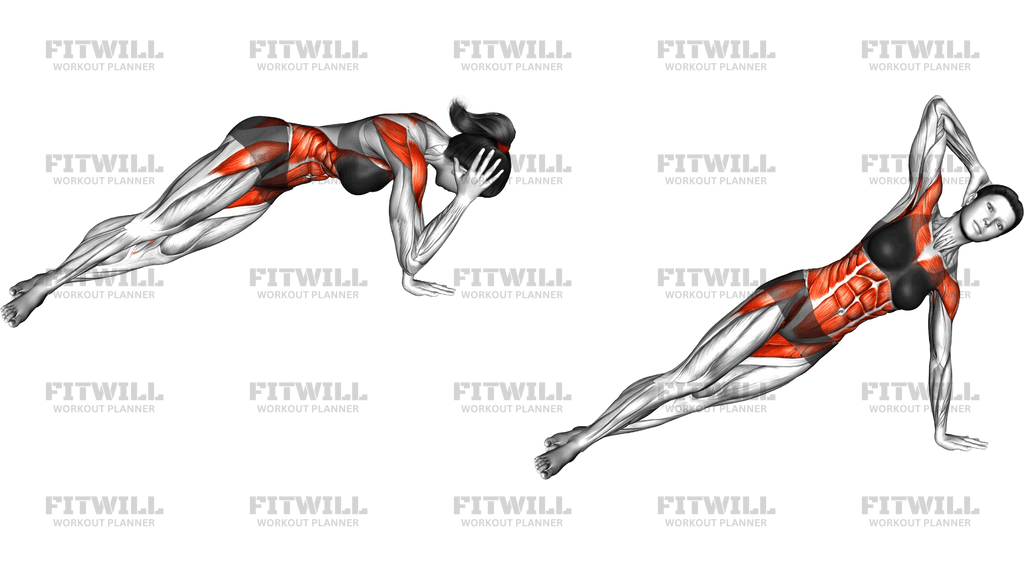
Rainbow Side Plank is a side plank variation that adds a sweeping overhead arc with the free arm, tracing a shape like a rainbow from one side of your body to the other. You hold a side plank on one hand, then reach the top arm up toward the ceiling, continue the arc over your head, and sweep it down toward the floor on the opposite side of your body before reversing the path. The moving arm drives rotation and lateral flexion through the trunk while the plank position stays fixed.
The main work comes from the obliques on the underside of your torso, which fight collapse the entire time. The top-side obliques and quadratus lumborum control the side-bending component of the arc, while the deep core stabilizes the spine against the shifting load of the moving arm. Your support-side shoulder takes on serious demand as well, since you are bracing on a straight arm through a long lever, and the glutes and outer hip keep the pelvis lifted and squared.
This movement suits lifters and general trainees who already own a solid static side plank and want to progress into anti-rotation and moving-load core work. It shows up in calisthenics conditioning, athletic training for sports that demand trunk control under momentum, and general core sessions where you want a challenge that does not require equipment beyond a mat.
Setup quality decides whether this exercise trains your core or your patience. Plant the support hand directly under the shoulder with fingers spread, stack the feet, and push the floor away so the bottom shoulder does not sink toward the ear. If your base is narrow or your hand drifts out of line, every arc of the arm sends wobble through the whole chain and the intended oblique tension disappears.
To execute it well, build the plank first, then move only the arm. Sweep it in a smooth semicircle overhead and down toward the mat on your far side, keeping the torso as still as you can while the ribs resist flaring. Reverse the arc with the same control. The temptation is to rush and let the hips sag or rotate; slower reps with a stable pelvis produce far more oblique demand than fast, loose ones.
A practical safety note: if your wrist or shoulder on the support side complains, drop to a forearm side plank version or reduce reps before forcing through discomfort. Keep the neck neutral by looking straight ahead rather than craning up at the moving hand, and stop the set as soon as the hips begin to drift downward in a way you cannot correct.
Fitwill
Log Workouts, Track Progress & Build Strength.
Achieve more with Fitwill: explore over 9600 exercises with images and videos, access built-in and custom workouts, perfect for both gym and home sessions, and see real results.
Start your journey. Download today!




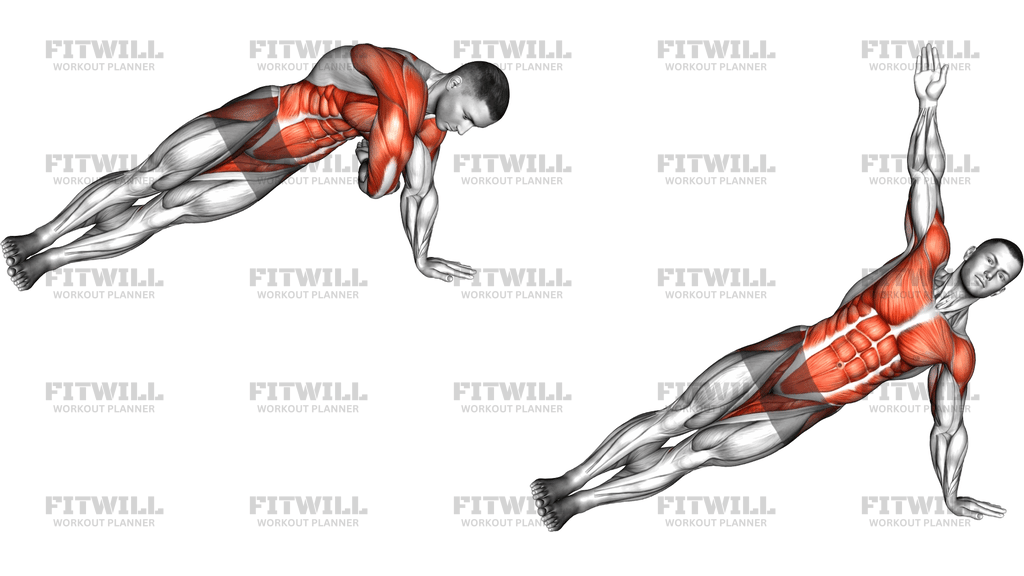
Instructions
- Place an exercise mat on the floor and sit on your right hip with your legs extended and stacked, your right hand planted on the mat under your right shoulder with fingers spread wide.
- Press through the right hand and the edges of your feet to lift your hips into a straight side plank, forming one line from heels to head, with your left arm resting along your left side.
- Brace your abs and squeeze your glutes so the pelvis stays level and does not tip forward or back.
- Extend your top arm straight up toward the ceiling so it is stacked over the support shoulder, palm facing forward.
- Sweep the raised arm in a smooth arc overhead and down toward the mat behind your head, tracing a rainbow shape across your body until your fingers point toward the floor on the opposite side.
- Keep your torso and hips facing forward and resist any twisting or sagging as the arm passes overhead.
- Reverse the arc with the same control, bringing the arm back up to the stacked position above your shoulder.
- Exhale as the arm sweeps down and away, inhale as it returns to the top.
- Complete the target repetitions on this side, lower your hips to the mat with control, then switch to the left hand and repeat on the other side.
Tips & Tricks
- If your hips sag the moment the arm goes overhead, shorten the arc and stop at the top third of the rainbow until your obliques can hold the pelvis through the full sweep.
- Spread the fingers of the support hand and actively grip the mat; a collapsed palm under a straight arm is the most common source of wrist strain in this exercise.
- Keep a soft micro-bend in the support elbow rather than locking it hard, which reduces joint stress without changing the plank position.
- Do not let the top arm lead the torso; the ribs and hips should stay square to the front while only the arm travels.
- If the straight-arm version irritates your shoulder, perform the same rainbow sweep from a forearm side plank, which keeps the arc but halves the shoulder demand.
- Avoid craning the neck to follow the hand; fix your gaze straight ahead so the cervical spine stays neutral through the arc.
- Stack the feet or stagger the top foot slightly in front for extra balance; do not let the bottom hip drift backward as the arm passes overhead.
- Film yourself from the front once: most people discover their hips drop on the down-sweep long before they feel it happening.
- Slow the return half of the arc deliberately, since the eccentric sweep back up is where form usually breaks and where the obliques get the most control work.
Frequently Asked Questions
What muscles does the Rainbow Side Plank work?
The obliques on the underside of the torso do the primary stabilizing work, with help from the deep core and the quadratus lumborum on the moving side. The support-side shoulder and the glutes and outer hips also work hard to hold the plank position.
Is the Rainbow Side Plank suitable for beginners?
It is a step up from a static side plank, so beginners should first hold a solid side plank for 20-30 seconds per side. Once that is comfortable, a forearm version with a shortened arm arc is a good entry point.
Why does my support wrist hurt during the Rainbow Side Plank?
The straight-arm base loads the wrist with your full upper-body weight while the moving arm shifts pressure around. Spread your fingers, press the whole palm into the mat, or switch to a forearm side plank to take the wrist out of the equation.
How far should my arm travel on the rainbow sweep?
The full version sweeps from stacked over the shoulder, overhead, and down toward the mat on the far side. If your hips twist or sag at any point in that arc, stop the sweep where the loss of position starts and build the range gradually.
Should I stack my feet or stagger them?
Stacked feet make the exercise harder for balance and load the outer hip more, while a slight stagger of the top foot gives a wider base. Start staggered if you wobble, then progress to stacked as your stability improves.
How is the Rainbow Side Plank different from a regular side plank?
A regular side plank is a static hold, while the Rainbow Side Plank adds a moving arm that challenges your trunk to resist rotation and side-bending through a changing position. That makes it more demanding on the obliques and the support shoulder.
Can I do the Rainbow Side Plank every day?
Because it is body weight and moderate in intensity, frequent practice is possible, but the shoulder and obliques still need recovery like any muscle. Two to four core sessions per week with at least a day between harder sessions is a sensible rhythm.
What should I do if I cannot hold a straight side plank yet?
Build the base first with bent-knee side planks or forearm side planks, then add the arm arc only when you can hold a full straight plank with steady hips. Skipping the progression usually leads to sagging hips and little oblique benefit.
How many repetitions should I aim for?
Start with 5-8 slow, controlled arcs per side, focusing on keeping the pelvis perfectly still. Add reps only when the full range looks as clean as your first rep.