Dumbbell Standing Neutral Grip To Pronated Grip Fr
The Dumbbell Standing Neutral Grip To Pronated Grip Front Raise is a front raise variation where you start each rep with your palms facing your thighs and rotate your hands to a palms-down, pronated position as the dumbbells travel up in front of your body. That rotation is the whole point of the movement: it changes how the shoulder and forearm line up at the top and forces the front delts to work through a slightly different path than a standard fixed-grip front raise.
This lift primarily trains the front delts, with support from the side delts, the upper fibers of the chest near the shoulder, the upper traps, and the forearms, which work hard to control the dumbbells while the wrists turn. Because you are standing, your legs, glutes, and core also stay busy keeping your torso upright and preventing the swing that makes lighter front raises sloppy.
The grip rotation makes this version useful for lifters who feel shoulder pinching with a fully pronated grip from the bottom, since the neutral start position tends to be more comfortable at the hang. It also adds a controlled forearm and wrist element that a regular front raise does not have, which makes it a good choice for anyone who wants more variety in shoulder accessory work without adding new equipment.
Setup matters more than it looks. Stand tall with feet about hip-width apart, a dumbbell in each hand at your sides, and a neutral grip with palms facing in. Brace your abs, pull your shoulder blades back and down, and keep a soft bend in the knees so your lower back is not doing the stabilizing. If you start rounded or leaning back, every rep that follows gets worse.
To execute it well, raise both dumbbells forward and up to roughly shoulder height while turning your palms from facing in to facing down, leading with your elbows rather than your hands. Pause briefly at the top with the arms close to parallel to the floor, then lower the dumbbells under control, rotating back to the neutral grip as your hands pass hip level. The lowering half should take about as long as the lift, not a free fall.
You will see this movement used as a shoulder accessory after presses, as a targeted front delt builder on shoulder day, or as a higher-rep finisher when the delts are already fatigued. Keep the weight moderate, since front raises punish ego lifting with momentum, and stop the set when your torso starts rocking or your elbows drop below the level of the dumbbells.
[ Workout Log & Planner ]
Put your next workout in Fitwill
Keep your plan and training log ready when you are.


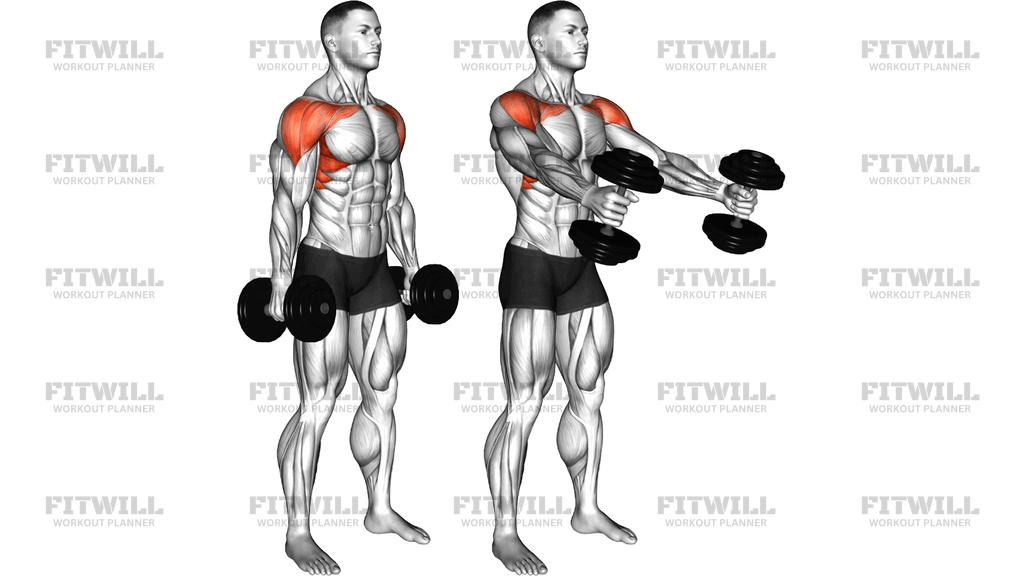
Instructions
- Stand upright with your feet about hip-width apart, holding a dumbbell in each hand at your sides with a neutral grip, palms facing your thighs.
- Pull your shoulder blades back and down, brace your abdominal muscles, and keep a slight bend in your knees so your torso stays stacked over your hips.
- Let your arms hang straight down with a small, permanent bend in the elbows before the first rep begins.
- Breathe in, then raise both dumbbells straight out in front of your body, leading with your elbows rather than your hands.
- As the dumbbells climb past hip level, rotate your wrists from the neutral position so your palms face the floor by the time your arms reach shoulder height.
- Stop at the top with your arms roughly parallel to the floor and the dumbbells in front of your shoulders, not higher than eye level.
- Pause for a beat at the top without shrugging your shoulders up toward your ears.
- Exhale as you lower the dumbbells slowly along the same path, rotating your wrists back to the neutral grip as your hands approach your thighs.
- Reset your posture briefly between reps so your lower back and traps stay out of the movement.
- Complete the set standing still, then set the dumbbells down with a bend in your knees rather than rounding over to reach the floor.
Tips & Tricks
- The most common mistake is turning this into a swing: if the dumbbells kick up with body English, drop the weight by a pair until you can lift them with the shoulders alone.
- Rotate the wrists during the lift, not before it. Starting with palms already down defeats the neutral-grip start and can feel pinchy at the bottom for some shoulders.
- Keep the elbows slightly bent and fixed; straightening and re-bending the arm each rep turns the set into a half front raise and half dumbbell curl.
- Stop at shoulder height. Raising the dumbbells toward the ceiling shifts the work to the upper traps and pulls you out of the front delt focus.
- If your wrists ache at the top, hold the dumbbells a little deeper in the hand so the handle sits against the base of the fingers instead of mid-palm.
- Do not let the dumbbells clang together at the top; keeping a few inches between them keeps tension on the front delts instead of resting at the lockout.
- Squeeze your glutes lightly during the set. It locks the pelvis down and makes cheating with a lower back arch much harder.
- When your grip starts failing before your shoulders, finish the set with single-arm raises holding one dumbbell so the tired forearms get a brief stagger.
- Front raises overlap with overhead pressing, so program this movement after your presses on shoulder day rather than before them.
Frequently Asked Questions
Which muscles does the Dumbbell Standing Neutral Grip To Pronated Grip Front Raise work?
The front delts do most of the lifting, with the side delts, upper chest fibers, and upper traps assisting. The forearms and grip stay active throughout because the wrists rotate from neutral to pronated during each rep.
Why rotate from a neutral grip to a pronated grip instead of keeping the palms down the whole time?
Starting with palms facing the thighs is often more comfortable at the hang and lets the shoulder settle into a friendlier position at the bottom. The rotation to palms-down at the top changes the working path and adds a wrist and forearm control element that a fixed-grip front raise lacks.
Is this exercise suitable for beginners?
Yes, as long as the weight is light enough to lift without swinging. Beginners should practice the wrist rotation slowly with very light dumbbells for a set or two before adding load.
How high should I raise the dumbbells?
Raise them to about shoulder height, where your arms are roughly parallel to the floor. Going higher mostly recruits the upper traps and reduces the emphasis on the front delts.
Should I raise both arms together or one at a time?
The standard version raises both dumbbells together, as shown in the movement. Alternating arms is a fine variation when your grip fatigues or you want to focus on one side at a time.
What is the most common mistake with this front raise variation?
Using momentum from the hips and lower back. Because the wrists rotate mid-rep, many lifters rush the turn and flick the dumbbells up; slow the rotation down and let the front delts drive the whole lift.
What can I substitute if I do not have dumbbells?
A barbell front raise or a cable front raise with a straight bar covers the same front delt pattern, though the independent wrist rotation of the dumbbell version is harder to copy with a bar.
How many sets and reps should I do?
Because this is an accessory movement, two to four sets of 10 to 15 controlled reps works well for most lifters. Use a weight you could lift for a few more reps than your target without breaking form.
Is it safe for my shoulders?
For most people, yes, when the weight is moderate and the arms stay at or below shoulder height. If you feel pinching at the top, lower the end range slightly and make sure you are not shrugging, and stop the exercise if sharp pain occurs.
Should I do this exercise before or after overhead pressing?
Do it after your presses. Front raises fatigue the same front delts you need for pressing, so saving this movement for later in the session protects your main lifts.