Kettlebell Bent Over Spinal Rotation
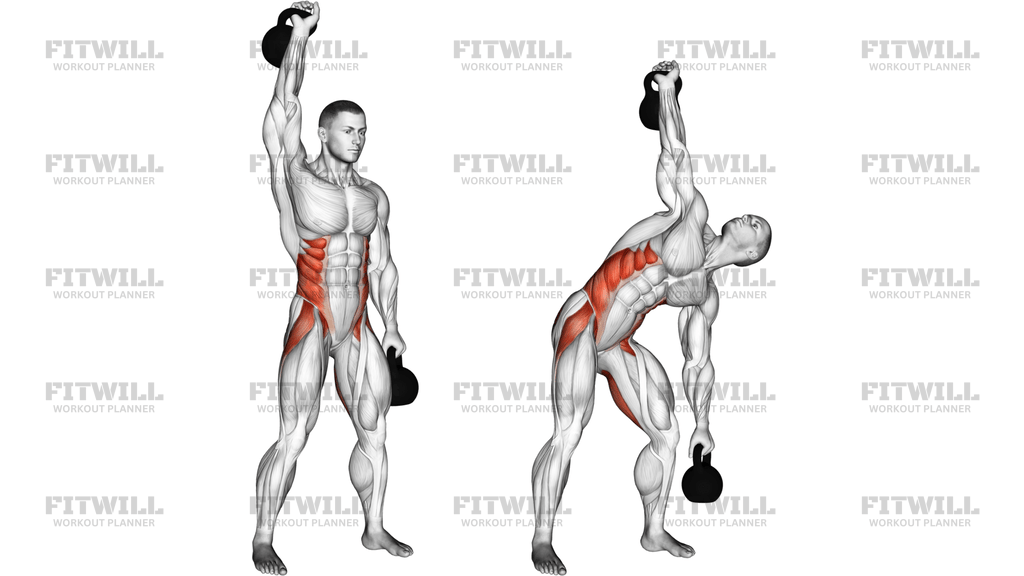
The Kettlebell Bent Over Spinal Rotation is a rotational core exercise performed from a hip hinge. You hold a kettlebell with both hands and let your arms hang straight down while you hinge forward at the hips with a flat back and soft knees. From there, you rotate your shoulders and upper body from side to side, letting the kettlebell swing across your body with each turn, while your hips and lower body stay as still as possible.
This movement trains the obliques hard, but it also challenges everything that has to resist or control rotation: the deep core muscles, the erector spinae along the lower back, and the muscles of the mid and upper back that hold your torso in the hinged position. Because the kettlebell creates a long lever at the end of your arms, the rotational demand is much greater than bodyweight twists, so the grip and forearms work as well.
The setup matters more than in most core exercises. Your spine's position during the hinge determines whether the rotation goes through your thoracic spine and obliques, as intended, or gets dumped into your lumbar spine, which is not built for heavy twisting under load. Before you start, set the hinge first: push your hips back, keep your chest angled toward the floor, brace your abdominals like you are about to be tapped on the stomach, and only then begin the rotation.
To execute the movement well, think of the turn coming from your ribcage and shoulders rather than from your arms. Your arms stay long and act like ropes attached to the kettlebell; the sweeping path of the weight toward one side and then the other is simply the result of your torso rotating. Move deliberately through the middle position instead of rushing past it, because that midpoint is where momentum tries to pull your lower back into a twist.
This exercise fits well into core circuits, athletic training blocks, and kettlebell complexes. It is especially useful for anyone who needs controlled rotational strength — throwing athletes, martial artists, racket sport players — and for lifters who want to reinforce the ability to hold a hinge while something is pulling them out of position. Because the obliques and lower back are highlighted throughout, it also serves as a teaching tool for bracing under rotation.
Keep the load modest when you learn the pattern. A kettlebell you can swing comfortably with one hand is usually more than enough when held with both hands at arm's length. If you feel the movement grinding in your lower back, or your hinge collapses as you rotate, the weight is too heavy or your range is too wide — shorten the turn and re-brace before each repetition.
[ Workout Log & Planner ]
Put your next workout in Fitwill
Keep your plan and training log ready when you are.


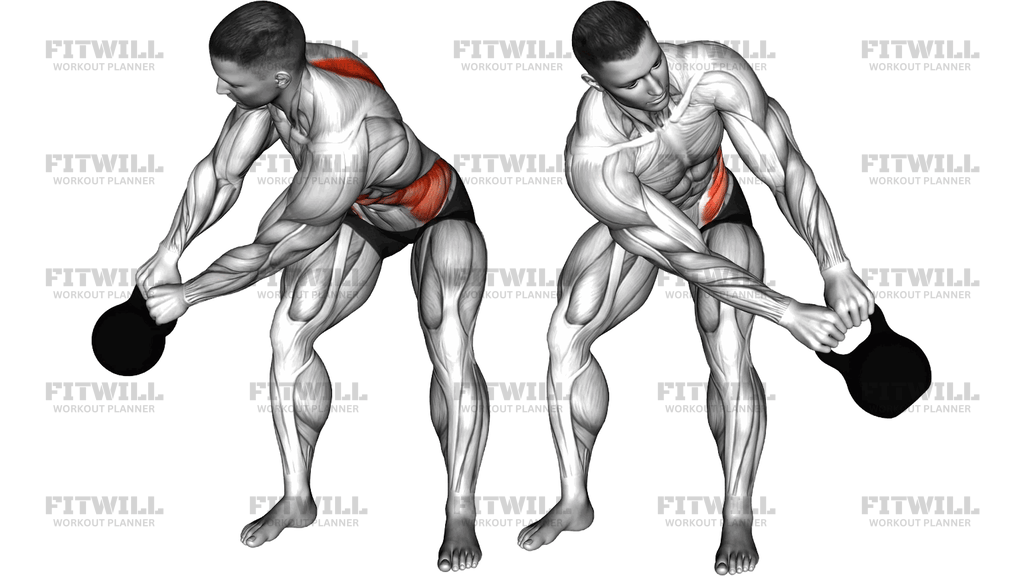
Instructions
- Stand with your feet about hip-width apart and hold a kettlebell by the handle with both hands, palms facing your body.
- Push your hips back into a hip hinge with your knees softly bent, lowering your chest until your torso is angled toward the floor and your arms hang straight down holding the kettlebell beneath your shoulders.
- Keep your back flat and long, pull your shoulder blades gently back, and brace your abdominals before any rotation begins.
- Rotate your shoulders and ribcage to the right, letting the kettlebell sweep across your body toward the right side while your arms stay extended.
- Control the weight back through the center and continue rotating to the left, allowing the kettlebell to travel toward the left side with the same arm position.
- Keep your hips, knees, and feet pointing forward and largely unchanged — the turning happens in your upper body, not your pelvis.
- Exhale as you rotate to each side and inhale as the kettlebell passes back through the middle.
- Complete all repetitions on one side, or alternate side to side, then set the kettlebell down on the floor by hinging at the hips rather than rounding your back.
Tips & Tricks
- The most common failure point is turning from the pelvis instead of the ribcage — if your feet or knees rotate with each rep, picture your hips bolted to the floor and let only your upper body turn.
- Rounding the back is a sign the hinge was never set. Reset by pushing your hips further back and lifting your chest slightly before you rotate.
- A kettlebell that is too heavy turns this into a momentum-driven swing where your lower back absorbs the whip. Drop the load until you can pause briefly at each end of the turn.
- Keep your arms long and relaxed; if your elbows bend and your shoulders start doing the work, the obliques stop driving the rotation.
- Do not twist your neck to chase the kettlebell — let your head travel with your shoulders and keep your eyes on the weight with a soft gaze.
- Speeding through the center position is where backs get irritated. Slow down as the kettlebell crosses the middle so your braced core, not momentum, controls the weight.
- Widen your stance slightly or turn your toes out a few degrees if you feel unstable; a wider base makes it easier to keep the hips quiet.
- If your grip burns out before your core, chalk your hands or use a lighter bell — the exercise is for rotation, not for a grip contest.
- Place the kettlebell on a stable surface between sets instead of lifting it off the floor with a rounded back to start the next set.
Frequently Asked Questions
What muscles does the Kettlebell Bent Over Spinal Rotation work?
The obliques on the sides of your abdomen do most of the rotational work, supported by the deep core, the erector spinae of the lower back, and the muscles of the upper back that hold the hinged torso position. Your forearms and grip also work to control the kettlebell.
How heavy should the kettlebell be for the Kettlebell Bent Over Spinal Rotation?
Start lighter than you expect — a kettlebell between 8 and 16 kg is enough for most people when held with both hands at arm's length. If your lower back feels torqued or your hinge position collapses during the turn, the weight is too heavy.
Is the rotation supposed to come from the lower back or the upper back?
The turn should come mainly from your ribcage and upper body while your hips stay squared forward. Your lower back contributes by staying braced and stable, not by twisting — chasing range by cranking the lumbar spine is the main mistake with this exercise.
Can beginners do the Kettlebell Bent Over Spinal Rotation?
Yes, provided they can hold a comfortable hip hinge. Beginners should use a light kettlebell, rotate through a smaller arc, and master the braced hinge before widening the range. Bodyweight torso rotations from a hinge are a good first step.
Why do my hips keep rotating during the exercise?
Your hips turn either because the weight is too heavy or because you are trying to generate the movement from the ground up. Dig your toes in, squeeze your glutes lightly, and consciously drive the turn from your shoulders and ribcage.
Should my arms move during the Kettlebell Bent Over Spinal Rotation?
Your arms stay long and travel passively with the rotation, like ropes attached to the kettlebell. If you are bending your elbows or actively swinging the weight, you are turning it into an arm exercise and losing the oblique focus.
What can I substitute if I do not have a kettlebell?
A single dumbbell held with both hands around one end, or a weight plate, gives a similar offset load. You can also do the same hinged rotation with bodyweight or a light band, though you will need to move slower to create enough challenge.
Is it safe to rotate the spine with a load?
When the hinge is set, the core is braced, and the load is controlled, rotational training is a normal part of strength work. Avoid this exercise if you have an active back injury or have been advised to limit loaded twisting, and stop if you feel sharp or localized spinal discomfort.
How many reps and sets should I use for the Kettlebell Bent Over Spinal Rotation?
Two to three sets of 8 to 12 rotations per side works well for controlled rotational strength. Prioritize smooth, deliberate turns over speed — this is one exercise where slower reps feel harder and do more.