Triple Broad Jump
The Triple Broad Jump is a horizontal plyometric exercise where you perform three standing long jumps in a row without pausing between them. Unlike a single broad jump, where you can pour everything into one explosive effort, the triple version forces you to land, absorb force, and immediately reapply it twice more. That landing-to-rebound transition is where most of the training value lives, because it teaches your nervous system to recycle energy quickly instead of letting it bleed away on each contact.
This movement is a staple for athletes in sports that demand horizontal power: sprinters, football and rugby players, jumpers, and field-sport athletes who need to accelerate, decelerate, and re-accelerate in short bursts. It also works well for general lifters who want to build explosive leg strength that carries over to squats, deadlifts, and sprinting. Because each jump loads the quads, glutes, and hamstrings through a rapid stretch-shortening cycle, three consecutive jumps create considerably more demand than one.
Setup matters more than people expect. You need a flat, non-slippery surface with at least six to nine meters of clear runway, since three maximal jumps cover serious ground. Wear supportive athletic shoes, keep the area behind and in front of you free of obstacles, and avoid hard concrete if you are new to plyometrics — a gym floor, rubber track, or turf is much kinder to your ankles and knees.
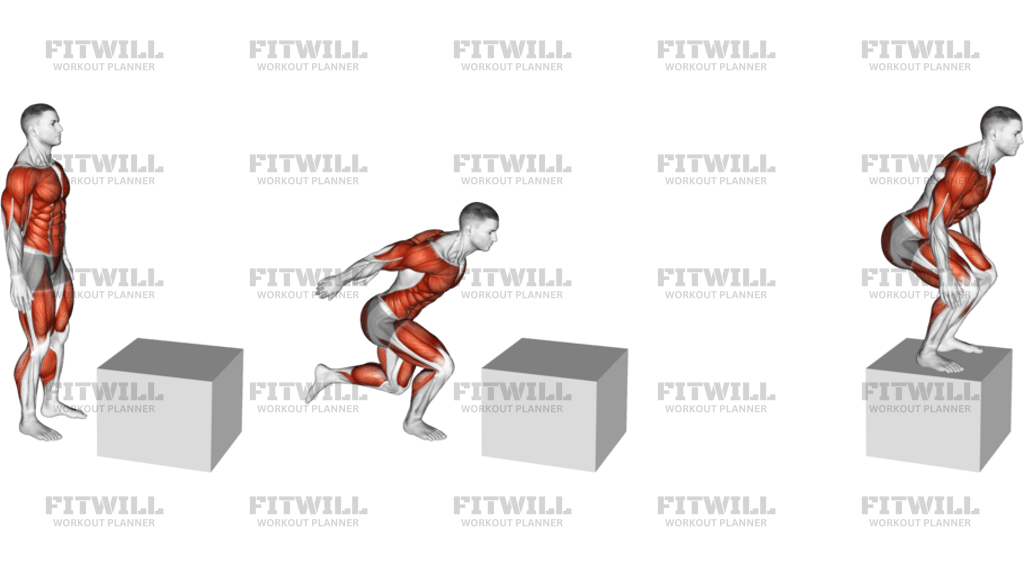
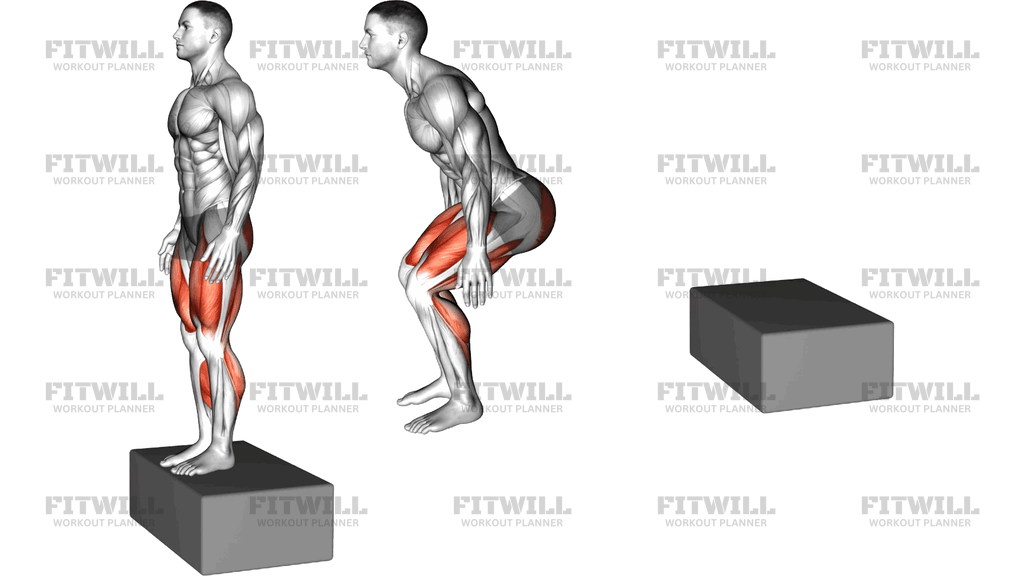
To execute well, drop into a quarter squat, swing your arms back, then drive them forward as you extend your hips and jump as far forward as you can. Land softly in a quarter squat with your weight mid-foot, and without pausing, immediately use that squatted position to launch jump two, then jump three. The arms should swing in rhythm with each jump, reaching forward in flight and swinging back as you load for the next takeoff. Aim to keep each jump close to full distance rather than letting the second and third fade badly.
A few practical points keep this exercise safe. Land with your knees tracking over your toes, chest up, and heels absorbing force rather than stiff-legged slaps into the ground. Stop the set when your jump distance drops noticeably — this is a power exercise, not a conditioning drill, and sloppy late-set landings are where ankle and knee trouble starts. Two to four sets of one triple, with full recovery between sets, is plenty for most trainees.
You can program the Triple Broad Jump at the start of a lower-body session as a nervous system primer before heavy squats or deadlifts, or as a standalone power block on speed days. Beginners can scale it down to a double broad jump or two single jumps with a short reset between them, then progress to the continuous triple as landing mechanics improve.
[ Workout Log & Planner ]
Put your next workout in Fitwill
Keep your plan and training log ready when you are.


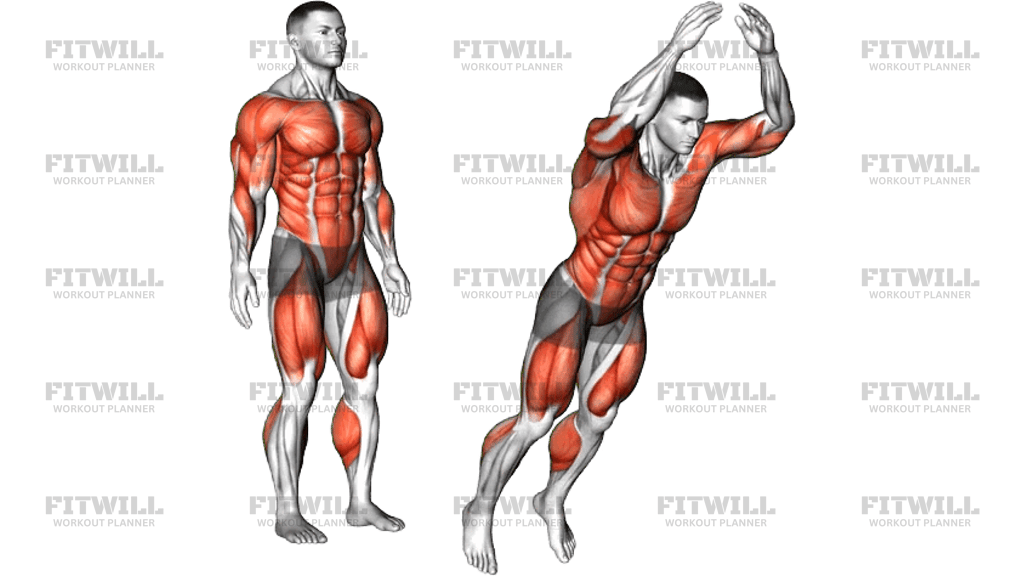
Instructions
- Find a flat, clear runway of at least six to nine meters with a non-slip surface, and stand with your feet about hip-width apart at the start line.
- Set your arms relaxed at your sides and take a breath, then hinge at the hips and knees to drop into a quarter squat while swinging both arms back behind your body.
- Brace your trunk briefly, keep your chest up and your weight spread across the whole foot, and pick a landing spot a few meters ahead.
- Explosively extend your hips, knees, and ankles while swinging your arms forward and upward to launch as far forward as possible.
- In flight, reach your arms up and forward, then prepare to land by pulling your feet out in front and bringing your arms back down.
- Land softly on the balls of your feet and settle into a quarter squat with knees tracking over your toes and your trunk leaning slightly forward over the base.
- Without pausing, rebound straight out of that landing: swing your arms back then forward again and launch jump two for maximum distance, repeating the same landing and rebound for jump three.
- After the third landing, hold the quarter squat for a moment, then stand up fully, exhale, and walk back to the start line.
- Breathe in during the initial load, exhale sharply on each takeoff, and take 60 to 90 seconds or more of rest before your next set of three jumps.
Tips & Tricks
- If your second and third jumps fall off by more than about ten percent of your first jump, cut the set — fading distance usually means you are grinding through fatigue instead of training explosiveness.
- Do not let your knees cave inward on landing; cue yourself to spread the floor slightly with your feet so the knees track over the middle of each foot.
- Avoid landing with straight legs or a stiff, flat-footed slap. Bend the knees and hips as your feet touch so your muscles, not your joints, absorb the impact.
- Swing the arms deliberately on every jump. Weak or late arm swings are one of the most common reasons triple jump distance drops sharply on the second and third effort.
- Keep the trunk leaning slightly forward through the landing and rebound. Standing too upright between jumps kills your forward momentum and forces a longer, weaker re-load.
- Do not pause between jumps. A deliberate stop turns the exercise into three separate broad jumps and removes the reactive rebound that makes the triple version valuable.
- Warm up your ankles and hips first with easy squats, leg swings, and a few sub-maximal single jumps before attempting full-distance triples.
- Train on grass, track, turf, or a rubber gym floor rather than concrete when possible, especially while you are still grooving the landing pattern.
- Choose distance goals you can actually reach. Chasing a spot beyond your ability leads to over-striding on landing, which drives the knees forward and stresses them.
Frequently Asked Questions
What muscles does the Triple Broad Jump work?
The main drivers are the quads and glutes, with strong help from the hamstrings and calves during takeoff and landing. Your core also works hard to hold your trunk stable through three explosive rebounds.
Is the Triple Broad Jump suitable for beginners?
Yes, once you can squat and land comfortably, but start with a single broad jump or a double and focus purely on soft, quiet landings. Add the third continuous jump once your mechanics hold together under two contacts.
How is the Triple Broad Jump different from a single standing broad jump?
A single broad jump lets you give one maximal effort and reset afterward. The triple version forces you to absorb a landing and immediately produce force twice more, which trains reactive strength and the stretch-shortening cycle far more than a one-off jump.
Should I pause between each of the three jumps?
No — the rebound should come straight out of the landing with minimal ground contact time. If you need to reset fully between jumps, you are doing repeated broad jumps, which is a fine exercise but a different stimulus.
Where in my workout should I program the Triple Broad Jump?
Place it early in a lower-body or speed session, ideally before heavy lifting, while your nervous system is fresh. Doing it after fatiguing squats or sprints reduces power output and increases the risk of a sloppy landing.
How many sets and reps should I do?
Two to four sets of one triple, with 60 to 90 seconds or more of rest between sets, works well for most people. Since it is a power exercise, quality and distance matter far more than volume.
The third jump is always much shorter than the first — is that a problem?
Some drop-off is normal, but a big fade usually points to landing too tall, weak arm swings, or pausing on the ground. Sit slightly deeper into each landing and keep the arms driving to preserve distance across all three jumps.
What can I substitute if I do not have room for horizontal jumps?
Three consecutive squat jumps or tuck jumps in place train a similar rebound pattern without needing a runway. If you have a short space, a double broad jump with a small reset is a reasonable compromise.
Are Triple Broad Jumps hard on the knees or ankles?
They place significant force through the knees, ankles, and hips, so landing mechanics decide whether the stress is productive or risky. Land softly in a quarter squat with knees over the toes, use a forgiving surface, and stop the set when your landings get loud or stiff.