Barbell Side Bent Version 2
Barbell Side Bend Version 2 is a loaded lateral-flexion exercise for the side of the waist. With the barbell carried across the upper back, the load stays centered while you bend the torso to one side and use the opposite-side obliques and quadratus lumborum to bring the body back upright.
The exercise targets the obliques, with the abs, lower back, and deep trunk muscles supporting posture. Because the bar sits high across the shoulders, even a light load can feel demanding. The value comes from a smooth side bend and a clean return to standing, not from twisting, bouncing, or forcing a deep range.
Set your feet firmly, place the bar below the neck across the upper back, and stand tall before moving. Bend directly to the side as if your ribs are sliding toward your hip, then return by pulling the ribs away from the hip on the working side. Keep both feet grounded and avoid rotating the shoulders around the spine.
This version fits best as a light to moderate accessory movement in a core or trunk-strength block. It can help build awareness and strength through the side body, but it should not cause sharp lower-back discomfort. Use a conservative range, move slowly, and choose a weight that lets you keep the bar level.
[ Workout Log & Planner ]
Put your next workout in Fitwill
Keep your plan and training log ready when you are.


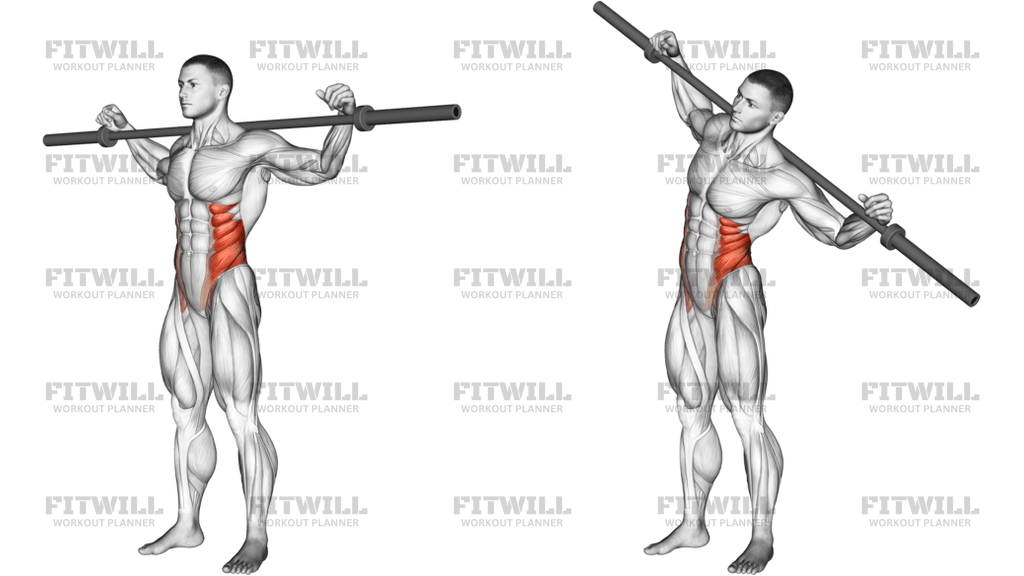
Instructions
- Stand with your feet about shoulder width and the barbell resting across your upper back below the neck.
- Hold the bar with both hands, keep your elbows slightly back, and set your chest tall.
- Brace lightly and keep your pelvis facing forward before you start the side bend.
- Bend your torso directly to one side, letting your ribs move toward that hip without twisting.
- Stop when you feel a controlled stretch through the opposite side of your waist.
- Use the obliques on the stretched side to pull your torso back to upright.
- Pause in the tall position, then repeat to the other side with the same range.
- Keep the bar level and your feet planted for every rep.
Tips & Tricks
- Start lighter than you expect because the bar sits far from the waist and increases the leverage.
- Imagine moving between two panes of glass so the bend stays side to side.
- Keep both heels down; shifting onto one foot can turn the exercise into a hip movement.
- Do not chase a deep stretch if your lower back starts to pinch at the bottom.
- Keep the bar across the shoulders, not the neck, so the head can stay neutral.
- Move slower on the way down than on the way up to avoid collapsing into the side bend.
- Use equal reps and equal range on both sides to keep the trunk work balanced.
- If the bar tilts or rolls, reduce the weight and reset your grip before continuing.
Frequently Asked Questions
What muscles does the Barbell Side Bend target?
It mainly targets the obliques, with support from the quadratus lumborum, abs, and lower back.
Should I hold the bar in my hands or on my back?
This version uses the bar across the upper back, which keeps the load centered while you bend side to side.
How much range should I use?
Use a comfortable range that you can control without twisting or straining your lower back.
Should the barbell be on my back or held in one hand?
For this version, keep the barbell across the upper back. A one-hand side bend is a different variation with the load on one side.
Should I rotate during Barbell Side Bend Version 2?
No. Bend directly to the side and return upright. Rotation reduces the focus on the obliques and can stress the lower back.
Is this a heavy core exercise?
It should usually be light to moderate. The spine is moving laterally, so control and range matter more than load.
Why do I feel one side stretch and the other side work?
As you bend, one side of the waist lengthens while the other shortens. The lengthened side then works to bring you back upright.
What can I use instead of a barbell?
A body bar, dowel, cable side bend, or single-dumbbell side bend can train a similar pattern with easier setup.