Dumbbell Over Bench One-Arm Neutral Wrist Curl
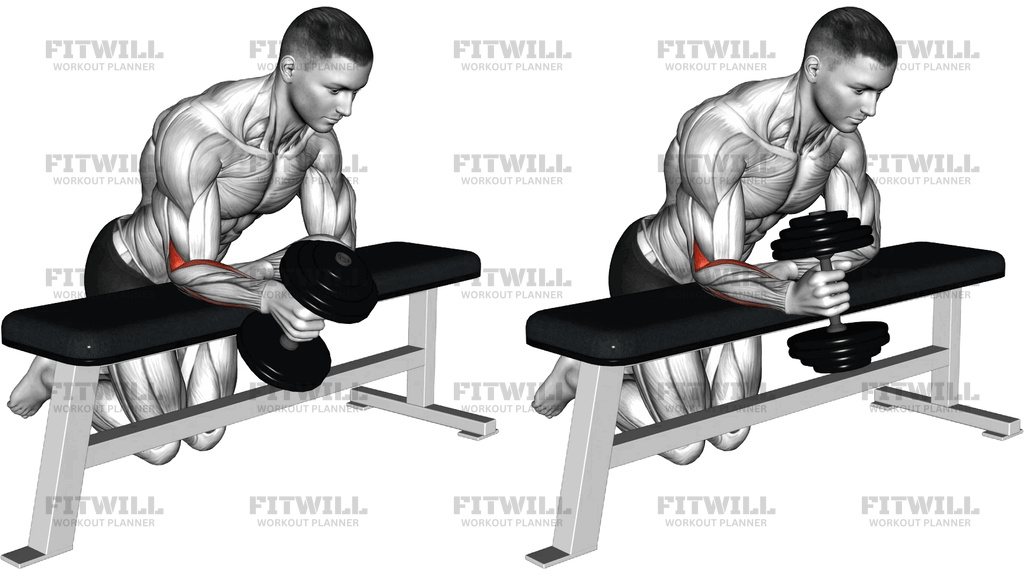
Dumbbell Over Bench One-Arm Neutral Wrist Curl is a single-side forearm exercise where the upper arm and forearm are braced on a bench while the hand works through wrist flexion against a dumbbell. The image shows a kneeling setup with the working forearm supported across the bench and the wrist hanging just off the edge so the dumbbell can move through a short, controlled arc. That support matters: it keeps the shoulder and elbow quiet and forces the forearm muscles to do the work.
This movement is mainly for the wrist flexors and the smaller muscles that help control grip and forearm stability. Because the lever arm is long at the hand, small changes in wrist angle make a big difference in load. A light dumbbell is usually enough. If the elbow lifts, the torso twists, or the dumbbell starts swinging, the set stops being a wrist curl and turns into a body English exercise.
The neutral hand position and the over-bench brace make this a very specific accessory drill. It is useful for building forearm size, improving wrist control for pulling and carrying work, and giving each side a clean, independent range of motion. The goal is not to chase a huge range or maximal weight. The goal is to keep the forearm planted, move only at the wrist, and use the same path on every rep.
A good rep starts from a controlled stretch with the wrist lowered and the dumbbell hanging under the bench edge. Curl the hand upward by closing the wrist, pause briefly near the top, and then lower under control until the forearm muscles are loaded again. The return should be slower than the lift, with the wrist staying in line and the dumbbell never dropping freely.
Use this exercise as a finisher or as part of forearm work when you want direct wrist flexion without full-body fatigue. It is especially useful when you need side-to-side balance in grip or forearm strength. Keep the load modest, the elbow pinned, and the movement smooth so the exercise stays precise and joint-friendly.
[ Workout Log & Planner ]
Put your next workout in Fitwill
Keep your plan and training log ready when you are.


Instructions
- Kneel or stand beside a flat bench and brace the working forearm across the pad with the wrist and hand hanging just off the edge.
- Keep the upper arm and elbow planted so the forearm is supported from the elbow to just before the hand.
- Hold a light dumbbell in a neutral grip and let it hang below the bench edge before the first rep.
- Set the wrist in a controlled stretch without letting the shoulder roll forward or the torso shift.
- Curl the hand upward by flexing the wrist, bringing the dumbbell toward the forearm in a short, clean arc.
- Squeeze briefly at the top while keeping the forearm pressed into the bench.
- Lower the dumbbell slowly until the wrist opens back to the starting stretch.
- Reset the wrist position before each rep and keep the movement strict for the full set.
- Repeat on the other side with the same setup and range of motion.
Tips & Tricks
- Use a lighter dumbbell than you would for a standing curl; the long lever at the hand makes the wrist work much harder than it looks.
- Keep the wrist just beyond the bench edge so the dumbbell can travel freely without the knuckles or plates hitting the pad.
- Do not let the elbow slide or the upper arm lift off the bench when the rep gets hard.
- Move through the wrist only; if the forearm starts rotating or the shoulder joins in, the load is too heavy.
- A brief squeeze at the top helps keep the curl honest and prevents bouncing out of the stretched position.
- Lower the dumbbell under control for a slower eccentric, because that is usually where the forearm gets the most work.
- Keep the grip firm enough to control the dumbbell, but avoid cranking the fingers so hard that the wrist stiffens and stops moving.
- If the bench height forces the shoulder to shrug or the torso to twist, reposition yourself before adding weight.
- Stop the set if you feel sharp pain in the wrist crease or elbow tendon; this should feel like focused forearm effort, not a joint pinch.
Frequently Asked Questions
What muscles does Dumbbell Over Bench One-Arm Neutral Wrist Curl work?
It mainly targets the wrist flexors and the smaller forearm muscles that stabilize the hand during gripping. Your grip and elbow stabilizers help, but the wrist flexion is the main job.
Is Dumbbell Over Bench One-Arm Neutral Wrist Curl beginner-friendly?
Yes, as long as you start with a very light dumbbell and a strict bench-supported setup. The exercise is simple, but the wrist is easy to overload if you rush the load.
Why is the forearm supported on the bench?
The bench removes shoulder and elbow motion so the wrist has to do the work. That makes the exercise more targeted and easier to control rep to rep.
Should the dumbbell hang below the edge of the bench?
Yes. Letting the hand hang slightly off the edge gives the wrist room to flex and extend through a clean, controlled arc.
How heavy should I use?
Use a weight that allows a slow lowering phase and a pause at the top without the forearm leaving the bench or the wrist jerking.
What is the most common mistake?
The biggest mistake is turning it into a shoulder or elbow movement. If the torso rocks or the elbow lifts, the dumbbell is too heavy.
Can I do this with both arms at once?
You can, but one arm at a time is usually better because it keeps each wrist honest and makes it easier to spot side-to-side differences.
Should I feel this in the wrist or the elbow?
The main burn should stay in the forearm and wrist flexors. If the elbow tendons or wrist joint hurt sharply, reduce the load or shorten the range.
How do I progress this exercise?
Progress by first making the reps smoother, then adding a small amount of load or a slower lowering phase. Strict control matters more here than big jumps in weight.