Dumbbell Rear Delt Row
Dumbbell Rear Delt Row is a bench-supported, one-arm dumbbell row variation that shifts the elbow path slightly wider to place more tension on the rear delts, upper back, and traps. The bench gives you a stable reference so the torso stays quiet while the shoulder and elbow do the work. It is a good choice when you want more targeted upper-back work than a standard lat-focused row.
The setup matters because this movement is easy to turn into a twisty, momentum-driven pull if the body is not anchored. Place one hand and the knee on the same side on a flat bench, keep the opposite foot planted on the floor, and hinge until the torso is nearly parallel to the ground. Let the dumbbell hang straight below the shoulder so the first rep starts from a clean, controlled position.
From there, pull by driving the elbow out and back toward the lower ribs or upper waist instead of straight toward the hip. The upper arm should travel slightly away from the torso, then finish with the shoulder still packed and the neck relaxed. A brief squeeze at the top is useful, but the rep should still look smooth rather than explosive.
This exercise works well as an accessory on upper-body days, especially when you want extra rear-delt volume without heavy spinal loading. It is also useful for lifters who spend a lot of time pressing and need more work for the back side of the shoulder. Keep the load moderate and the range honest so the rear delts and upper back keep the tension instead of the lower back or traps taking over.
The safest and most productive reps are the ones that stay consistent from start to finish. Lower the dumbbell slowly, reset the shoulder before each pull, and avoid shrugging or rotating the torso to finish the set. If the bench position starts to wobble or the elbow path changes rep to rep, the weight is probably too heavy for the rear-delt emphasis this variation is meant to create.
[ Workout Log & Planner ]
Put your next workout in Fitwill
Keep your plan and training log ready when you are.


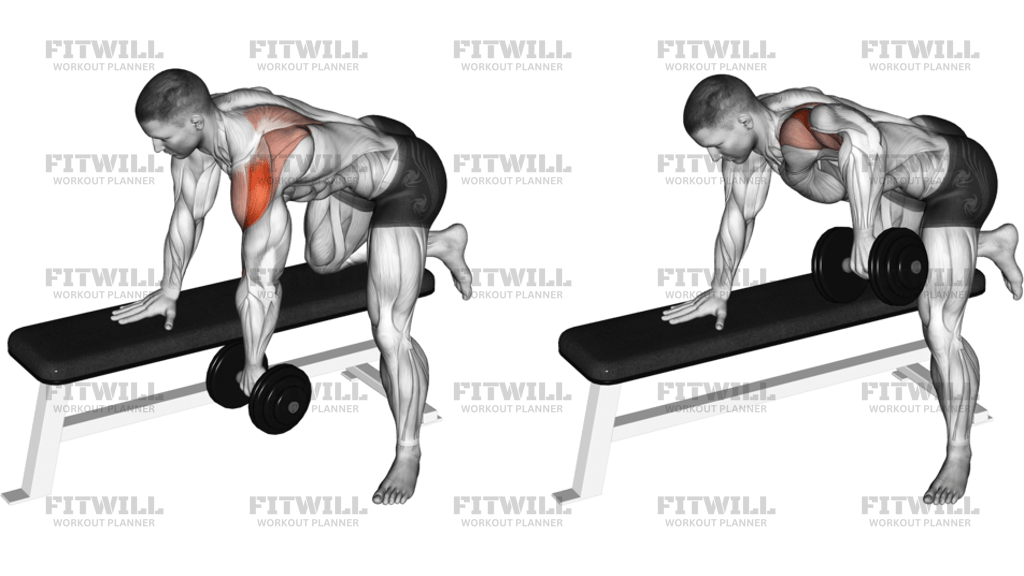
Instructions
- Place a flat bench beside you and rest the hand and knee on the same side of your body on the pad, with the opposite foot planted on the floor.
- Hinge forward until your torso is nearly parallel to the floor and let the dumbbell hang straight under the working shoulder.
- Keep the free hand firm on the bench and square your hips so they do not open as you row.
- Brace your torso and keep the neck long instead of letting the head drop or rotate.
- Begin the pull by driving the elbow out and back toward your lower ribs or upper waist.
- Lift until the upper arm is close to the torso or slightly behind it without shrugging the shoulder toward the ear.
- Pause briefly at the top, then lower the dumbbell slowly until the arm is straight again.
- Finish all reps on one side before switching sides and repeating the same path and tempo.
Tips & Tricks
- Press the bench hand and knee into the pad so your torso does not roll open as the dumbbell gets heavier.
- Think about moving the elbow out and back, not the hand up, to keep the rear delt doing the main work.
- Keep the dumbbell path close to the bench side of your body; drifting wide usually turns the rep into a shrug.
- Use a moderate load and a strict tempo, because rear delts fatigue sooner than the larger back muscles in this setup.
- Keep the wrist neutral so the forearm stays aligned with the dumbbell and the pull feels smooth.
- Stop the top of the rep when the upper arm reaches the torso line; forcing extra height often takes tension off the target area.
- Lower the dumbbell for two to three seconds so the shoulder stays controlled through the full range.
- If your low back starts to take over, raise the bench support slightly or reduce the torso angle before adding weight.
Frequently Asked Questions
What muscles does Dumbbell Rear Delt Row work?
It mainly works the rear delts, upper back, and traps, with the biceps helping to finish the pull. The bench-supported position also challenges the mid-back and trunk to stay steady.
How is this different from a regular one-arm dumbbell row?
The elbow travels a little wider and usually finishes higher, which shifts the emphasis away from the lats and toward the rear delts and upper back.
Where should the hand and knee go on the bench?
Place the hand and knee on the same side of your body on a flat bench, then keep the opposite foot on the floor so the torso stays anchored while you row.
How high should I pull the dumbbell?
Pull toward the lower ribs or upper waist. If the elbow keeps climbing past the torso line, the movement usually turns into more of a shrug than a rear-delt row.
Do I need to touch the dumbbell to my body at the top?
No. The goal is a controlled pull with a clear elbow path, not forcing the dumbbell into your ribs or chest.
Is Dumbbell Rear Delt Row beginner-friendly?
Yes, if you start light and use the bench for balance. Beginners usually do best when the torso stays still and the dumbbell moves slowly.
What is the most common mistake with this bench-supported setup?
Rotating the hips open to help the dumbbell up is the biggest one. That usually means the load is too heavy or the pull is drifting away from the rear delt line.
Can I do both sides in the same workout?
Yes. Complete all reps on one side, then switch sides and match the same tempo, range, and elbow path on the other side.