Lateral Box Jump
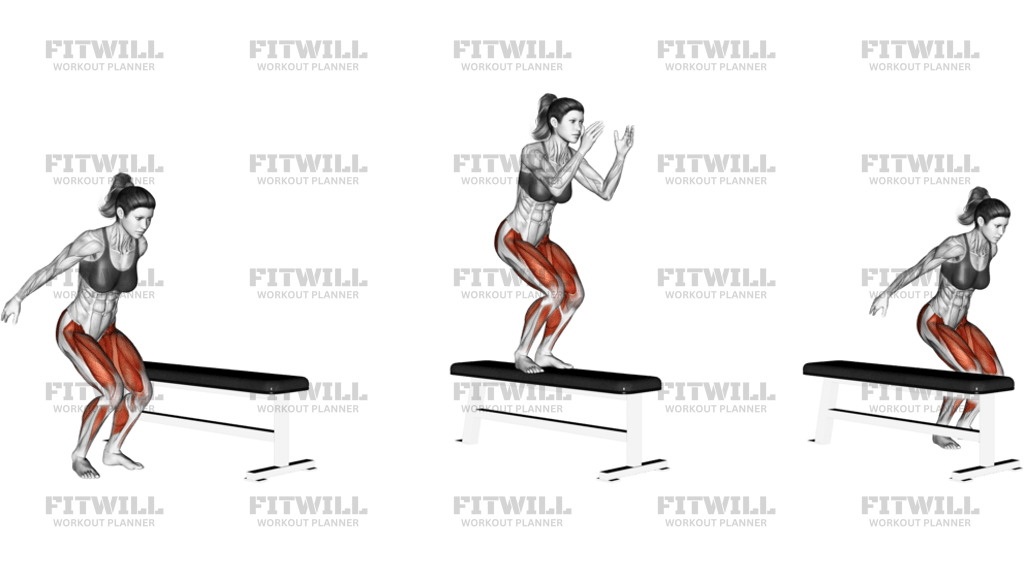
Lateral Box Jump is a bodyweight plyometric drill built around a side-to-side takeoff over a box or bench. It trains explosive hip and knee extension, quick force transfer, and the ability to land and stabilize in a new position without collapsing through the knees or torso. Because the movement is lateral, it also asks more of the glutes, adductors, calves, and trunk than a straight-ahead box jump.
The setup matters because the jump is only useful if the landing is clean. Stand beside the box with enough room to load the hips, and pick a height you can clear while landing softly on both feet. The box should be stable, dry, and wide enough for your feet. If the landing surface feels crowded or your knees cave inward on contact, the height is too aggressive for the current set.
Each repetition should look like a quick preload, a powerful sideways drive, and a controlled stick on top of the box or on the far side, depending on the version you are performing. Use your arms to help create momentum, but let the legs do the work. Land through the midfoot, keep the chest stacked over the hips, and absorb the impact by bending at the ankles, knees, and hips together instead of dropping straight down.
This exercise is useful in athletic warm-ups, power sessions, and lower-body conditioning blocks when you want speed and coordination rather than slow grinding strength. It is not a high-volume fatigue exercise. Reps should stay crisp, with full recovery between jumps if you want true power output. If the box is too high or the landing gets noisy and unstable, reduce the height before adding more speed.
For most people, the biggest wins come from better timing and cleaner landings, not from chasing the tallest box. Keep the rep count low enough that every jump looks identical, step or hop down with control, and stop the set when your landing quality starts to fade.
[ Workout Log & Planner ]
Put your next workout in Fitwill
Keep your plan and training log ready when you are.


Instructions
- Place a sturdy box or bench beside you so you have room to jump laterally across it.
- Stand to one side of the box with your feet about hip-width apart and your chest facing forward.
- Set your hips back slightly, keep a soft bend in your knees, and load your weight into the leg closest to the box.
- Swing your arms and drive sideways off both feet or primarily off the loaded leg, depending on the version you are using.
- Jump across to the top of the box or over it, keeping your knees aligned with your toes.
- Land softly on both feet with your weight centered and your chest stacked over your hips.
- Hold the landing for a brief moment until you are stable and balanced.
- Step down or hop down under control, then reset fully before the next rep.
- Breathe in during the reset and exhale as you explode into the next jump.
Tips & Tricks
- Choose a box height that lets you land quietly instead of stomping onto the surface.
- Keep the box close enough that you do not need a long running start or a big lean to clear it.
- Think about pushing the floor away sideways, not reaching your feet toward the box.
- Let the arms help with timing, but do not throw your torso so far that you lose balance in the air.
- Land with the knees tracking over the middle toes so the hips do not cave inward.
- Use a full foot or midfoot landing on the box, then settle the heels if the surface allows it.
- Step down between reps instead of jumping down if the box is high or fatigue is building.
- Keep the reps sharp and stop the set when the landing gets noisy, slow, or unstable.
Frequently Asked Questions
What does the lateral box jump train?
It trains lateral power, hip drive, landing control, and single-rep explosiveness through the glutes, quads, calves, and trunk.
Is this the same as a regular box jump?
No. A lateral box jump moves sideways, so it challenges coordination and hip control more than a straight-ahead jump.
How high should the box be?
Use the lowest height that lets you jump and land cleanly. If you have to tuck hard, twist, or slam the landing, the box is too high.
Should I jump onto the box or over it?
Follow the version shown in your program. The key is a controlled lateral takeoff and a soft, balanced landing on the intended surface.
Can beginners do lateral box jumps?
Yes, but start with a low box and low volume. Beginners should prioritize stick landings before trying faster or higher reps.
What is the biggest form mistake?
The most common mistake is landing with the knees collapsing inward or turning the jump into a messy hop instead of a controlled power rep.
Do I need to step down after each rep?
Usually yes. Stepping down keeps the landing leg fresh and makes it easier to keep every jump explosive and safe.
How should I program this exercise?
Use it for low-rep power work or as part of an athletic warm-up. It works best when each rep is fast, clean, and fully reset.