Lever Back Extension
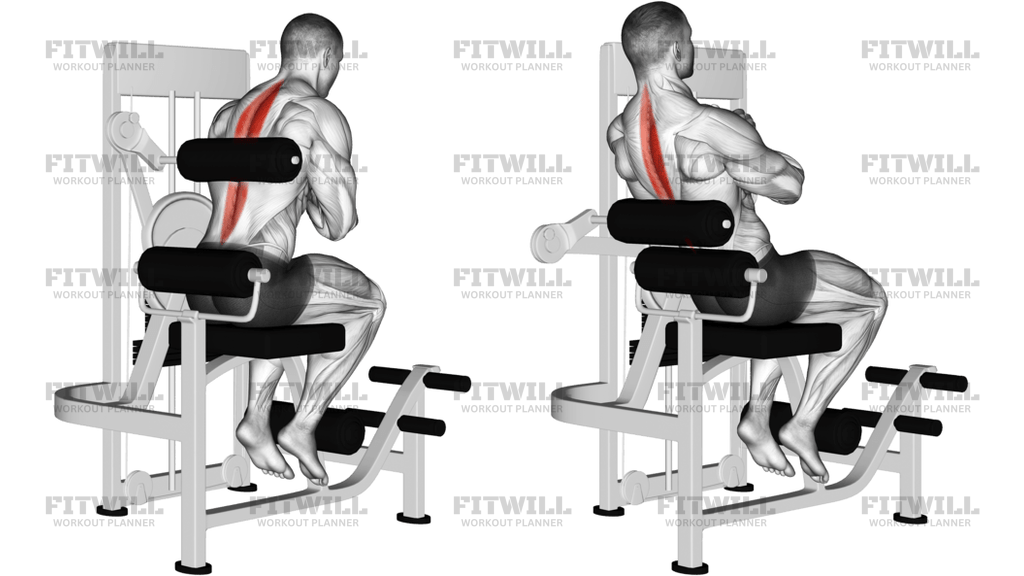
Lever Back Extension is a machine-based trunk extension exercise performed with your pelvis and thighs anchored against the pads while your torso moves against the lever arm. It is a controlled way to train the muscles that extend and stabilize the spine, especially the erector spinae, with the machine providing a fixed path so you can focus on clean repetition quality instead of balance or coordination.
The setup matters because the pad placement decides whether the movement feels like a smooth back extension or a sloppy hip slide. Sit so your hips stay pinned to the seat, your lower body is firmly supported, and the upper pad contacts your upper back or shoulder blade area without forcing you to shrug. Keep your feet planted on the foot platform and your torso organized before you start the first rep.
From there, the repetition should feel deliberate and repeatable. Let the torso move through a controlled forward bend, then drive back up by extending the spine and hips until you reach a tall, neutral finish. The top position should feel strong, not exaggerated, so stop short of leaning back past neutral or jamming the low back into hyperextension. Breathing should stay steady, with a braced exhale on the way up and a controlled inhale on the way down.
This exercise is useful as accessory work for posterior-chain strength, trunk endurance, and back-focused conditioning when you want a guided machine pattern. It is also a practical option for beginners who need more support than a free-weight back extension variation. Use a load and range that let you keep the neck long, the ribs under control, and the movement smooth from the first rep to the last.
[ Workout Log & Planner ]
Put your next workout in Fitwill
Keep your plan and training log ready when you are.


Instructions
- Sit on the machine with your hips pinned to the seat, your lower body secured under the pads, and your feet planted on the foot platform.
- Set the upper pad across your upper back or shoulder blade area, then cross your arms over your chest or hold the handles if the machine provides them.
- Start with your torso tall, ribs stacked over your pelvis, and your neck long instead of jutting forward.
- Inhale and brace your trunk before each rep so the motion comes from the machine path, not from a loose torso.
- Lower your chest and shoulders forward in a slow, controlled arc until you reach the bottom of the range you can own without collapsing into a hard round back.
- Drive through your mid-back, low back, and hips to extend the torso back up until you are tall and aligned with the pads.
- Finish the rep in a strong neutral position, not in an exaggerated backward lean or forced hyperextension.
- Exhale as you lift, then inhale as you return under control for the next repetition.
Tips & Tricks
- Adjust the pads first. If your pelvis can slide or your upper back sits too high, the rep turns into a body shift instead of a back extension.
- Keep your ribs from flaring as you come up. The best finish is tall and stacked, not arched hard through the low back.
- Do not throw your torso upward from the bottom. A smooth start protects the spine and keeps the lever arm from jerking.
- Use a smaller range if your lower back feels pinchy at the bottom. Depth should be something you can control without losing position.
- Think about lifting through the chest and extending the spine together, not just cranking the neck or swinging the shoulders back.
- Keep your chin slightly tucked so the neck stays long and the upper traps do not take over the rep.
- Choose a load that lets you pause briefly at the top without shaking or losing pad contact.
- If the machine allows it, use the handles only as a light anchor. Do not pull with the arms to fake extra range.
Frequently Asked Questions
What muscles does the lever back extension train?
It mainly trains the spinal erectors, with the glutes and other posterior-chain muscles helping to finish the extension.
Where should the pads sit on this machine?
Your hips should stay pinned against the seat, and the upper pad should contact the upper back or shoulder-blade area without forcing you to shrug.
Should I round forward at the bottom?
A small forward bend is normal, but do not collapse into a hard rounded spine. Keep the descent controlled and stop before you lose position.
Can beginners use the lever back extension machine?
Yes. The guided path makes it beginner-friendly as long as the load is light and the range stays controlled.
Is this the same as a Roman chair back extension?
The goal is similar, but the lever machine gives you a more fixed path and more support through the pelvis and torso.
How far back should I lean at the top?
Only until you are tall and neutral. Leaning past neutral usually turns the rep into low-back compression instead of clean extension.
What should I do if my lower back feels uncomfortable?
Shorten the range, reduce the load, and make sure the pelvis stays locked into the pads. If discomfort remains, stop the set.
Should I use the handles or cross my arms?
Either works, but keep the arms passive. The movement should come from the torso, not from pulling with the hands.