Smith Leg Press
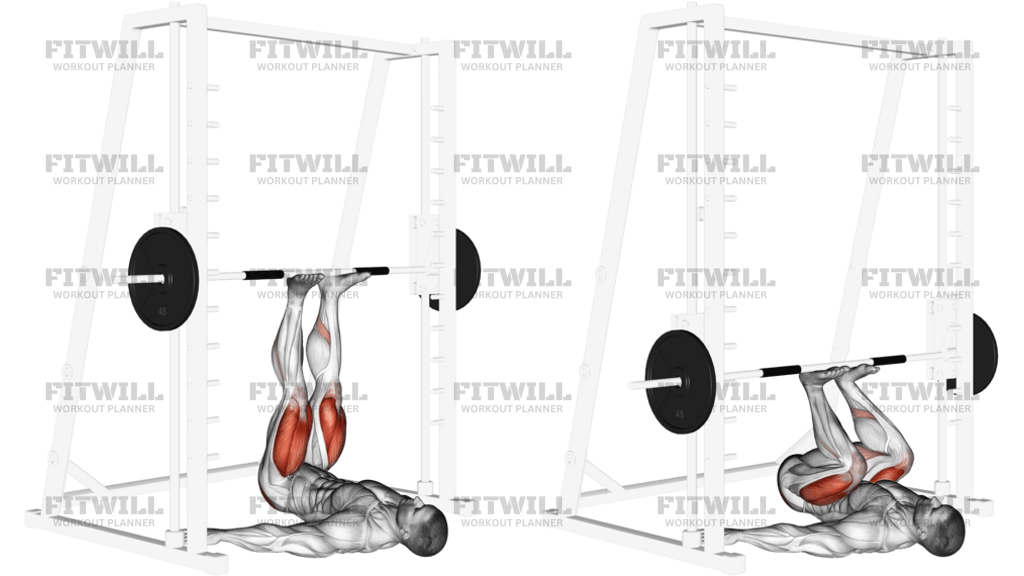
Smith Leg Press is a floor-based pressing variation performed under a Smith machine, where your legs drive the guided bar while your back stays on the floor. It is a lower-body strength exercise that usually shifts the work toward the glutes and thighs, with the exact emphasis changing a little based on foot placement, stance width, and how far you bend your knees and hips. Because the bar path is fixed, the exercise rewards careful setup more than brute force.
This movement is useful when you want a guided press pattern without a sled-style leg press machine. The Smith machine gives you a stable track, which makes it easier to focus on leg drive, pelvic control, and even pressure through both feet. It can fit well in glute-focused sessions, quad work, or general lower-body training when you want a repeatable range of motion and a clear way to load the legs.
The setup matters because the bar needs to line up with your feet, hips, and knees before the first rep. Lie flat with your shoulders and head anchored to the floor, then place both feet on the bar so your heels and midfoot can drive evenly. If your feet are too low, the knees may travel too far forward and the bar can feel cramped; if they are too high, the press can turn into more of a hip-dominant push. A stance that keeps the knees tracking over the toes usually gives the cleanest path.
On each repetition, lower the bar only as far as you can while keeping your pelvis steady and your low back from arching off the floor. Press the bar away by extending the knees and hips together, then control the return instead of letting the weight drop back into the bottom. Breathing should stay simple: brace before the press, exhale as you drive up, and inhale as the bar comes back down.
Smith Leg Press works best as a controlled accessory lift rather than a sloppy max-effort movement. It can build useful leg strength, but the fixed track also means a poor foot position will feel awkward fast, so the load should stay honest and the range should stay pain-free. If the bar feels like it is drifting, your feet are slipping, or your hips are twisting, reduce the weight and reset the setup before continuing.
[ Workout Log & Planner ]
Put your next workout in Fitwill
Keep your plan and training log ready when you are.


Instructions
- Lie on your back under the Smith machine with your shoulders and head flat on the floor and the bar positioned above your feet.
- Place both feet on the bar about hip- to shoulder-width apart, with your heels and midfoot centered so the bar stays balanced across both sides.
- Bend your knees and hips until you reach the bottom position that lets your pelvis stay anchored and your low back remain close to the floor.
- Brace your torso and keep your hands on the floor or the machine frame if you need extra balance before the first rep.
- Press the bar away by extending your knees and hips together, driving evenly through both feet instead of shifting to one side.
- Keep your knees tracking in line with your toes as the bar rises, and stop short of a hard knee lockout at the top.
- Lower the bar slowly until you return to the same bottom position without bouncing or letting your hips lift.
- Inhale on the way down, exhale as you press up, and reset your breath before the next rep.
- Re-rack the bar on the hooks or safeties before you move your feet or sit up.
Tips & Tricks
- Put the bar across the part of your foot that lets you push evenly; if the pressure shifts into your toes, the setup is too low.
- A slightly higher foot position usually makes the press feel more glute-heavy, while a lower foot position tends to bring the thighs forward more.
- Keep your heels from peeling off the bar on the way up, because that usually means the load is too heavy or your foot placement is off.
- If your low back arches hard off the floor, shorten the range before the bar gets so low that your pelvis tips forward.
- Do not let your knees collapse inward when the bar rises; think about pushing both knees in the same direction as your toes.
- Use a controlled lower on every rep so the Smith bar does not bounce into the bottom position.
- A pause in the bottom can expose weak control and clean up the rep, but only if your feet stay planted and your hips stay square.
- If one side of the bar rises faster than the other, reset your foot width and center the bar before adding more load.
Frequently Asked Questions
What muscles does Smith Leg Press work most?
Smith Leg Press mainly trains the glutes and thighs, with the exact emphasis shifting based on where you place your feet on the bar.
Is Smith Leg Press the same as a machine leg press?
No. This version uses the Smith machine bar while you lie on the floor, so the path is fixed but the body position is very different from a sled leg press.
Where should my feet go on the Smith machine bar?
Place both feet about hip- to shoulder-width apart with the bar centered across your heels and midfoot. Small changes in foot height will shift the feel toward the glutes or thighs.
How deep should I lower on Smith Leg Press?
Lower only as far as you can while keeping your pelvis from tipping and your low back close to the floor. The bottom position should feel controlled, not jammed.
Can beginners do Smith Leg Press safely?
Yes, if they start light and learn how to keep both feet planted on the bar. The fixed track makes it easier to learn than a free barbell variation, but the setup still matters.
Why do my knees cave in during Smith Leg Press?
That usually means your stance is too narrow, the load is too heavy, or you are losing pressure through one foot. Reset your feet and keep your knees tracking over your toes.
What if the Smith bar feels awkward on my feet?
Adjust foot height and width until the bar sits squarely over your heels and midfoot. If the track still feels off, reduce the load and shorten the range of motion.
Do I need to lock my knees at the top?
No. Finish the press with strong leg extension, but keep a soft knee so you do not slam into the joints or lose tension.
Can I use Smith Leg Press for glute-focused training?
Yes. A slightly higher foot placement and a controlled hip bend usually make it more glute-biased, especially when you keep the pelvis stable.