Smith Standing Military Press
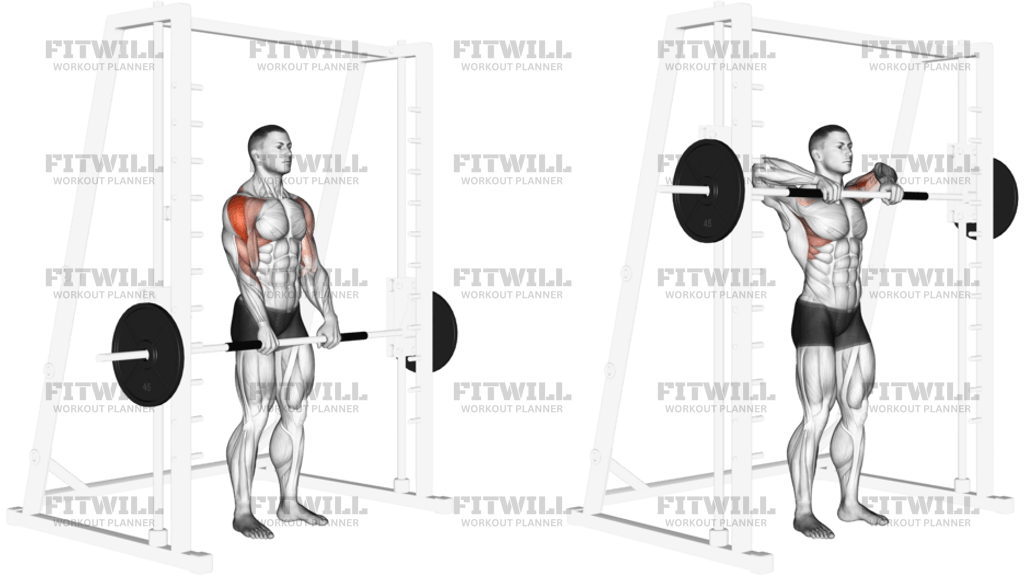
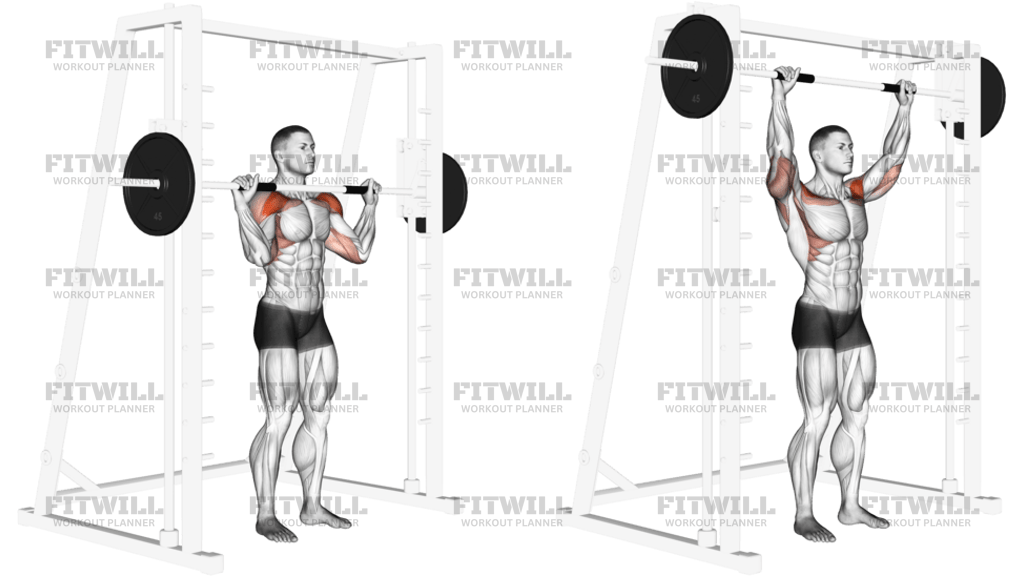
Smith Standing Military Press is a standing overhead press performed on a Smith machine, so the bar travels on a fixed path while you train the shoulders and triceps. The guided track can make the exercise feel very stable, but it also makes setup important: your feet, torso angle, and bar start position need to match the machine so the press stays smooth instead of forcing your shoulders into an awkward line.
The main emphasis is on the deltoids, especially the front and middle heads, with triceps and upper traps helping finish the press and stabilize the bar. Because the bar path is fixed, this version often lets lifters focus on strict pressing strength, controlled tempo, and clean lockout work without having to balance the bar in open space. It is especially useful when you want a direct shoulder press with less demand on balance than a barbell version.
Set the bar at upper-chest height, stand tall with the ribs stacked over the pelvis, and grip the bar just outside shoulder width. In the start position, the forearms should be close to vertical and the elbows slightly in front of the bar so the press begins from a strong front-rack line. A small amount of head movement is normal: let the bar clear your face, then bring your head back under the bar as it rises.
Press the bar upward in a controlled line, keeping the torso braced and the knees quiet. Finish with the elbows extended overhead and the shoulders active, then lower the bar back to the upper chest under control. The repetition should feel like a deliberate shoulder press, not a back bend or leg drive. If the machine track does not line up well with your shoulder position, move your feet slightly forward or backward until the start and finish feel natural.
This exercise works well as a primary shoulder movement, a strength accessory, or a controlled pressing option when you want repeatable reps and clear loading. It is also a practical choice for beginners who need the machine to guide the path, provided the weight stays light enough to keep the torso still and the bar path smooth. Stop the set if the lower back starts to arch hard, the bar drifts behind the head, or the shoulders lose a stable finish overhead.
[ Workout Log & Planner ]
Put your next workout in Fitwill
Keep your plan and training log ready when you are.


Instructions
- Set the Smith bar at upper-chest height, step under it, and grip just outside shoulder width with the wrists stacked over the forearms.
- Plant your feet about hip-width apart and position them so the bar can travel cleanly without forcing you to lean back.
- Lift the bar out of the hooks, hold it at the top of the upper chest, and keep the elbows slightly in front of the bar.
- Brace your midsection and keep the ribs down before starting the press.
- Press the bar upward in the machine's fixed line, letting your head move back slightly so the bar clears your face.
- As the bar passes your forehead, bring your head back under it and finish with the elbows locked overhead.
- Lower the bar slowly back to the upper chest while keeping the torso upright and the shoulders controlled.
- Reset your breath at the bottom and repeat for the planned reps.
- Re-rack the bar only after it is fully settled at the top or back at the start position.
Tips & Tricks
- If the bar path feels cramped at the bottom, move your feet a few inches forward so the press can start in front of your face instead of straight through it.
- Keep the glutes and abs tight enough to prevent a big lower-back arch when the bar gets heavy.
- Aim for the upper chest or collarbone area on the way down; dropping lower usually turns the press into a shoulder-stress position.
- Do not shrug early on the first half of the rep; let the shoulders rise naturally only as you finish overhead.
- Use a grip that keeps the wrists stacked over the elbows, not bent far backward.
- If one shoulder feels pinched, reduce range slightly and check that the elbows are not flaring too far out at the bottom.
- Lower the bar under control; a slow eccentric keeps the shoulders organized and helps you stay inside the machine track.
- Exhale through the press and take a fresh breath before each rep instead of holding a long, sloppy breath cycle.
- Choose a load that lets you keep the head and torso still while the arms do the work.
Frequently Asked Questions
What muscle does Smith Standing Military Press target most?
The deltoids are the main target, especially the front and middle heads.
Can beginners perform this exercise?
Yes. The Smith machine helps guide the bar, which can make the movement easier to learn with light loads.
Where should the bar start?
Set it around upper-chest or collarbone height so you can unrack it without losing your shoulder position.
Should I lean back to finish the press?
No. A small amount of upper-body movement is fine, but a big lean turns the press into a lower-back compensation.
How should my feet be placed?
Start about hip-width apart, then adjust slightly forward or back until the fixed bar path feels smooth and natural.
Does this work the triceps too?
Yes. The triceps help finish the lockout, especially on heavier reps.
Why does my neck feel tight during this press?
Usually the shoulders are shrugging too early or the load is too heavy. Keep the neck long and finish the rep with the upper back active.
What is a good substitution if the Smith track feels awkward?
A seated dumbbell shoulder press or a standing barbell overhead press are the closest free-weight alternatives.