Square Hop
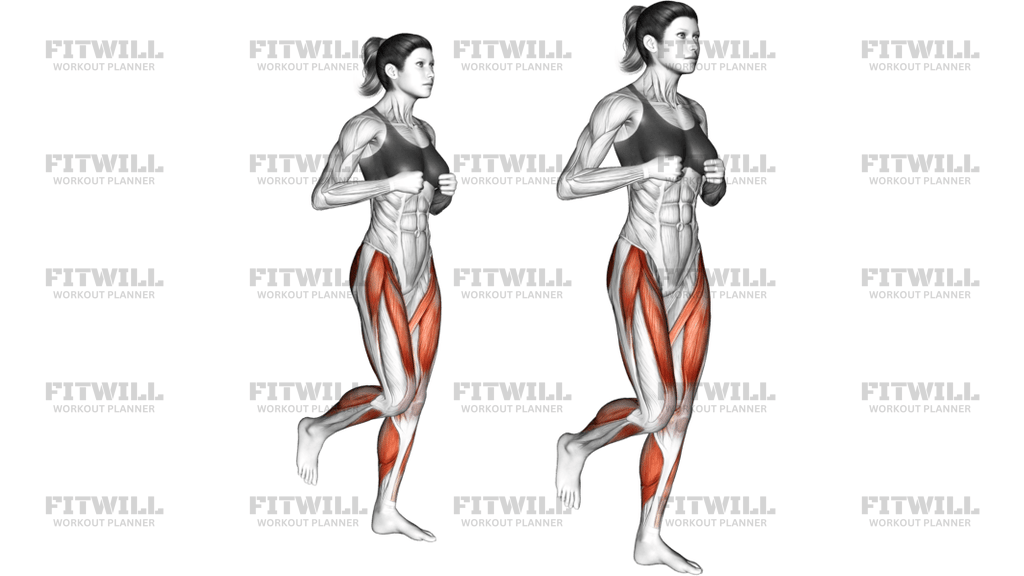
Square Hop is a bodyweight plyometric drill built around quick, elastic hops between the corners of a square pattern on the floor. It is meant to train foot speed, ankle stiffness, landing control, and the ability to redirect force without letting the knees or torso wobble. The training effect comes from clean, repeatable contacts rather than from chasing height or rushing the cadence.
Because this is a repeated landing drill, the setup matters. Mark a small square with tape or use four visible floor points, then start in an athletic stance with the feet under the hips, the knees softly bent, and the chest stacked over the pelvis. The body should feel spring-ready before the first hop, not flat-footed or collapsed.
Each rep should travel from one corner to the next with a short, controlled push off the floor. Land quietly, absorb the impact through the ankles and knees, and redirect immediately into the next direction. Keep the hops compact enough that you can stay organized in the air and stop the motion cleanly if you need to reset.
The lower legs do most of the visible work, but the quads, glutes, and core help keep the landing stable and the path precise. That makes Square Hop useful for warm-ups, change-of-direction prep, athletic conditioning, or low-volume plyometric work when you want sharper reactions without a large setup or heavy load.
Use it only when every contact stays crisp. If the drill gets noisy, if the feet drift outside the square, or if the knees cave inward on landing, shorten the distance or slow the rhythm. The best version looks compact, springy, and controlled from the first corner to the last.
[ Workout Log & Planner ]
Put your next workout in Fitwill
Keep your plan and training log ready when you are.


Instructions
- Mark a small square on the floor with tape or choose four clear floor points, then stand at one corner in an athletic stance.
- Set your feet under your hips, soften your knees, and keep your chest stacked over your pelvis before you start the first hop.
- Brace lightly through the trunk and load into the balls of your feet so the body feels spring-ready, not flat-footed.
- Hop from one corner of the square to the next with a short, quick push off the floor.
- Land quietly on each corner, letting the ankles and knees absorb the impact without collapsing inward.
- Redirect immediately into the next corner without pausing long enough to lose rhythm or balance.
- Keep your hips and shoulders organized so the body travels around the square without twisting to create extra distance.
- Finish the planned sequence, then step out of the square and reset before the next set.
Tips & Tricks
- Keep the square small enough that you can land inside the points without reaching or lunging.
- Think about pushing the floor away rather than jumping as high as possible.
- Use a quiet landing as your quality check; loud feet usually mean too much height or too much speed.
- Let the arms swing naturally for rhythm, but do not let them pull the torso off center.
- Keep the feet under you on every contact instead of letting them drift ahead of the hips.
- If the knees knock inward, reduce the speed and tighten the square before adding more reps.
- Stay on the forefoot or midfoot long enough to redirect, but do not let the heels slam down.
- Breathe out on the takeoff rhythm and keep the torso braced so the hops stay crisp.
Frequently Asked Questions
What does Square Hop train most?
It trains plyometric power, foot speed, ankle stiffness, and the ability to land and redirect cleanly.
Do I need equipment for Square Hop?
No load is needed, but tape or floor markers help define the square and keep the path consistent.
How big should the square be?
Start small enough that each hop lands inside the corners without reaching, twisting, or losing balance.
Should the landings be loud or soft?
They should be soft and quiet. A loud landing usually means too much jump height or a square that is too large.
Can beginners do Square Hop?
Yes, if the square is small and the pace is controlled. Beginners should focus on rhythm and clean landings before speed.
Where should I feel this exercise?
You should feel the calves and lower legs working hard, with the quads, glutes, and core helping stabilize each landing.
Is Square Hop a conditioning drill or a strength exercise?
It is mainly a plyometric conditioning drill, though it also builds lower-body stiffness and coordination.
What is the biggest mistake to avoid?
Do not turn it into a long, bounding jump. The drill works best when the hops stay compact and the body stays organized.