Wrist Roller
Wrist Roller is a standing forearm exercise that uses a bar, strap, and hanging plate to load the wrist flexors and wrist extensors through a long, controlled range. The setup matters because the arms stay lifted while the wrists do the work, so even a small change in elbow angle or torso position can move tension away from the forearms and into the shoulders.
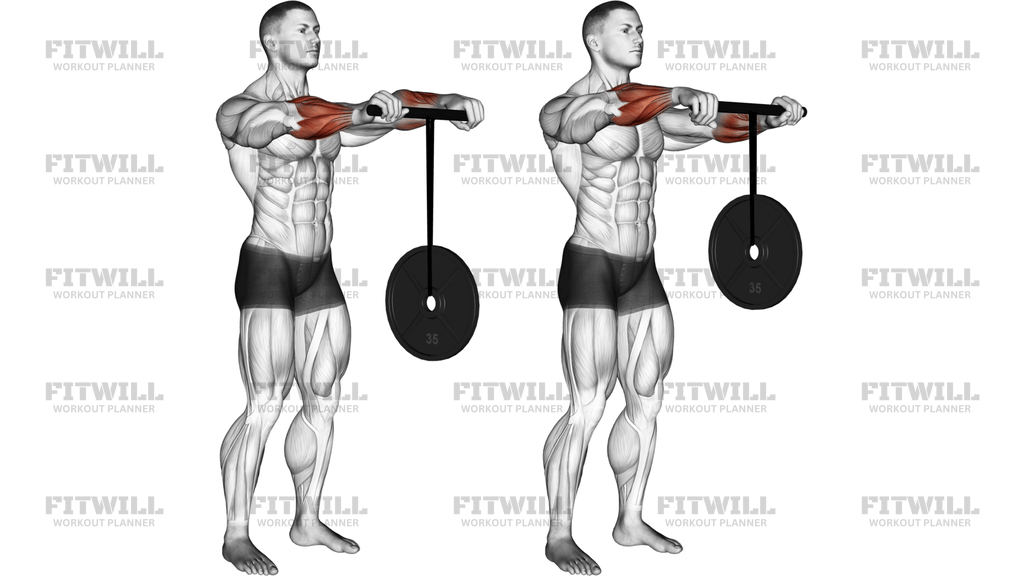
In the image, the lifter stands upright with both arms extended in front of the body and the roller held at shoulder height. The weight hangs from the center of the handle by a strap, which creates a constant downward pull that the wrists must overcome. That hanging load makes the exercise useful for grip strength, forearm size, and sport-specific control, especially for climbing, racket sports, combat sports, and any training that depends on hand endurance.
The working phase is simple but demanding: roll the bar to wind the strap up and raise the plate, then reverse the motion to lower it under control. The forearms should stay busy while the shoulders remain quiet, the ribs stay stacked over the pelvis, and the elbows keep almost the same angle from start to finish. If the body starts leaning back, shrugging, or bending the elbows to help, the set has turned into a different exercise.
This movement is usually best used as an accessory finisher or grip block near the end of a session, after your main lifts are done. Light to moderate loading lets you keep the handle level, the strap centered, and the lowering phase slow enough to keep tension on the forearms instead of letting gravity rip the plate down. Beginners can use it successfully, but only if they start conservatively and treat the return phase as seriously as the roll-up.
[ Workout Log & Planner ]
Put your next workout in Fitwill
Keep your plan and training log ready when you are.


Instructions
- Stand tall with your feet about hip-width apart and hold the roller at shoulder height in front of you so the strap hangs straight down in the middle.
- Use the grip shown in the image, with both hands spaced evenly on the handle and your wrists stacked in line with your forearms.
- Keep your elbows almost straight, shoulders down, and ribs stacked so the only joint that really moves is the wrist.
- Start with the plate hanging still and the handle level, then brace lightly before the first roll.
- Roll the handle to wind the strap up and raise the plate toward the bar using controlled wrist flexion or extension, depending on the direction of travel.
- Keep your torso quiet and avoid shrugging, leaning back, or bending the elbows as the plate gets heavier.
- Pause briefly when the plate reaches the top and the strap is fully wound without letting the shoulders drift forward.
- Reverse the motion slowly to unwind the strap and lower the plate under control until it hangs still again.
- Finish each rep with the handle steady, then repeat for the planned number of roll-ups and roll-downs.
Tips & Tricks
- Start lighter than you think you need; the forearms fatigue quickly, and a plate that is too heavy will force elbow bend or body sway.
- Keep the handle level so the strap winds evenly on both sides instead of tilting and twisting your wrists.
- Let the wrists move through the full range, but keep the elbows locked in a soft, consistent angle the whole time.
- Squeeze the handle firmly enough to keep it from slipping, but do not turn the set into a death grip that shortens wrist motion.
- Lower the plate more slowly than you raise it; the eccentric phase is where the forearms usually get the best stimulus.
- If your shoulders start burning first, lower the arms slightly and reset your posture before continuing.
- Exhale as you wind the strap up and inhale while you control the plate back down.
- Stop the set when the handle starts wobbling or your wrists can no longer keep the plate path smooth.
Frequently Asked Questions
What muscles does the Wrist Roller train most?
It mainly trains the wrist flexors and wrist extensors, with the brachioradialis, biceps, and shoulder stabilizers helping to keep the arms fixed.
Can beginners perform this exercise?
Yes, but it should start very light so the wrists can learn the rolling path without the elbows bending or the torso swinging.
Should my elbows stay straight during the set?
They should stay almost straight the whole time. A little soft bend is fine, but changing the elbow angle turns the exercise into an arm-dominant movement.
Do I need to roll the weight both up and down?
Yes. The roll-up loads the forearm differently from the controlled roll-down, and both parts help build more complete wrist endurance.
Why do my shoulders feel tired during Wrist Roller?
Your arms are held up in front of you the whole time, so the shoulders have to stabilize the position. If they take over, lower the load and keep the ribs from flaring.
How heavy should the plate be?
Heavy enough that the forearms have to work hard, but light enough that you can keep the handle level and lower the plate slowly without jerking.
Is this just a grip exercise?
Grip is part of it, but the main driver is wrist motion. The handle should stay secure in the hands while the wrists do the rolling.
Where does this fit in a workout?
It works well as a forearm finisher after pulls, carries, or climbing work, when you want direct wrist and grip fatigue without needing much space.