Dumbbell Upright Shoulder External Rotation
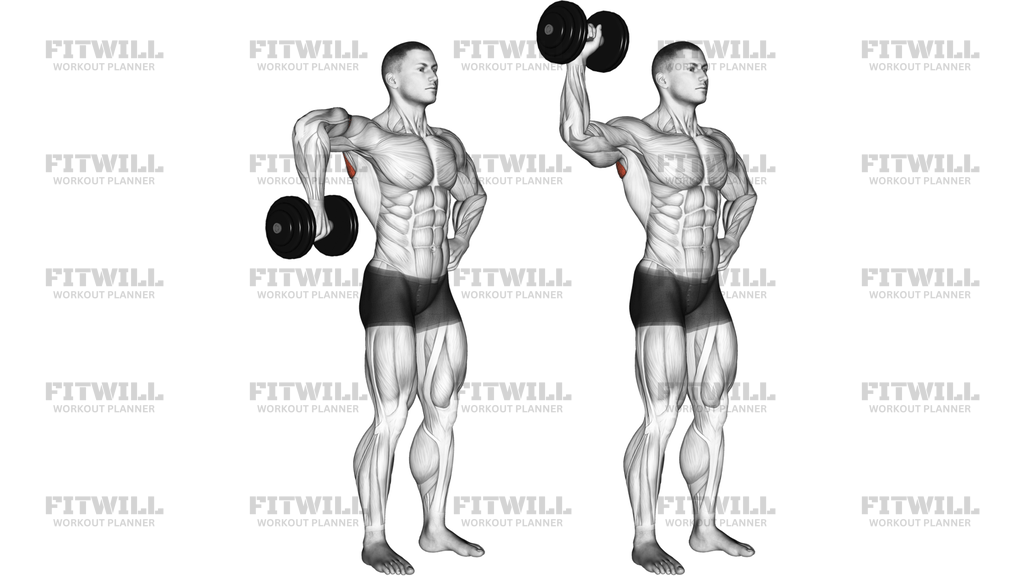
Dumbbell Upright Shoulder External Rotation is a standing single-arm shoulder drill that rotates the forearm upward while the upper arm stays fixed at shoulder height. The exercise is built to train external rotation control at the shoulder, which makes it useful for the rotator cuff, rear delts, and the smaller stabilizers that keep the shoulder joint centered during pressing, pulling, and overhead work. It is not a momentum lift; the value comes from a slow, exact path and a shoulder that stays organized from the first inch of motion to the last.
The setup is the main part of the exercise. The working elbow should stay lifted roughly level with the shoulder, bent to about 90 degrees, while the upper arm remains almost parallel to the floor. That arm position creates the torque that external rotators have to resist and control. Keep the ribs stacked, the neck long, and the torso quiet so the shoulder can rotate without the trunk twisting to help. If the elbow drops or the ribcage flares, the movement stops being an external-rotation drill and turns into a loose upper-body compensation pattern.
At the top of the rep, the dumbbell should finish nearly vertical above the elbow while the forearm has rotated upward under control. The upper arm should not drift backward, the shoulder should not shrug, and the wrist should not collapse. On the way down, lower the dumbbell slowly until the forearm hangs again and the shoulder is still steady. The descending phase matters because it is where the cuff has to control rotation rather than simply getting pulled back by the weight. Smooth breathing helps keep the torso calm and the rep repeatable.
This movement is best used as warm-up work, accessory work, or light shoulder-prep volume before pressing or upper-body training. It can be helpful for lifters who want better external rotation strength, cleaner shoulder positioning, or a more controlled overhead setup. Keep the load light enough that the elbow stays fixed and the range stays pain-free. If the front of the shoulder pinches, reduce the angle, shorten the range, or stop the set instead of forcing a deeper rotation. Clean reps matter more here than heavy dumbbells or high fatigue.
Fitwill
Log Workouts, Track Progress & Build Strength.
Achieve more with Fitwill: explore over 9600 exercises with images and videos, access built-in and custom workouts, perfect for both gym and home sessions, and see real results.
Start your journey. Download today!




Instructions
- Stand tall with your feet about hip-width apart and hold one dumbbell in the working hand.
- Raise the upper arm until the elbow is level with the shoulder, bent to about 90 degrees, with the upper arm nearly parallel to the floor.
- Keep the shoulder blade set gently back and down, and stack the ribs over the pelvis so the torso stays quiet.
- Start with the forearm hanging down and the dumbbell below the elbow.
- Rotate the forearm upward until the dumbbell is nearly vertical above the elbow while the upper arm stays fixed in place.
- Pause briefly at the top without shrugging, leaning, or twisting the trunk.
- Lower the dumbbell slowly back to the start until the forearm hangs down again.
- Reset the shoulder position before the next rep and switch sides only after the set is complete or as programmed.
Tips & Tricks
- Pick a dumbbell that lets the elbow stay exactly where you placed it; if the arm drifts, the load is too heavy.
- Keep the upper arm at shoulder height for the whole rep, because dropping the elbow turns this into a different movement.
- Rotate the forearm, not the torso; if your ribcage turns toward the dumbbell, you are cheating the range.
- Let the shoulder stay packed and quiet at the top instead of shrugging toward the ear.
- Use a slower lowering phase than the lifting phase to keep tension on the external rotators.
- Keep the wrist neutral so the dumbbell does not fold the hand backward as it gets heavier.
- Stop the set the moment the front of the shoulder pinches or the upper arm starts to move behind the body.
- Use this as a light accessory or warm-up movement, not as a lift to chase heavy loading.
Frequently Asked Questions
What muscles does Dumbbell Upright Shoulder External Rotation train most?
It mainly trains the shoulder external rotators and rear-delt stabilizers, with the upper back helping keep the arm position steady.
Is this the same as a dumbbell lateral raise?
No. In this exercise the upper arm stays lifted and still while the forearm rotates upward around the elbow.
How heavy should the dumbbell be?
Light enough that you can keep the elbow level with the shoulder and rotate without leaning, twisting, or shrugging.
Where should the elbow be during the rep?
The elbow should stay about level with the shoulder and bent to roughly 90 degrees from start to finish.
Why does this movement feel awkward at first?
The shoulder is rotating in a fixed 90/90 position, so the range is small and the control demand is high even with a light dumbbell.
Can beginners do this exercise safely?
Yes, if they use a very light dumbbell and keep the motion pain-free and strict.
What should I do if the front of my shoulder pinches?
Shorten the range, lower the arm angle slightly, or stop the set instead of forcing the rotation deeper.
Is there a good substitute for this movement?
A cable or band external rotation can work well if you want smoother resistance or a different shoulder feel.