Band Push-Up
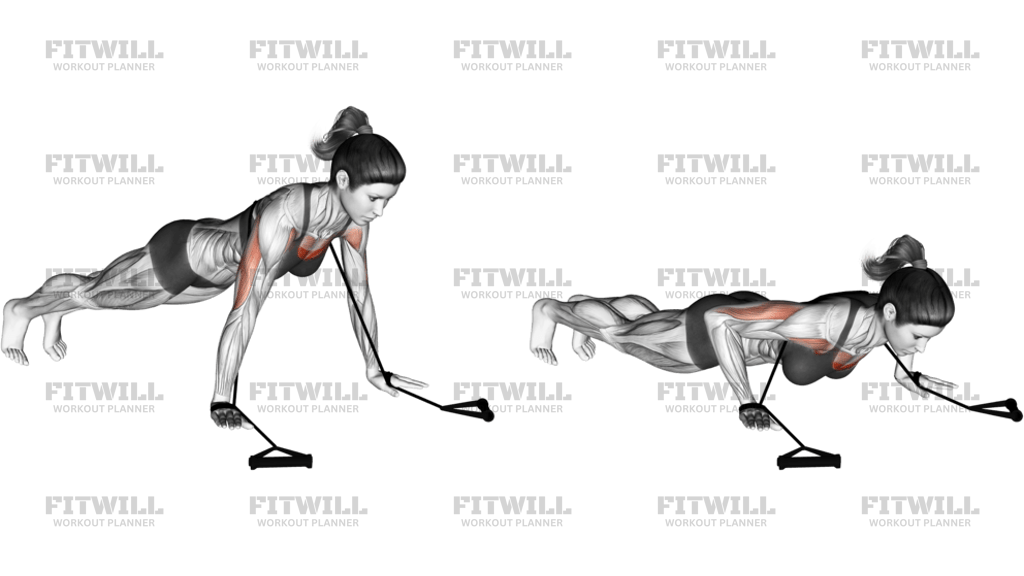
Band Push-Up is a push-up variation that adds external resistance with a band stretched across the upper back and anchored under the hands. It keeps the familiar floor press pattern of a standard push-up, but the band increases tension as you approach the top of each rep, which makes the lockout more demanding for the chest, triceps, and front shoulders.
The exercise is useful when you want bodyweight pressing with a little more load without moving straight to a heavy bench press. Because the band changes the resistance curve, Band Push-Up rewards a strong plank position and a crisp press from the floor. The primary work stays on the pectoralis major, while the anterior deltoids, triceps brachii, and rectus abdominis help keep the rep clean and controlled.
Setup matters more here than in a normal push-up because the band has to stay secure while you move. Place your hands on the floor slightly wider than shoulder width, trap the band under both palms, and let it run across the upper back before you walk your feet back into a long plank. Your shoulders should stay stacked over the wrists, your body should form one straight line, and your ribs should stay down so the band does not pull you into a sagging midsection.
On each repetition, lower under control until the chest nears the floor, with the elbows tracking at roughly a 30 to 45 degree angle from the torso. Pause only long enough to stay organized, then press the floor away and finish with full elbow extension without shrugging the shoulders. Exhale on the press and inhale on the descent so your trunk stays braced while the chest and triceps do the work.
Band Push-Up fits well as a strength accessory, a push day finisher, or a progression once regular push-ups feel too easy. It is also practical when you want a portable pressing option that does not require a bench or machine. Use a band that lets you keep a flat plank, a smooth descent, and a stable hand position; if the band shifts, the hands slide, or the hips pike, reduce the tension and clean up the setup before adding reps.
[ Workout Log & Planner ]
Put your next workout in Fitwill
Keep your plan and training log ready when you are.


Instructions
- Loop the band across your upper back and trap both ends under your palms on the floor, with your hands slightly wider than shoulder width.
- Walk your feet back into a strong plank so your shoulders stay over your wrists and your body makes one straight line from head to heels.
- Spread the floor with your hands, brace your ribs down, and squeeze your glutes before the first rep.
- Lower your chest toward the floor under control, letting your elbows track about 30 to 45 degrees from your sides.
- Keep the band centered across your back as you descend and stop just before your chest touches down if your range starts to collapse.
- Press the floor away hard, driving through the palms while the band adds resistance near the top of the rep.
- Finish with straight arms and steady shoulders, without letting your upper back round or your neck crane forward.
- Inhale on the way down, exhale as you press up, and reset your plank before each new repetition.
Tips & Tricks
- A slightly wider-than-shoulder-width hand position usually keeps the band more stable across the upper back.
- If the band bunches at the shoulders or slides toward the neck, start the set over and reset the loop before adding reps.
- Use a band tension that still lets you reach the floor with a clean chest-to-ground path instead of shortening the range to survive the set.
- Keep the elbows from flaring straight out; the band can make sloppy shoulder position feel worse at the bottom.
- The band makes the top half harder, so drive the press all the way to lockout instead of relaxing once the chest clears the floor.
- If your hips rise first, shorten the set or lighten the band because the plank is breaking before the press.
- Pause briefly at the bottom only if you can keep the ribs down; turning the pause into a collapse usually wastes the tension.
- A smooth descent and explosive press works better here than bouncing off the floor, because the band already increases the load near the top.
Frequently Asked Questions
What muscles does Band Push-Up train the most?
The main emphasis is on the chest, with the triceps and front shoulders helping drive the press and the core keeping the plank position solid.
Where should the band sit during Band Push-Up?
It should run across the upper back and stay trapped under both palms on the floor so the resistance stays centered and secure during the rep.
Is Band Push-Up good for beginners?
Yes, if you use a light band or no band at first and can hold a straight plank without the hips sagging or the hands sliding.
What is the most common mistake in Band Push-Up?
Letting the band shift while the torso collapses is the biggest problem. Keep the hands planted, ribs down, and hips level so the resistance stays useful instead of turning into wobble.
How do I know if the band is too heavy for this push-up?
If you cannot lower with control, your chest barely moves, or your shoulders drift forward before the press, the band is too strong for the current set.
Can I substitute Band Push-Up for a weighted push-up?
Yes, it can be a practical substitute, especially when you want portable resistance that increases as you press toward lockout.
Should my elbows flare out on Band Push-Up?
No. A moderate tuck, roughly 30 to 45 degrees from the torso, usually keeps the shoulders happier and makes the press more efficient.
Why does the top of Band Push-Up feel harder than the bottom?
That is the point of the band. Tension increases as the band stretches, so the lockout demands more force from the chest and triceps than the bottom does.