Band Upright Row
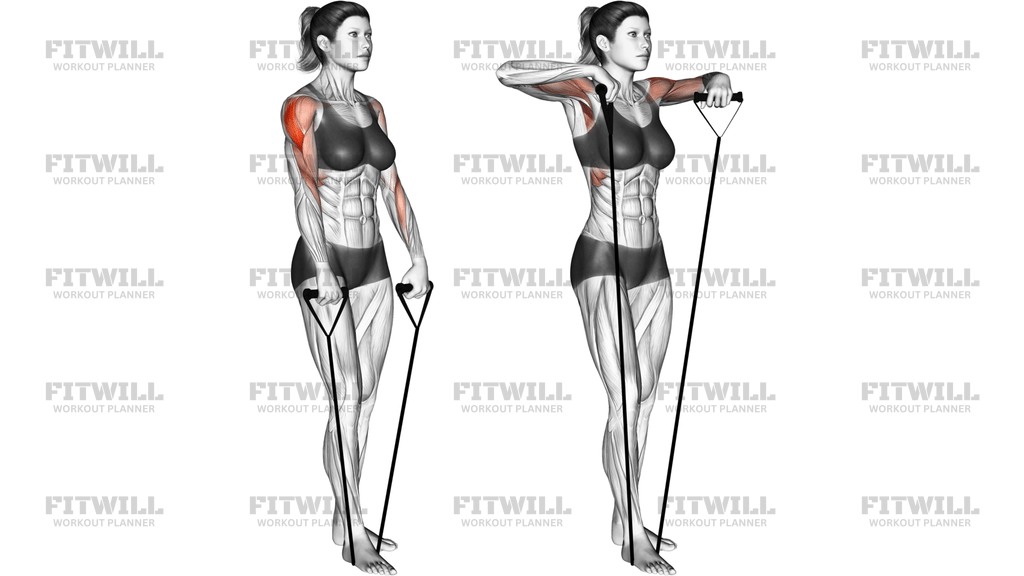
Band Upright Row is a standing shoulder exercise performed with the band anchored under both feet and the handles pulled upward along the front of the body. It is a simple way to train the delts, upper traps, and upper back with continuous tension, making the movement useful for warmups, accessory work, and lighter hypertrophy sets when you want controlled shoulder elevation instead of heavy loading.
The setup matters because the band path changes completely based on how you stand on it and where your hands start. In the image, the lifter stands tall with a narrow stance, arms straight, and the band hanging in front of the thighs before each rep begins. That starting position lets you create tension from the bottom without leaning back or shrugging early, and it gives you a clear line for the pull.
During the rep, the elbows lead the motion and travel out and up while the hands stay close to the torso. The handles rise to about lower-chest to upper-chest height, with the wrists kept neutral and the shoulders doing the work instead of the lower back. The return should be slow and controlled so the band does not snap the arms down and the shoulders stay organized between reps.
This exercise is most useful when you want shoulder and trap work with a low setup cost. It can be a practical option for home training, deload weeks, or finishers because the resistance changes smoothly as the band stretches. Use a lighter band if the top position feels pinchy or if the elbows drift too high, and shorten the range if needed to keep the movement pain-free and repeatable.
Good execution comes from staying upright, keeping the neck long, and letting the shoulders rise without turning the rep into a body swing. The goal is clean, even tension through the pull, not a jerky heave. If you can maintain the same torso angle, elbow path, and return speed for every rep, the band upright row becomes a precise shoulder builder instead of a momentum exercise.
[ Workout Log & Planner ]
Put your next workout in Fitwill
Keep your plan and training log ready when you are.


Instructions
- Stand on the band with both feet about hip-width apart and hold a handle in each hand in front of your thighs.
- Keep your chest tall, ribs stacked over your pelvis, and your arms straight before the first rep starts.
- Let the band hang with light tension while your palms face your body and your shoulders stay down.
- Brace your trunk, then begin the pull by lifting your elbows out and up along the front of your body.
- Keep the handles close to your torso as they travel upward, and do not let your back lean away from the band.
- Raise the band until your elbows are near shoulder height or the handles reach lower-chest to upper-chest level.
- Pause briefly at the top, keeping the neck long and the wrists neutral instead of bending them back.
- Lower the handles slowly to the start position under control and keep tension on the band the whole way down.
- Exhale on the pull, inhale on the return, and stop the set if the shoulders pinch or the torso starts to swing.
Tips & Tricks
- Choose a band that lets you reach the top without shrugging hard or jerking your torso backward.
- Keep the handles close to your shirt line; letting them drift forward usually turns the row into a front-delt raise.
- Think about leading with the elbows instead of the hands so the upper traps and delts share the work cleanly.
- Stop the rep where your shoulders still feel smooth; forcing the elbows above a comfortable height can create a pinch.
- A narrow stance is fine, but keep your weight centered over both feet so the band does not pull you off balance.
- Do not curl the wrists upward to finish the pull; the forearms should stay mostly neutral through the top.
- Use a slower lowering phase than lifting phase to keep tension on the delts and upper back.
- If you feel it mostly in the neck, reduce range of motion and lower the band resistance before adding reps.
Frequently Asked Questions
What muscle does Band Upright Row target most?
The main target is the delts, with the upper traps and upper back assisting as the elbows rise.
Can beginners perform this exercise?
Yes. Beginners usually do best with a light band and a shorter range so they can keep the pull smooth and pain-free.
Where should my hands and band start?
Start standing on the band with the handles in front of your thighs, arms straight, and the band already under light tension.
How high should I pull the handles?
For most people, the handles should rise to lower-chest or upper-chest height while the elbows stay near shoulder level or slightly below.
Why does this exercise use a band instead of a barbell or dumbbells?
The band gives smooth resistance and is easy to set up, which makes it useful for shoulder work when you want constant tension without heavy loading.
What if my shoulders feel pinched at the top?
Shorten the range, use a lighter band, and stop before the elbows rise into an uncomfortable position.
Should I shrug my shoulders hard during the pull?
No. The shoulders will rise a little, but the movement should still look controlled, with the elbows driving the lift rather than a sharp shrug.
What is the biggest form mistake?
Using body swing or leaning back to finish the rep. The torso should stay tall while the band and elbows do the work.