Band Lying Hip External Rotation
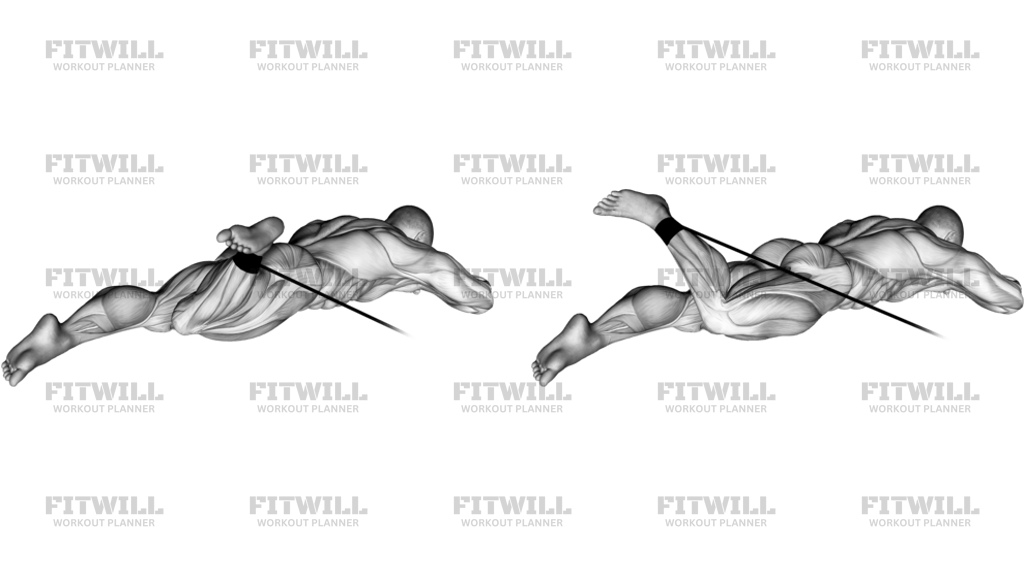
Band Lying Hip External Rotation is a side-lying band drill for opening and strengthening the hip rotators while teaching the pelvis to stay quiet. It is often used to wake up the glutes, improve hip control, and prepare the legs for squats, lunges, pivots, or any movement that depends on clean hip alignment.
The setup matters more than the range. When you lie on your side with your hips stacked and the band above the knees, the top leg can rotate outward without the torso twisting away from the work. That makes it a useful low-load accessory for activation work, warm-ups, and rehab-style sessions where you want the hip to move smoothly instead of aggressively.
Done well, the exercise should feel like a controlled opening of the top knee rather than a sweep of the whole body. The lower leg stays still, the ribs stay down, and the pelvis stays nearly square while the band creates just enough resistance to make the hip rotators and outer glute muscles work. A small, clean rep is better than forcing the knee farther open by rolling backward.
Use light tension and keep the tempo deliberate. Open the knee, pause briefly where the hip feels strongest, then lower it back with control before the band pulls the legs out of position. If the front of the hip pinches or the low back starts helping, the range is too large or the band is too heavy.
This movement is best treated as a controlled support exercise, not a max-strength lift. It can help beginners learn hip position and can also serve advanced lifters who need a short, precise drill before lower-body training. The goal is a repeatable pattern: hips stacked, pelvis steady, rotation coming from the hip, and every rep finished with the same clean shape.
Fitwill
Log Workouts, Track Progress & Build Strength.
Achieve more with Fitwill: explore over 9600 exercises with images and videos, access built-in and custom workouts, perfect for both gym and home sessions, and see real results.
Start your journey. Download today!




Instructions
- Lie on your side with your hips and shoulders stacked, knees bent about 90 degrees, and the band looped above your knees.
- Rest your head on your bottom arm or a pillow and keep your feet together so the lower body stays organized.
- Set your pelvis slightly forward so the top hip does not roll backward as you move.
- Brace lightly through your midsection and keep your rib cage from flaring open.
- Keeping the feet in contact, rotate the top knee upward against the band without letting the torso twist.
- Open only as far as you can keep the pelvis still and the band tension under control.
- Pause briefly at the top while the outer hip is working, then exhale and lower the knee slowly.
- Return to the starting position with control before beginning the next repetition.
Tips & Tricks
- Use a light band; this drill should feel precise, not like a maximum-effort abduction exercise.
- If your top hip rolls backward, shorten the range and keep the pelvis stacked.
- Keep the feet touching or lightly pressed together so the movement comes from hip rotation, not a leg lift.
- A small, smooth opening is better than forcing the knee wide and losing pelvic position.
- Slow the lowering phase so the band does not snap the leg back down.
- If you feel the front of the hip pinch, reduce the range and check that your knees are not drifting forward.
- Keep the neck and jaw relaxed; tension should stay in the hip, not creep into the upper body.
- Use this before lower-body lifts or agility work when you want cleaner hip control.
- Stop the set as soon as the pelvis starts rocking or the band makes you rotate through the trunk.
Frequently Asked Questions
What does Band Lying Hip External Rotation train?
It trains hip external rotation control, with the outer glute and deep hip rotators doing most of the work.
Is this basically a banded clamshell?
Yes, the setup is very similar to a clamshell: side-lying, knees bent, and the top knee opening against the band.
Where should the band go for this exercise?
Loop the band above the knees so the hips can rotate without the ankles or feet having to fight extra leverage.
How far should I open the top knee?
Open only as far as you can keep the pelvis stacked and the lower body quiet; a smaller clean range is better than a bigger sloppy one.
Why do I feel this in my low back?
That usually means the pelvis is rolling backward or the ribs are flaring. Shorten the range and keep the trunk more still.
Can beginners do Band Lying Hip External Rotation?
Yes. It is beginner-friendly when you use a light band and focus on a slow, controlled opening of the knee.
What if I feel it mostly in the front of the hip?
Reduce the range and make sure the thigh is rotating from the hip instead of sliding forward.
When is this exercise useful in a workout?
It works well in warm-ups, activation blocks, or rehab-style accessory work before heavier lower-body training.