Standing Iliotibial Stretch
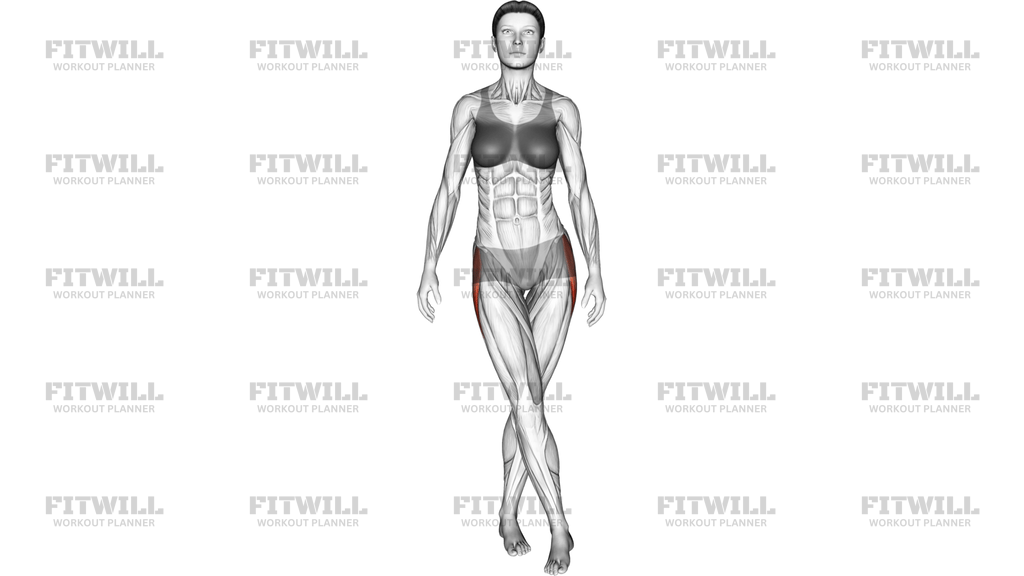
Standing Iliotibial Stretch is a standing mobility drill for the outer hip, glutes, and lateral thigh. It is usually done with bodyweight only, and a mat is optional if you want extra comfort under your feet. The goal is not to crank on the knee or force the torso sideways; it is to create a controlled line of tension from the hip through the outside of the thigh while keeping the pelvis and rib cage organized.
The movement matters because the IT band itself is dense tissue and does not lengthen much on its own. What you are really training is the ability to position the hip and trunk so the surrounding tissues, especially the glute medius, tensor fasciae latae, and upper outer thigh, can relax into a mild stretch. That is why the setup should stay tall, square, and balanced before you lean or shift. If your balance is shaky, use a wall or rack lightly instead of letting the stretch turn into a wobble.
A good repetition starts by crossing one leg behind the other, softening the standing knee, and keeping both feet pointed forward. From there, shift the hips toward the front-leg side and lean the torso away from the stretched side just enough to feel the outer hip open. Keep the chest facing forward, avoid rotating the hips open, and breathe steadily so the stretch settles instead of tightening up. The end position should feel like a smooth pull along the outside of the hip and thigh, not a pinch in the low back or knee.
This stretch fits well after running, cycling, squats, lunges, or any session that leaves the lateral hip feeling tight. It can also be used in a warm-up if you keep the hold brief and controlled. Use it as a mobility reset rather than an aggressive test of flexibility. Smaller positions usually work better than big dramatic ones, and a calm, repeatable stretch is more useful than forcing a larger range that changes your posture.
[ Workout Log & Planner ]
Put your next workout in Fitwill
Keep your plan and training log ready when you are.


Instructions
- Stand tall with your feet under your hips and place one hand near a wall or rack if you need balance.
- Cross the leg you want to stretch behind the other leg and keep both toes pointing forward.
- Keep both knees soft and square your hips to the front before you start leaning.
- Shift your hips toward the front-leg side until you feel the outside of the crossed leg start to open.
- Lean your torso away from the crossed leg without twisting your chest or letting your hips rotate open.
- Keep the stretched-side foot light and flat while breathing out slowly into the end position.
- Hold the stretch for a few calm breaths without bouncing or pushing into pain.
- Return to upright under control, uncross your legs, and repeat on the other side.
Tips & Tricks
- Use a wall lightly if the crossed-leg position makes you unstable.
- Keep the chest facing forward so the stretch comes from the side bend, not from twisting.
- A smaller cross-over usually gives a cleaner hip stretch than forcing the feet far apart.
- If you feel the stretch in the knee, reduce how far the leg crosses and keep the toes forward.
- The best sensation is usually high on the outer hip and upper outer thigh, not in the low back.
- Keep the standing knee softly bent so you do not lock out and shift tension away from the target side.
- Long, quiet exhales help the lateral hip relax more than hard pushing does.
- Stop short of any sharp pulling or pinching around the hip joint.
Frequently Asked Questions
What areas does Standing Iliotibial Stretch target?
It mainly targets the outer hip and lateral thigh, especially the glute medius and tensor fasciae latae area.
Does this stretch the IT band itself?
Not directly in a major way. The position mostly opens the surrounding hip and thigh tissues that attach into the IT band.
Do I need a wall or any equipment?
No equipment is required. A wall or rack is only there to help you balance if the crossed-leg stance feels unsteady.
Which side should I feel it on?
You should feel the stretch on the outer hip and thigh of the leg that is crossed behind and lengthened.
Should my torso twist during the stretch?
No. Keep your chest facing forward and let the stretch come from a controlled side lean and hip shift.
Is this a good beginner stretch?
Yes, as long as you keep the cross-over small and use support when needed. Beginners should avoid forcing a big range.
What if I feel the stretch in my knee?
Shorten the cross-over, keep both toes forward, and back off the range. Sharp knee pain is a sign to stop and reassess.
When should I use this stretch?
It works well after running, lower-body lifting, cycling, or whenever the outer hip feels tight and compressed.