Resistance Band Squatting Front Warming-Up
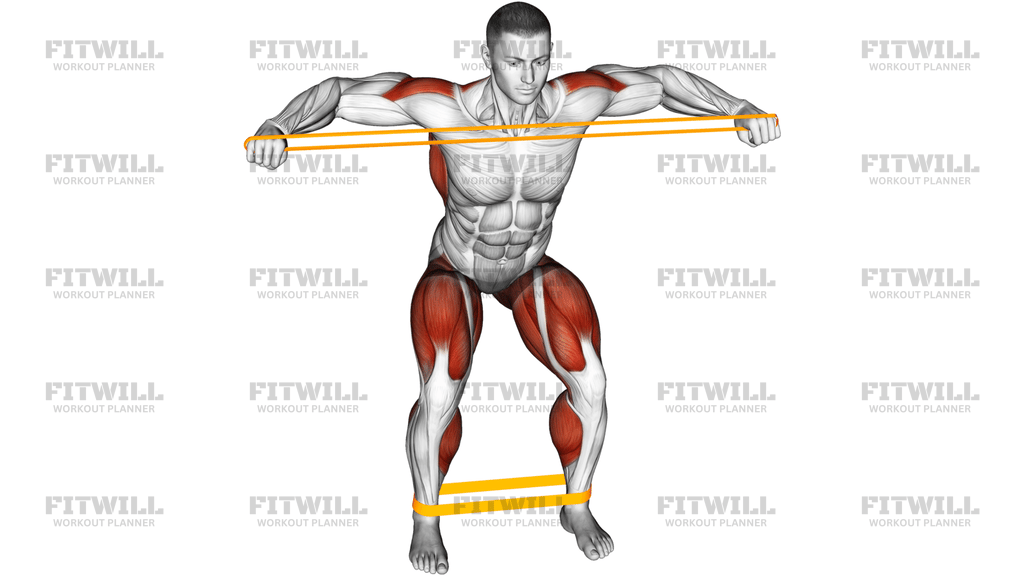
Resistance Band Squatting Front Warming-Up is a banded squat-position warm-up that combines a shallow squat with active forward reach and constant elastic tension. It is meant to prepare the body for front-loaded squatting, not to exhaust it. The position asks the legs, trunk, shoulders, and upper back to stay organized at the same time, which makes it a useful rehearsal before front squats, goblet squats, or any session that needs a tall torso and clean knee tracking.
The setup matters because the band changes how you feel every part of the rep. In the image, the feet stay planted while the lower band adds awareness around the ankles and the hands hold the upper band in front of the body. That combination encourages you to keep pressure through the whole foot, hold the knees in line with the toes, and keep the chest lifted instead of collapsing forward as you descend.
Treat each repetition like a controlled pattern reset. Lower into a shallow squat under tension, pause when the position still feels stacked, and stand back up without bouncing out of the bottom. The arms should stay active in front of the shoulders, the ribs should stay over the pelvis, and the head should remain neutral so the upper back does not take over from the legs. If the depth or tension causes the heels to lift or the lower back to tuck, reduce the range immediately.
This drill works best early in a workout or between heavier squat sets when you want a technical reminder rather than more load. It is especially useful if your front squat tends to fold forward, if your knees drift inward, or if your upper body loses tension when you enter the bottom position. Beginners can use it with a very shallow range and light band tension, while experienced lifters can use it as a position-focused warm-up before heavier squatting work.
The main benefit is better squat mechanics under light resistance: steadier feet, cleaner torso position, and more reliable brace timing. When the movement is done well, the body feels more ready for loaded squats because the hips, knees, trunk, and shoulders have already been asked to work together before the main sets begin.
[ Workout Log & Planner ]
Put your next workout in Fitwill
Keep your plan and training log ready when you are.


Instructions
- Step on the lower band with feet about shoulder-width apart and place it just above the ankles.
- Hold the upper band in front of your chest with the arms extended at shoulder height and a slight bend in the elbows.
- Turn the toes slightly out, soften the knees, and stack the ribs over the pelvis before you start moving.
- Sit back and down into a shallow squat while keeping the heels heavy and the whole foot on the floor.
- Press outward into the front band so the shoulders stay active and the chest does not cave in.
- Keep the knees tracking over the second and third toes as you reach the bottom of the squat.
- Pause briefly in the lowest position you can control without losing posture or band tension.
- Drive through the midfoot and heels to stand back up, then reset before the next rep.
- Step out of the bands carefully after the set and keep the same stance if you repeat it.
Tips & Tricks
- Use light band tension; this drill should improve position, not turn into a strength test.
- Keep the squat shallow enough that your lower back never has to tuck under at the bottom.
- If your heels start to rise, widen the stance slightly or shorten the range before adding tension.
- Push the knees out just enough to stay lined up with the toes; do not force a wide stance that twists the feet.
- Hold the arms long and active in front of you so the upper back stays engaged instead of slumping forward.
- Breathe in before each descent and exhale as you stand so the torso stays braced without stiffening the neck.
- Keep the weight centered over the midfoot rather than rocking onto the toes as the squat gets deeper.
- Stop the set when the movement turns into a bounce, because the warm-up value drops fast once control is gone.
Frequently Asked Questions
What does Resistance Band Squatting Front Warming-Up train?
It primarily rehearses squat posture and activation for the quads, glutes, core, upper back, and shoulders.
Is this meant to be a strength exercise or a warm-up?
It is mainly a warm-up and movement-prep drill, so the goal is better position and tension, not heavy loading.
How deep should I squat in this drill?
Only squat as low as you can while keeping the heels down, the knees tracking over the toes, and the torso stacked.
Why are the hands held in front of the body?
The forward reach helps keep the chest lifted and reminds you to stay organized through the upper back as you squat.
Do I need the ankle band shown in the image?
The ankle band increases awareness of foot pressure and knee tracking, but you can still use the drill with lighter band tension if that setup is not available.
Can beginners do this exercise?
Yes, beginners can use a shallow range and very light tension as long as they can keep the heels grounded and the torso steady.
What is a common form mistake?
Letting the chest drop and the knees cave inward is the biggest issue, especially when the squat gets deeper.
When should I use this in a workout?
Use it early in a lower-body session or between heavier squat sets when you want to rehearse position without adding fatigue.