Medicine Ball Woodchop Bulgarian Split Squat
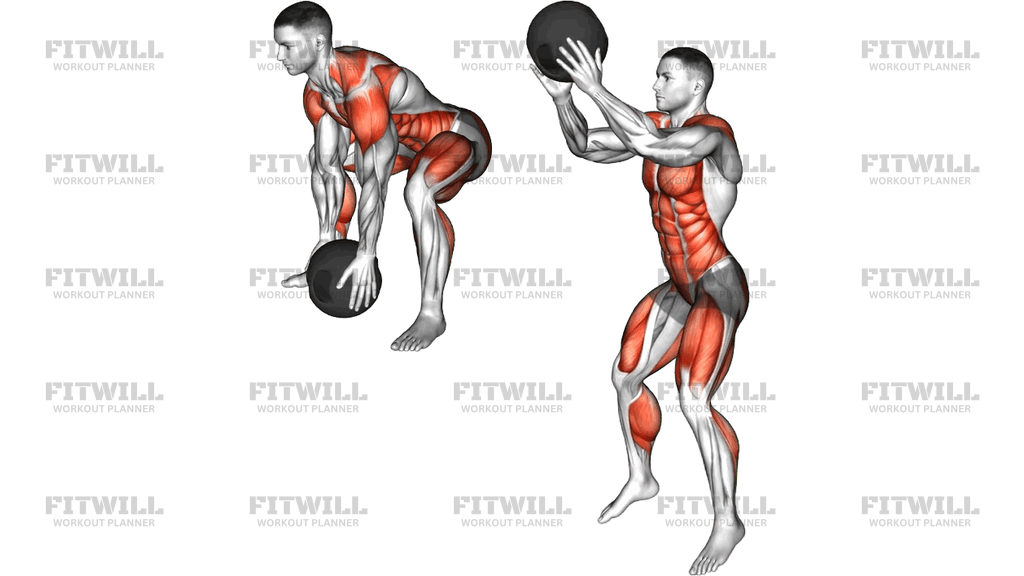
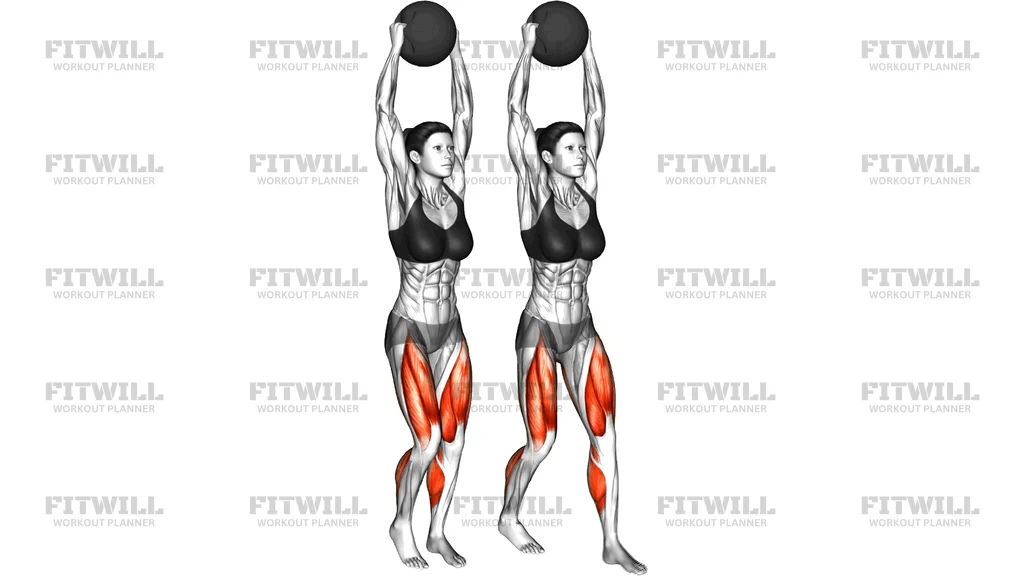
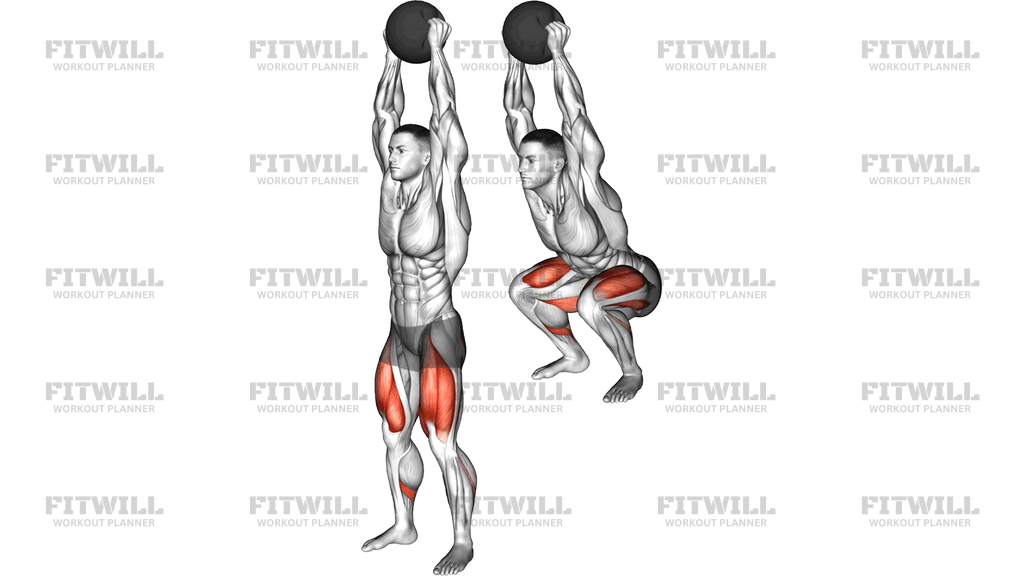
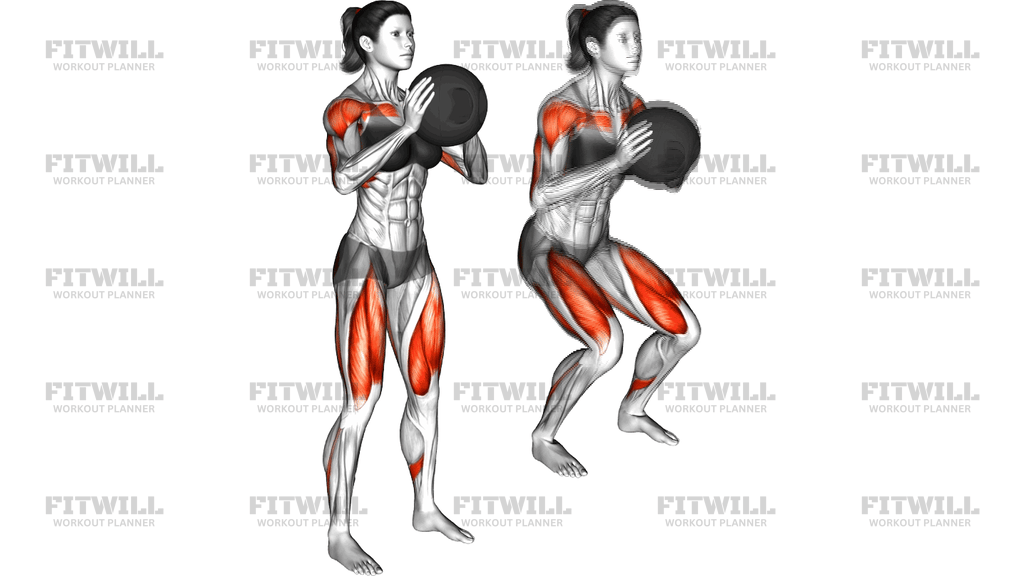
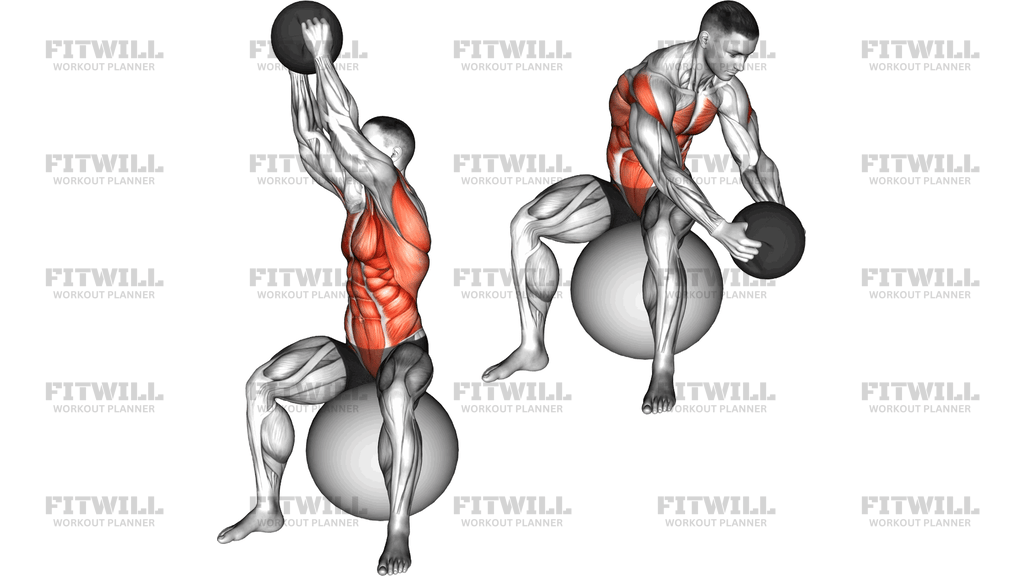
The Medicine Ball Woodchop Bulgarian Split Squat combines two demanding patterns into one exercise: the rear-foot-elevated split squat and a diagonal woodchop with a medicine ball. Your rear foot rests on a flat bench behind you while your front leg takes most of your bodyweight. You hold the medicine ball with both hands, start with it pressed overhead, and as you lower into the squat you pull the ball down and across toward the hip of your front leg, then raise it back overhead as you stand.
This hybrid works your legs hard — the front leg's glutes, quads, and hamstrings handle the squat while the rear hip flexor gets a stretch in the elevated position. Because the ball travels on a diagonal path across your torso, your obliques and deep core have to resist rotation and control the arc, and your shoulders work to keep the ball moving smoothly overhead and down. It trains strength, balance, and coordinated movement from the ground up in a way that carries over to swinging, throwing, and running actions.
The split squat setup matters more here than in a standard version because you are moving a load through space while balancing on one leg. Take the time to position your front foot far enough forward that your shin stays roughly vertical at the bottom and your knee does not drive past your toes. If your stance is too short, you will pitch forward and lose the diagonal chopping line; too long, and your hips drop and your lower back starts to arch.
Use a light medicine ball to start — something you can press overhead with straight elbows and control through the whole arc without wobbling. Move slowly on the way down, chop the ball along the diagonal as you descend, pause briefly near your front hip, then drive through your front heel and let the ball travel back up with the stand. Exhale as you rise, inhale as you lower.
This exercise suits intermediate trainees who already own both a stable Bulgarian split squat and an overhead position. It appears in athletic conditioning programs for rotational power and single-leg strength, and in general training for people who want more out of their leg work than just a squat. Because balance is the limiting factor early on, keep reps moderate and stay away from failure until the movement feels smooth on both sides.
[ Workout Log & Planner ]
Put your next workout in Fitwill
Keep your plan and training log ready when you are.


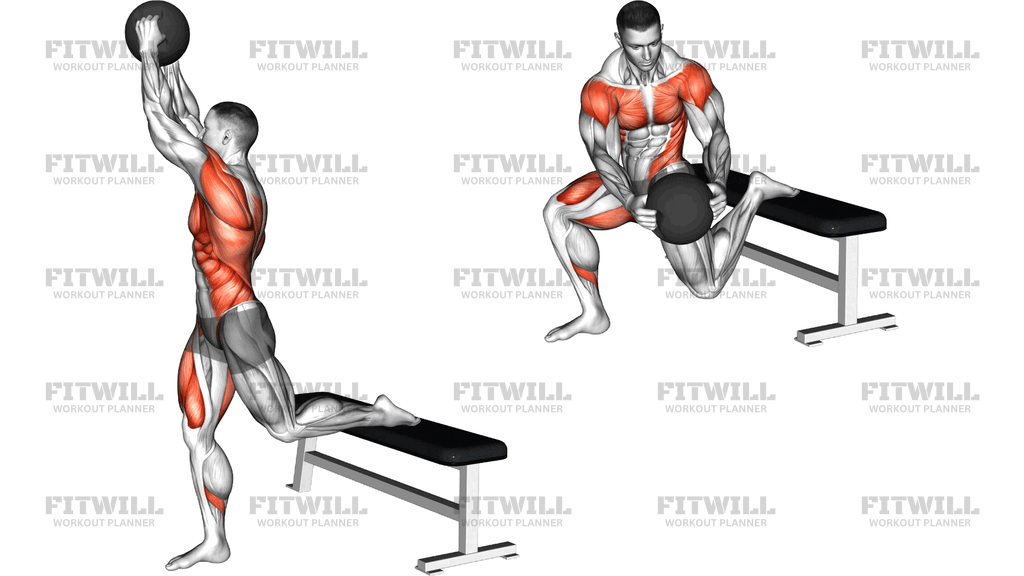
Instructions
- Place a flat bench behind you and rest the top of one foot on it, laces down, with your other foot planted about two to three feet in front so you can drop straight down without your front knee drifting past your toes.
- Hold a medicine ball with both hands, fingers spread around the sides, and press it straight overhead with your arms extended and elbows locked out.
- Brace your core and squeeze the glute of your rear leg to square your hips toward the front foot.
- Begin the descent by bending your front knee and hip straight down, and at the same time pull the ball diagonally down and across your body toward the outside of your front leg's hip.
- Lower until your front thigh is close to parallel with the floor and your rear knee hangs just above the ground, with the ball held beside your front hip.
- Pause for a beat, keeping your torso tall and your shoulders level rather than twisting the chest toward the ball.
- Drive through your front heel to stand, raising the ball back along the same diagonal until your arms are fully overhead.
- Exhale as you stand and lift the ball; inhale as you lower into the next rep.
- Complete all reps on one side, then reposition and switch legs so the ball chops toward the opposite hip.
Tips & Tricks
- If your balance wobbles as the ball goes overhead, widen your front foot slightly or shift it a few inches to the side — a wider base under a raised load makes a huge difference in a rear-foot-elevated split squat.
- Watch for the ball drifting toward the midline of your body at the bottom; the chop should finish beside your front hip, not in front of your belt, or you lose the rotational demand on the obliques.
- Keep your elbows extended at the top but let them bend naturally as the ball comes down — locking the arms through the whole arc strains the shoulders and slows the movement.
- A common mistake is letting the front knee collapse inward as the ball pulls you down and across; think about spreading the floor with your front foot to keep the knee tracking over the toes.
- If you feel your lower back arch as the ball goes overhead, your ball is likely too heavy or your ribs are flaring; use a lighter ball and tuck your ribs slightly before pressing up.
- Keep your hips square throughout — rotating the torso to help the chop turns this into an easy half-rep and removes tension from the front-leg glutes.
- Start with a shallow range on the first set of each side; the diagonal ball path plus the elevated rear foot challenges balance more than either exercise alone, so earn depth gradually.
- Do not rush the upward chop — the transition from hip-level to overhead is where most people lose control of the ball and the squat position together.
Frequently Asked Questions
Which muscles does the Medicine Ball Woodchop Bulgarian Split Squat work hardest?
The front leg's glutes and quads do most of the work during the squat, with the hamstrings assisting. The obliques and core stabilize against the diagonal ball path, and the shoulders handle the overhead position.
How heavy should my medicine ball be for this exercise?
Choose a ball light enough that you can hold it overhead with straight arms and complete the full chop without your torso wobbling or your back arching. For most people starting out, that means a much lighter ball than they would use for a standing woodchop, since you are balancing on one leg at the same time.
Is the Medicine Ball Woodchop Bulgarian Split Squat suitable for beginners?
Beginners should first learn a bodyweight Bulgarian split squat and a standing medicine ball woodchop separately. Once both feel stable, combining them with a very light ball is a reasonable progression.
Should the ball chop toward the same side as my front leg or the opposite side?
Chop the ball down toward the hip of your front leg, as this keeps the arc natural and lets you balance over your working leg. Chopping across to the rear side pulls your torso into rotation and makes the split squat unstable.
My rear knee aches when my foot is on the bench — what should I change?
Make sure the top of your foot, not your knee or shin, rests on the bench, and keep your hips square so the rear leg tracks straight. If discomfort persists, drop the ball and practice the split squat alone, or place your rear foot on a lower surface.
Can I substitute anything for the medicine ball?
A light dumbbell held by the head in both hands works, and a kettlebell can be held by the horns. A slam ball or sandbag also fits because both hands can wrap around it, which keeps the diagonal path secure.
Why does the Medicine Ball Woodchop Bulgarian Split Squat improve balance so much?
Your base of support is limited to one foot while a moving load travels overhead and across your body, forcing the ankle stabilizers, hips, and core to constantly correct. This is why balance often fails before strength does in the early sessions.
How many reps and sets should I do?
Start with 2 to 3 sets of 6 to 8 reps per leg with a light ball, resting between sides. Because the movement is balance-limited, prioritize smooth, controlled reps over chasing higher numbers.
Is it a problem if my front knee travels forward over my toes?
Some forward knee travel is normal, but excessive drift usually means your stance is too short or you are leaning your chest toward the ball as you chop. Step your front foot farther forward and keep your torso tall to bring the knee back over the midfoot.
When should I progress to a heavier ball?
Add weight only when you can complete all reps on both sides with the ball held steady overhead, a level torso, and no knee collapse. If adding weight breaks your form, it will cost you more in stability than it gains in strength.