Weighted Medicine Ball Hollow Hold
The Weighted Medicine Ball Hollow Hold takes the classic gymnastics hollow body position and adds load with a medicine ball held in your hands. You lie on your back, press the ball into the floor behind or above your head with straight arms, then lift your shoulders and legs so your body forms a shallow banana shape held rigid from fingertips to toes. The ball serves two jobs at once: it lengthens the lever arm your abs have to control, and it gives you something to squeeze, which helps you brace harder than you would with empty hands.
This is one of the most effective isometric core exercises available because it trains the abs in their real job, which is resisting extension. When your arms and legs are lifted and weighted, your lower back constantly wants to arch and your ribs want to flare. Holding the hollow position forces your rectus abdominis and deep core to stay switched on the entire time, while your hip flexors work hard to keep straight legs off the floor. You will also feel your shoulders and lats working to keep the ball pressed up and stable overhead.
The setup matters more here than in most ab exercises. Where you place the ball changes the difficulty dramatically. Holding it pressed to the ceiling above your chest is the hardest variation because the weight sits farthest from your center. Cradling it at your chest or resting your hands on it at your sides scales the load down. Start where you can hold a clean position, not where your lower back peels off the floor within five seconds.
This exercise suits anyone who has outgrown basic hollow holds, as well as athletes who need a stiff, resilient midsection for sprinting, jumping, lifting, or gymnastics-style training. Because it is an isometric hold, it builds endurance and bracing capacity rather than visible six-pack size on its own, and it pairs well with dynamic movements like leg raises or ball passes.
To execute it well, think about pressing the ball toward the ceiling while pulling your ribs down and pushing your lower back gently into the floor before you lift. Then raise your shoulder blades and straight legs together, keeping the low back in contact with the mat. The moment your back arches or your legs drop, the set is over, whether the clock says so or not. Quality holds of twenty to forty seconds beat sloppy minute-long attempts every time.
The main safety point is your lower back. If you feel strain, pinching, or arching, bend your knees slightly, shorten the hold, or use a lighter ball. Discomfort in the abs is expected; discomfort in the spine is a signal to regress the position.
[ Workout Log & Planner ]
Put your next workout in Fitwill
Keep your plan and training log ready when you are.


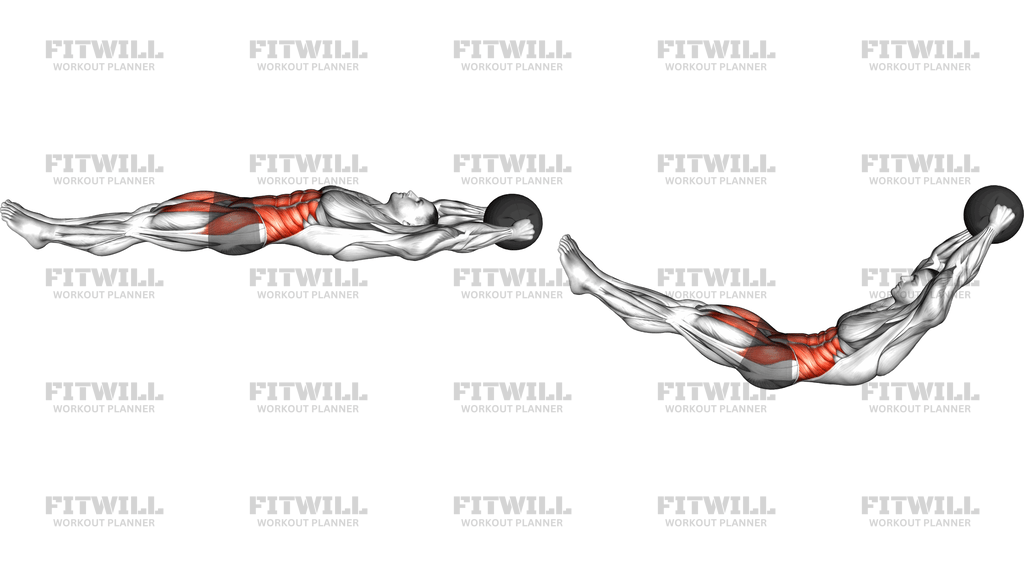
Instructions
- Lie flat on your back on an exercise mat with your legs straight and together, and hold a medicine ball in both hands with your arms extended straight behind or above your head.
- Press the ball firmly toward the ceiling so your arms stay straight and your shoulders stay engaged rather than sagging toward your ears.
- Exhale, pull your ribs down, and press your lower back into the mat so there is no gap between your spine and the floor.
- Keeping the ball stacked over your chest, lift your shoulder blades and head off the mat while simultaneously raising your straight legs to about hip height or slightly lower.
- Squeeze your glutes, point or flex your toes, and lock in the hollow shape so your body forms a shallow curve with only your lower back and hips touching the mat.
- Hold this rigid position, breathing shallow and steady through your nose, keeping the ball steady and your arms vertical the entire time.
- Watch for your lower back arching away from the mat; if it does, lift your legs slightly higher or bend your knees to shorten the lever.
- When the hold ends, lower your legs and upper back back down to the mat under control, then set the ball down beside you before resting.
- Reset your brace with a full exhale before starting the next hold, and rest at least 30 to 60 seconds between sets.
Tips & Tricks
- If your ribs flare toward the ceiling, you have lost the hollow; exhale hard and think about pulling your belly button toward your spine before lifting the legs.
- A ball held straight above your chest is far harder than one cradled at your chest, so progress the arm position before adding a heavier ball.
- The most common failure is the lower back arching as the legs lower; this means the lever is too long, so bend your knees slightly rather than letting the back lift.
- Keep active shoulders by pressing the ball up, not just holding it; dead arms are why the ball drifts forward and the hold collapses.
- Start with a light ball of 4 to 8 pounds. A heavy ball turns this into a shoulder endurance test before your abs get anything out of it.
- Squeeze the ball hard with both hands; that grip tension radiates through your arms and makes your whole midsection brace harder.
- Time your sets honestly: end the hold the moment your form breaks, even if that means three good sets of 20 seconds instead of one shaky 60-second hold.
- Warm up with a short bodyweight hollow hold first so you can find the position before adding load.
- Keep your head in line with your arms and look at the ball or slightly past it; craning your chin to your chest strains the neck without helping the abs.
Frequently Asked Questions
What muscles does the Weighted Medicine Ball Hollow Hold work?
The primary muscles are the abs, especially the rectus abdominis and deep core stabilizers, with strong support from the hip flexors holding straight legs up. Your shoulders and lats also work to keep the medicine ball pressed overhead and stable.
Where should I hold the medicine ball during the Weighted Medicine Ball Hollow Hold?
Hold it in straight arms above your chest for the standard version, which maximizes the load on your abs. If that is too hard, cradle the ball against your chest or hold it at your sides to reduce the lever length.
Is the Weighted Medicine Ball Hollow Hold good for beginners?
Beginners should first master the unweighted hollow hold with knees bent or hands at their sides. Once you can hold a clean bodyweight position for about 30 seconds without your lower back arching, add a light medicine ball.
Why does my lower back arch during the Weighted Medicine Ball Hollow Hold?
Your legs and arms create a long, weighted lever that pulls your spine into extension when your abs fatigue. Fix it by raising your legs slightly, bending your knees, using a lighter ball, or shortening the hold.
How heavy should the medicine ball be for the Weighted Medicine Ball Hollow Hold?
Most people do best with a 4 to 10 pound ball, since the point is a sustained hold, not maximal load. Choose a weight you can hold for 20 to 40 seconds while keeping your lower back glued to the mat.
How long should I hold the Weighted Medicine Ball Hollow Hold?
Aim for 20 to 40 seconds per set with strict form, building up to 60 seconds over weeks. Multiple crisp sets beat one long hold where your back arches and your legs sag.
Can I substitute another exercise for the Weighted Medicine Ball Hollow Hold?
A bodyweight hollow hold, a hollow rock, or a V-sit hold all train the same anti-extension bracing pattern. A weighted dead bug or plank with a weight on your back also works if you do not have a medicine ball.
Should I breathe during the Weighted Medicine Ball Hollow Hold?
Yes, breathe shallow and continuous rather than holding your breath, since this is a timed endurance hold. Exhale as you set the position, then take small, steady breaths through your nose while keeping your ribs down.
Is the Weighted Medicine Ball Hollow Hold safe for my back?
It is generally safe when your lower back stays pressed into the mat and you stop when form breaks. If you feel spinal pinching rather than ab fatigue, reduce the lever by bending your knees or regress to the unweighted version.