Bosu Ball Single Leg Deadlift
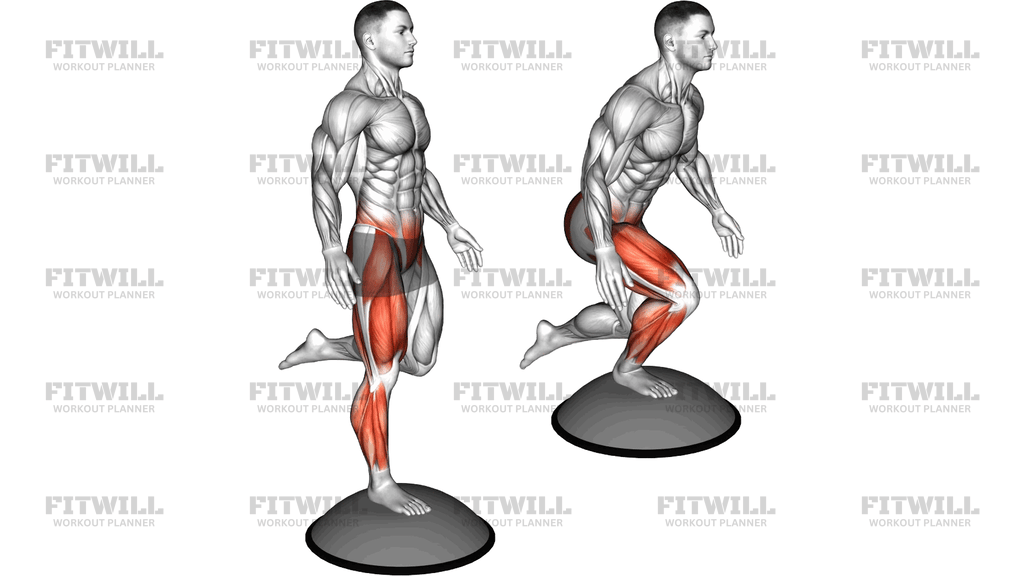
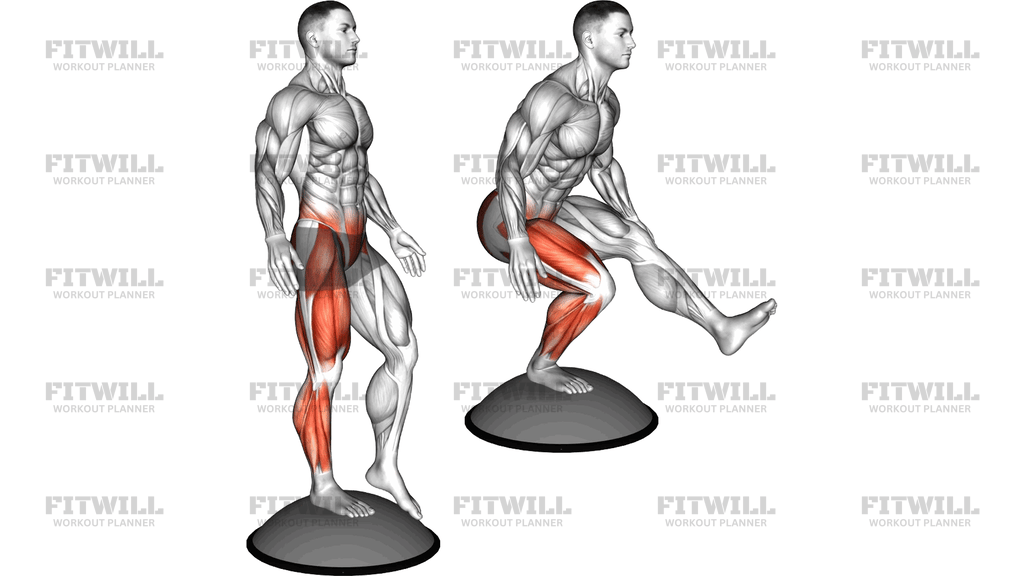
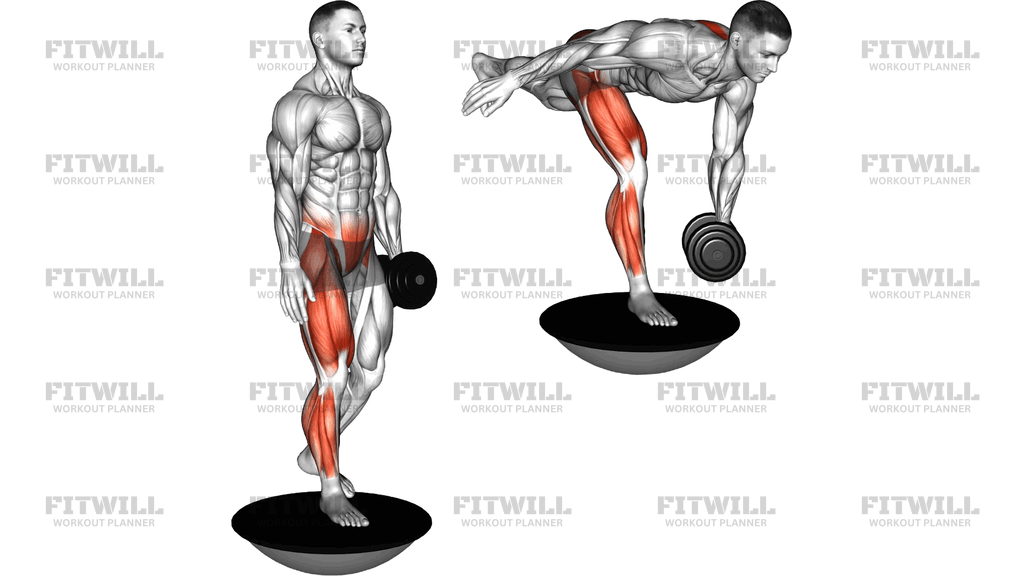
The Bosu Ball Single Leg Deadlift is a balance-focused hinge performed while standing on one leg on top of a Bosu ball, with the dome side up. From a tall single-leg stance, you push your hips back and fold forward until your torso approaches parallel to the floor while your free leg swings behind you as a counterweight, then drive through your standing heel to return upright. Your arms hang down toward the ball and reach forward as you hinge, which helps you find a long, level line from crown to back heel.
This movement earns its place in a program because it stacks two demands at once: a proper hip hinge and single-leg stability on an unstable, rounded surface. The hamstrings and glutes of the standing leg handle the hinge, while the calves, ankles, and deep core work continuously to keep you from tipping off the ball. Because you are working unilaterally with no added load, it also exposes and helps correct side-to-side differences in strength, balance, and hip control.
It suits intermediate trainees who already own a solid floor-based single-leg deadlift, and it is popular with runners, field-sport athletes, and anyone rehabbing or prehabbing ankle and hip stability. It also works well as a warm-up primer before heavier lower-body lifting, or as a finisher when you want balance work without loading the spine. Beginners can still use it, but expect to spend the first few sessions simply learning not to wobble off the dome.
Setup matters more than speed here. Center your standing foot on the dome, roughly where the ball's apex meets the flat middle, with your toes spread and weight distributed across the whole foot. Keep a soft bend in the standing knee, brace your ribs down over your pelvis, and pick a fixed spot on the floor in front of you. Starting tall and settled before you hinge is what separates a clean rep from a stumble.
The execution cue that matters most is hinge, not squat: your hips travel backward, your chest lowers, and your back stays long rather than rounded. Let the free leg extend straight behind you so it loads the glute of the moving leg and counterbalances your torso. Move slowly in both directions, especially on the way back up, because the unstable surface punishes rushing. If you lose your balance, step off safely, reset your foot position, and start the rep again rather than fighting a losing position.
The main practical safety point is to keep the working range honest. Only hinge as far as you can keep your back flat, your hips square, and your standing knee tracking over your mid-foot. A wobbly, rounded-back reach to the floor trains nothing useful. Control and consistency on the ball beat depth every time.
[ Workout Log & Planner ]
Put your next workout in Fitwill
Keep your plan and training log ready when you are.


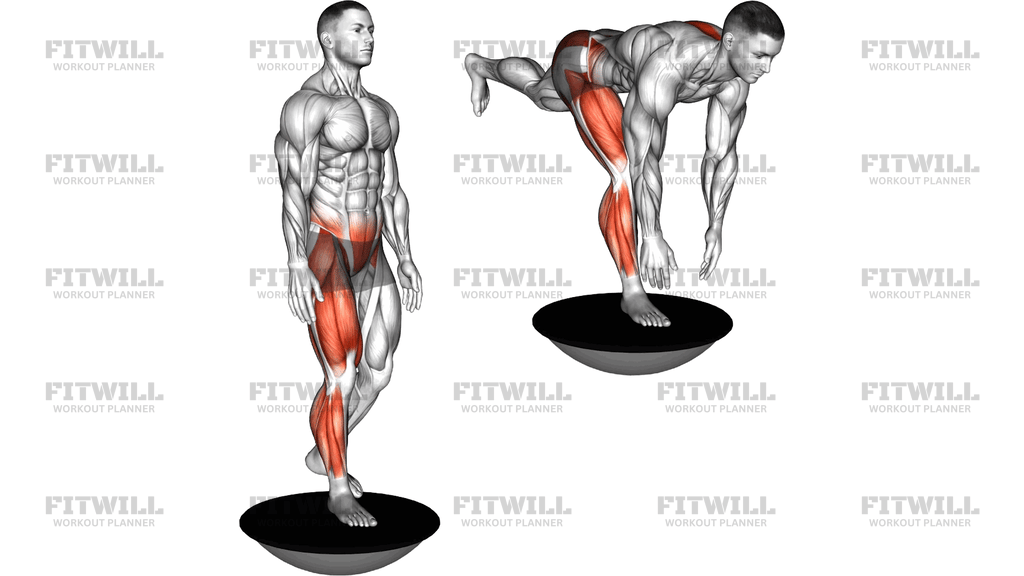
Instructions
- Place a Bosu ball on a non-slip floor with the dome side up, and step onto the center of the dome with your right foot, leaving your left foot on the floor for support.
- Once settled, lift your left foot off the ball and let it hover just behind you, standing tall on your right leg with a soft bend in the right knee and your toes spread for grip.
- Stack your ribs over your pelvis, brace your abs, pull your shoulder blades gently back, and fix your eyes on a spot on the floor about a meter in front of the ball.
- Begin the hinge by pushing your hips straight back, letting your torso lower forward while your arms hang and reach down toward the ball.
- Keep hinging until your chest faces the floor and your torso is close to parallel, with your left leg extended straight behind you so your head, hips, and back heel form one long line.
- Pause briefly at the bottom, keeping your back flat and your hips square to the floor rather than letting the trailing hip rotate open.
- Drive through the heel and mid-foot of your standing leg, squeeze the glute, and return to a tall single-leg stance without letting the hovering foot touch down.
- Exhale as you hinge forward and inhale as you stand back up, keeping your breath steady instead of holding it.
- Complete all reps on the right leg, step off the ball, re-center your foot, and repeat the set on the left leg.
- If you tip off the dome at any point, step down safely, shake out your ankles, and restart the rep from a settled stance.
Tips & Tricks
- If you keep sliding off the dome, your foot is too far forward on the curve. Place the ball of your foot across the flat center of the dome and grip with your toes.
- The most common mistake is bending the standing knee into a squat instead of hinging. Cue yourself to push the hips back and reach the tailbone toward the wall behind you.
- Watch for the trailing hip hiking up or rotating outward as you fold. Point the toes of your lifted leg toward the floor and squeeze that glute to keep the hips level.
- A rounded lower back at the bottom usually means you went deeper than your hamstrings allow. Shorten the range until your spine stays long, and earn more depth over weeks.
- Fix your gaze on a static spot on the floor, not your feet or the ball. Looking around on an unstable surface is the fastest way to lose balance.
- Move at roughly half the speed you would use on the floor. The wobble on the way up is where the ankle stabilizers learn, so do not rush past it.
- Start with the easiest version: tap the toes of your free leg down between reps, or hold a wall or rack with one hand until your balance improves, then progress to no support.
- If one side wobbles badly more than the other, give the weak side one extra set and always start your sets with it while you are fresh.
- Do this drill before heavy deadlifts or squats as neural priming, or after training as balance work, but avoid doing it right before heavy lifting when your stabilizers are already fatigued.
Frequently Asked Questions
Which muscles does the Bosu Ball Single Leg Deadlift work?
The hamstrings and glutes of the standing leg do the hinging, while the calves, ankle stabilizers, and deep core work to keep you balanced on the dome. The glute of the trailing leg also stays active as it holds the leg extended behind you.
Is the Bosu Ball Single Leg Deadlift suitable for beginners?
It can be, but most beginners should first master a single-leg deadlift on the floor. If you start directly on the ball, keep the range shallow, tap your free leg down between reps, or stand near a wall for light support.
Where exactly should my foot be on the Bosu ball?
Place your standing foot across the flat center of the dome so your weight sits over the ball's apex. Too far forward on the curve and the ball will roll your ankle outward; too far back and you lose grip through the heel.
Should I hold a dumbbell during this exercise?
Not at first. The unstable surface provides plenty of challenge on its own, and adding load before your balance is solid usually turns the rep into a staggered fight rather than a clean hinge. Add a light dumbbell in the opposite hand only once you can complete controlled sets on each leg.
How far down should I hinge on the Bosu Ball Single Leg Deadlift?
Hinge until your torso is close to parallel with the floor and your free leg forms a straight line behind you, but only as far as you can keep your back flat and hips square. A shorter, flat-backed rep is worth more than a deep one with a rounded spine.
Why do my calves burn more than my hamstrings during this exercise?
The rounded dome forces constant small corrections through your ankles, so your calves and foot stabilizers work hard, especially when you are new to the drill. This fades as your balance improves, and slightly slowing the hinge usually shifts the emphasis back to the hips.
My standing knee wobbles inward on the ball. How do I fix it?
Spread your toes, keep pressure spread across the whole foot, and consciously track your knee over your second toe with a soft, consistent bend. If the wobble persists, reduce your hinge depth and rebuild the range gradually.
What can I substitute if I do not have a Bosu ball?
A regular single-leg deadlift on the floor trains the same hinge, and a folded balance pad or a stability ball held for light fingertip support can add instability. You lose the exact dome feedback, but the balance and hamstring demand carries over well.
How many reps and sets should I do?
Two to four sets of six to ten controlled reps per leg works well for most people. Because balance degrades with fatigue, prioritize slow, clean reps over high numbers, and stop a set once your form on the dome gets sloppy.
Is it safe for my lower back and knees?
When performed with a braced core, a soft knee bend, and a flat-backed hinge, it is a low-load way to build hip and ankle stability. Keep the range within your control, avoid hinging with a rounded back, and step off the ball cleanly rather than trying to save a lost rep.