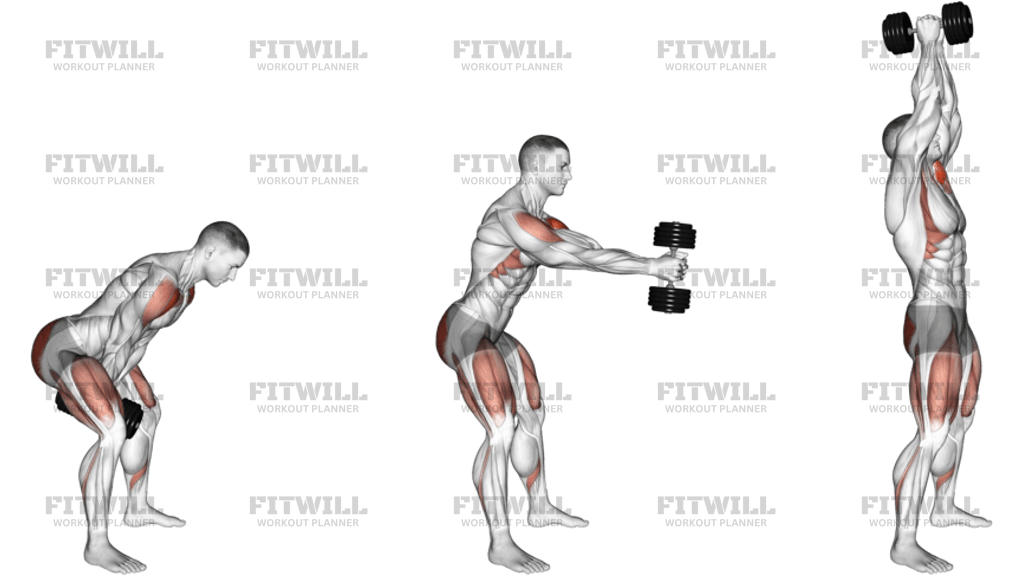
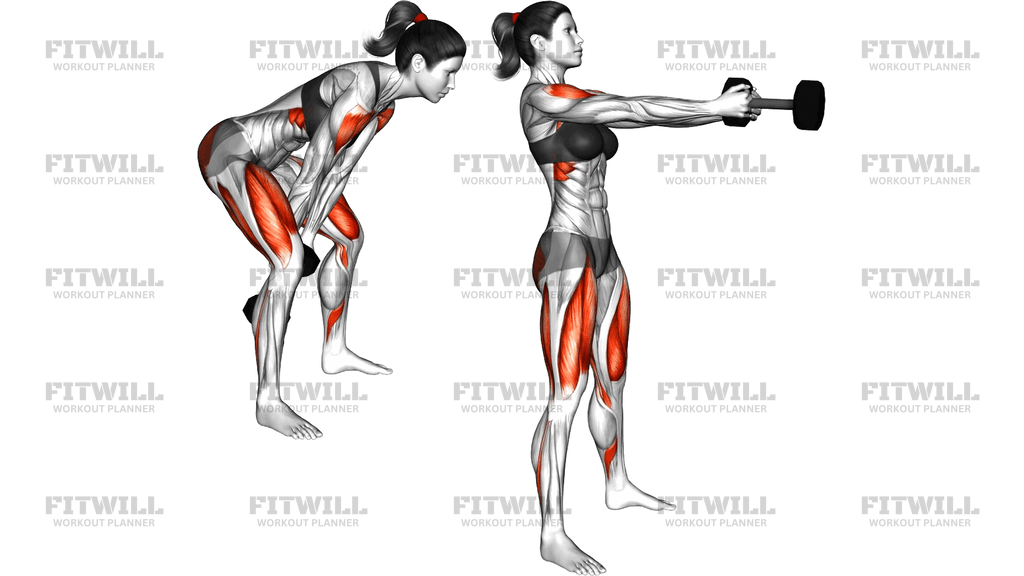
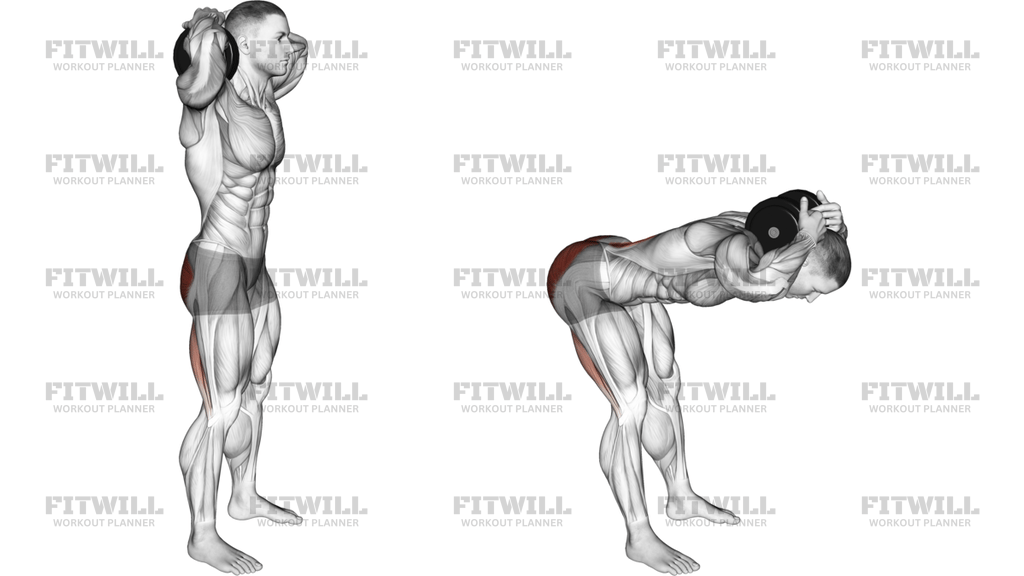
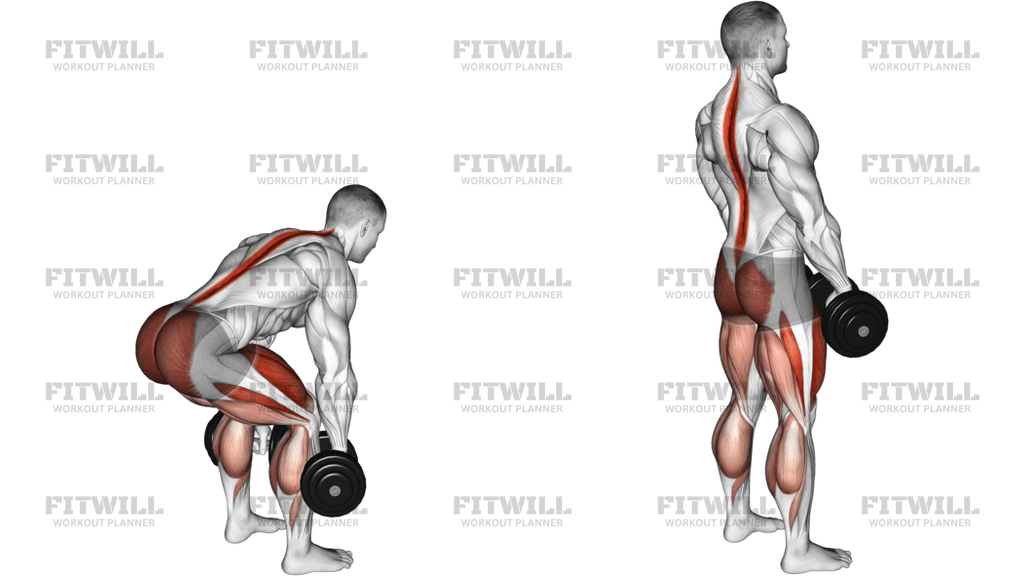
Dumbbell Bosu Ball Single Leg Deadlift
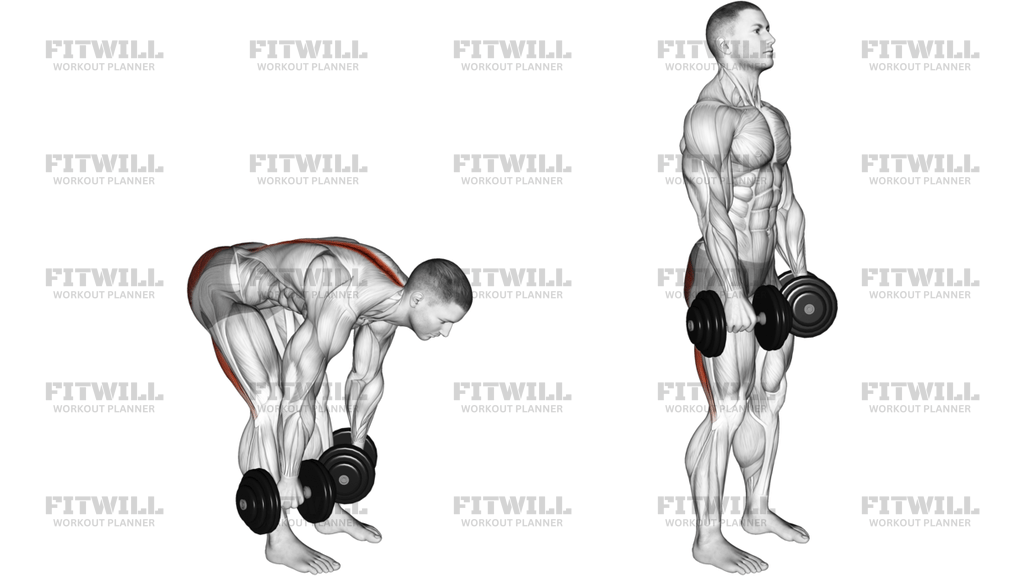
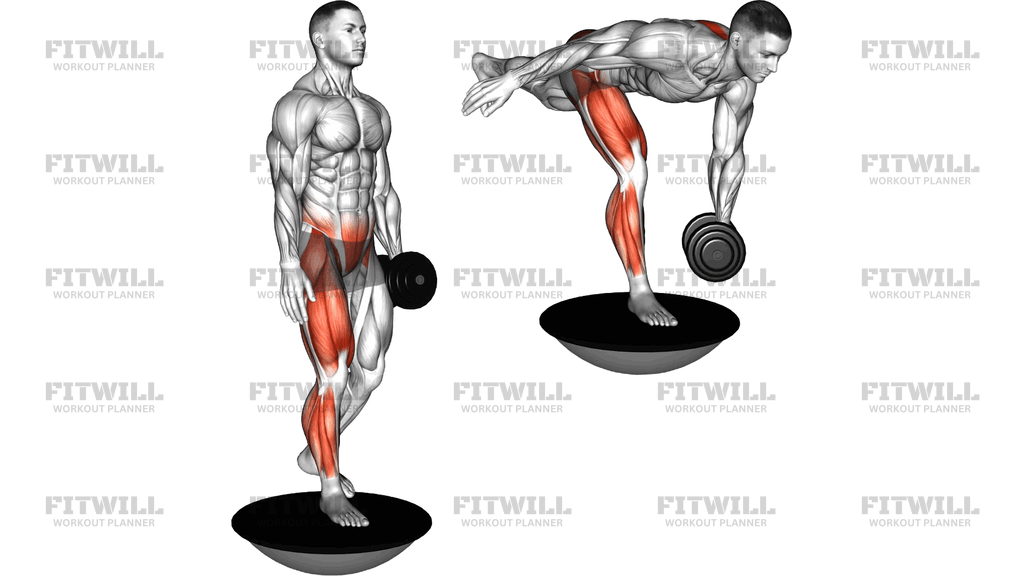
The Dumbbell Bosu Ball Single Leg Deadlift is a unilateral hinge performed while balancing on one leg on top of a Bosu ball. You hold a dumbbell in one hand, stand tall on the unstable surface, then push your hips back and hinge forward until your torso approaches parallel to the floor while your free leg travels behind you. The combination of a single-leg stance, an unstable platform, and a loaded hinge makes this one of the more demanding balance-based deadlift variations you can program.
This movement trains the hamstrings and glutes of the standing leg as the primary movers, with the erector spinae working hard to hold your spine in a neutral position as you tilt forward. What separates it from a floor-based single leg deadlift is the demand placed on the ankle stabilizers and the small muscles of the foot, which must constantly correct to keep you centered over the Bosu ball. Your core, especially the obliques, also works to stop your torso from rotating as the dumbbell pulls you toward one side.
This variation is most useful for lifters who already own a solid single-leg deadlift on stable ground and want to challenge their balance and hip stability further. It shows up in lower body sessions, posterior chain work, and rehab-informed programming where athletes need to rebuild single-leg control after ankle or knee issues. It is also a practical choice for sports like soccer, basketball, and tennis, where cutting, decelerating, and landing all happen on one leg under unstable conditions.
Setup matters more here than in most hinge variations. Place the Bosu ball where you have clear space around you, stand on the flat platform side with your foot centered, and keep the dumbbell light enough that you can complete every rep without your ankle collapsing inward or your back rounding. Starting with the dumbbell in the hand opposite your standing leg usually gives the most natural counterbalance, though you can hold it on the same side to increase the balance demand.
To execute it well, create tension before you move. Grip the floor with your toes, brace your abs, and think about driving your standing hip back rather than simply leaning forward. Let the dumbbell travel straight down toward the floor while your back leg lifts and extends behind you, forming one long line from head to heel at the bottom. Pause briefly, then drive your hips forward and squeeze the standing glute to return to standing. The return is where most reps are lost, so move just as deliberately on the way up as on the way down.
The main safety points are simple: keep your spine long instead of letting your lower back round, keep your standing knee soft and stacked over your foot rather than caving inward, and stay near a wall or rack until your balance is consistent. Because the Bosu ball introduces instability, this is not the place to chase heavy loads. Treat it as a quality movement, not a maximum effort lift.
[ Workout Log & Planner ]
Put your next workout in Fitwill
Keep your plan and training log ready when you are.


Instructions
- Place a Bosu ball flat side down on level ground and clear the area around it so you have nothing to trip over if you step off.
- Hold a dumbbell in one hand at your side with a firm grip, and step onto the center of the Bosu ball with one foot, letting your other foot hover just behind you.
- Shift your weight over the middle of your standing foot and grip the ball surface with your toes to lock in your balance point.
- Brace your core, pull your shoulders back, and set your standing knee in a slight, soft bend with the kneecap tracking over your toes.
- Push your hips straight back and hinge forward, lowering the dumbbell in a vertical line while your free leg extends behind you and your chest lowers toward the floor.
- Continue until your torso is close to parallel with the ground, your back leg and torso form a straight line, and the dumbbell hangs directly under your shoulder.
- Pause for a beat at the bottom, then drive your hips forward and squeeze the glute of your standing leg to pull yourself back up to standing.
- Exhale as you hinge down and inhale as you return to the top, or breathe steadily throughout if the pause feels more natural.
- Complete all reps on one side, step carefully off the Bosu ball, switch the dumbbell to the other hand, and repeat on the opposite leg.
Tips & Tricks
- Fix your eyes on a spot on the floor a few feet in front of you. Looking down at the dumbbell or up at the ceiling shifts your center of mass and makes balancing on the Bosu ball noticeably harder.
- If you keep wobbling side to side, the dumbbell is usually too heavy. Drop the load so you can control the correction under your ankle rather than fighting the weight.
- Avoid rounding your lower back at the bottom. If your hamstring flexibility limits your hinge depth, stop the descent where your spine stays long instead of forcing your torso flat.
- Keep your hips squared forward. A common mistake is letting the hip of the lifted leg rotate open toward the ceiling, which turns the exercise into a spinal twist instead of a hinge.
- Press through your big toe and heel together rather than letting your weight drift to the outside edge of the foot, which is the usual cause of ankle rolling on the dome side.
- Move slower on the return than on the descent. Most balance losses happen during the drive up, when people rush and pop off the Bosu ball before regaining control.
- If the full version is too unstable, hold the dumbbell in the hand on the same side as your standing leg, or perform the first set with just your body weight to rehearse the path.
- Keep a small bend in your standing knee instead of locking it. A locked knee removes tension from the hamstring and makes your balance jittery.
- Position the Bosu ball close to a wall or squat rack at first so you can touch it with a fingertip if you lose your balance, rather than abandoning the set.
Frequently Asked Questions
Which muscles does the Dumbbell Bosu Ball Single Leg Deadlift work the most?
The hamstrings and glutes of the standing leg do the main work of the hinge. Your lower back, obliques, ankle stabilizers, and the small muscles of the foot work hard to keep you balanced and prevent rotation.
Is the Dumbbell Bosu Ball Single Leg Deadlift suitable for beginners?
Not as a starting point. Beginners should first master a regular bodyweight hip hinge and a single leg deadlift on the floor, then add the Bosu ball once they can balance on one leg for 30 seconds or more without wobbling badly.
Should I hold the dumbbell on the same side or the opposite side of my standing leg?
Holding the dumbbell in the hand opposite your standing leg gives you better counterbalance and is the standard choice. Holding it on the same side increases the balance demand and is a useful progression once the standard version feels stable.
Which side of the Bosu ball should I stand on?
Stand on the flat platform side with the dome facing the floor, which is the setup shown for this exercise. This gives a firm but slightly unstable surface to grip with your foot and keeps the challenge manageable.
Why do I keep losing my balance during the descent?
The most common causes are hinging too fast, looking down at the dumbbell, and letting your weight drift toward the outer edge of your foot. Slow the tempo, fix your gaze on a spot on the floor ahead, and consciously press through the center of your foot.
How heavy should the dumbbell be for this exercise?
Choose a load noticeably lighter than what you would use for a floor-based single leg deadlift. If your ankle collapses or your torso twists to complete a rep, the weight is too heavy for this variation.
Can I substitute the Bosu ball with something else?
Yes. A folded exercise mat, a balance pad, or simply the floor are all workable substitutes. Removing the unstable surface makes the exercise easier on your balance while the hamstring and glute work stays largely the same.
How many reps and sets should I do?
Two to three sets of 6 to 10 controlled reps per leg works well. Because balance, not strength, usually fails first, err on the side of fewer quality reps rather than pushing to failure.
Is it safe for my knees and lower back?
When performed with a neutral spine, a soft standing knee, and a load you can control, it is a generally safe hinge pattern. Stop if you feel sharp pain, and if you have a history of ankle instability or back issues, practice near a support and start with body weight only.