Cable Incline Fly (On Stability Ball)
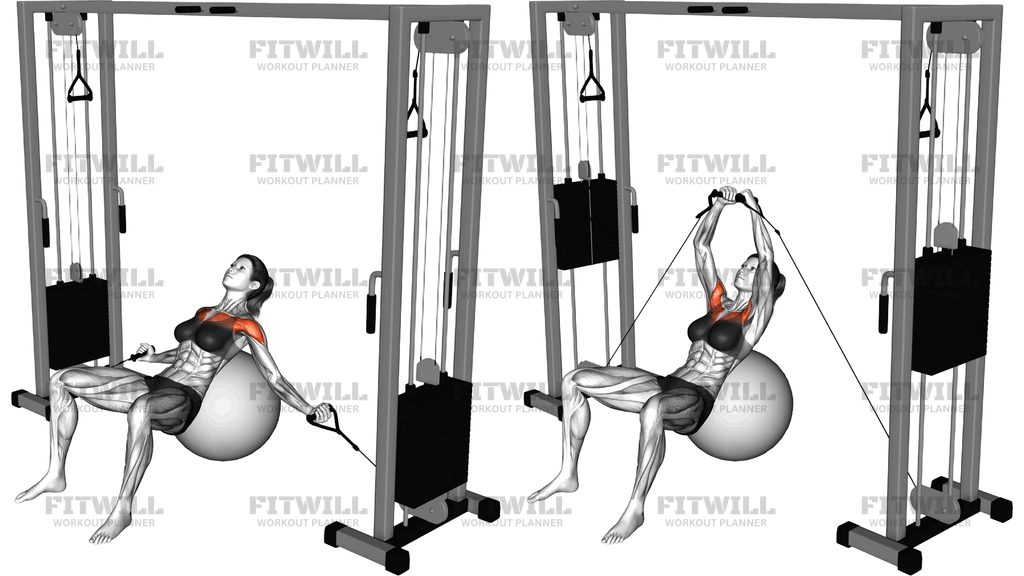
The Cable Incline Fly (On Stability Ball) is a chest isolation exercise performed with your upper back draped over a stability ball between two cable towers. Single handles are attached to the low pulleys on each side, and you sweep your arms in a wide arc from out beside you, up and together above your head. Because the ball places your torso on an incline while the cables pull from low and behind you, the resistance travels along a path that favors the upper chest and front shoulders, similar to what you would get on an incline bench, but with cable tension that stays constant through the whole arc.
This setup suits lifters who want a fresh angle on chest work without loading a barbell overhead, and it is especially useful for people who struggle to feel their upper chest in regular pressing. The continuous cable tension makes the top of the movement, where your hands come together overhead, just as demanding as the stretch at the bottom. That stretch position, with the arms wide and slightly behind the torso, is where most lifters feel this exercise the most.
The stability ball is doing more than replacing a bench. Your hips sit low and your upper back rests on the ball, so your glutes, hamstrings, and entire core work continuously just to keep your torso from rolling or twisting. This makes the exercise a genuine core challenge on top of the chest work, and it means you should always use lighter weight than you would on a fixed incline bench.
To execute it well, keep a soft bend in the elbows from start to finish and think of the movement as hugging a large barrel upward. The arms should sweep in a fixed arc with the elbows locked at roughly the same angle, and your wrists should stay neutral rather than bending back. Let the stretch happen at the bottom without forcing your shoulders backward, then pull with intent toward the finish point above your forehead.
A few practical points matter for safety. Set the ball on a non-slip surface, position it before you grab the handles, and keep your feet planted wide with the heels down the entire set. Choose a weight you can control for slow reps, because a heavy load at full stretch on an unstable surface is the fastest way to lose balance. If you are new to training on a ball, practice the body position with no weight or very light weight until your torso feels steady before adding real resistance.
[ Workout Log & Planner ]
Put your next workout in Fitwill
Keep your plan and training log ready when you are.


Instructions
- Position a stability ball between two cable towers and set both low pulleys to the lowest attachment point with single handles connected.
- Sit on the ball holding one handle in each hand, then walk your feet forward and roll down until your upper back and shoulders rest on top of the ball and your hips hang below your shoulders.
- Place your feet flat on the floor about hip-width to shoulder-width apart with knees bent around 90 degrees, and let the cables run behind and below your shoulders.
- Brace your core and squeeze your glutes slightly so your torso forms a stable incline line from knees to head, then raise both arms out to the sides with a soft, fixed bend in each elbow.
- Sweep your arms up and inward in a wide arc, leading with the elbows, until your hands meet above your forehead or upper chest.
- At the top, bring the handles close together or let them lightly touch, and focus on pressing the handles toward each other rather than just completing the path.
- Reverse the arc slowly, opening your arms back out to the sides until you feel a comfortable stretch across the upper chest, keeping the elbows at the same bend.
- Exhale as you sweep the handles up and together, inhale as you lower them back out wide.
- Keep your hips level and your torso square forward for every rep; if the ball rolls or your body twists, stop, reset your position, and continue with a lighter weight.
- Finish the set by bringing your arms in, sitting up carefully, and setting the handles down before releasing the cables.
Tips & Tricks
- The most common mistake is loading too heavy. Because the ball removes all back support, a weight that feels manageable on an incline bench can pull you sideways or off the ball at full stretch, so start with roughly half your usual incline fly load.
- If your hips sag or your lower back arches hard at the stretch position, walk your feet slightly closer to the ball and re-squeeze your glutes to rebuild the incline line.
- Do not let the elbows straighten as you fatigue. When the arms extend, the movement drifts toward a pullover and the shoulder joint takes on more stress than the chest.
- Keep the arc wide and high. Cutting the sweep short and pulling the handles toward your hips turns this into a low-pulley chest fly instead of the incline path it is meant to follow.
- Choose a ball size that puts your upper back on top with your torso inclined, not one that is so large your head and neck slide off the crest of the ball.
- Warm up the shoulders with a few very light reps first; the deep stretch behind the torso is not the place to discover a cold shoulder.
- If one side lags or the handles meet unevenly overhead, slow the tempo down so the weaker arm dictates the speed instead of letting the strong side snap the reps through.
- Avoid craning your chin toward your chest as the arms come up; keep your head resting against the ball so your neck stays neutral.
- Grip the handles firmly but not white-knuckle tight, and keep your wrists stacked over your elbows rather than bending backward under cable tension.
Frequently Asked Questions
Which muscles does the Cable Incline Fly (On Stability Ball) work?
The primary targets are the upper chest and front shoulders, with the chest as a whole contributing through the arc. Your core, glutes, and hamstrings also work hard to hold your torso steady on the ball.
Why use a stability ball instead of an incline bench for this fly?
The ball creates the incline angle while adding an instability demand, so your trunk muscles stay active the entire set. The trade-off is less stability, which means lighter weights and more balance practice.
Is the Cable Incline Fly (On Stability Ball) suitable for beginners?
It can be, but only after you are comfortable holding an incline position on a ball. Start with very light weight or even just the handle weight for a few sessions until your torso no longer wobbles during the sweep.
How high should my hands finish at the top of the movement?
Sweep the handles together above your forehead or upper chest, not down toward your hips. Finishing high is what makes this an incline-angle fly rather than a standard low-pulley chest fly.
What is the most common mistake with this exercise?
Going too heavy and losing position, usually seen as hips dropping, torso twisting, or the ball rolling under you. The cables pull from behind and below, so any excess load fights you hardest at the widest part of the stretch.
How much should my elbows bend during the fly?
Keep a small, consistent bend, around 15 to 30 degrees, and hold that angle through the whole rep. If the elbows straighten as you fatigue, the arms start doing a pullover and the shoulder takes on extra stress.
What can I use instead of a stability ball for the Cable Incline Fly?
An incline bench set between two low pulleys gives you the same arm path with far more stability. A Bosu ball is another option, though the surface is smaller and less forgiving.
How do I breathe during this exercise?
Exhale as you sweep the handles up and together, and inhale as you open your arms back out to the stretch. Breathing on the effort helps you keep your core braced while the ball moves under you.
Is it safe to stretch my arms behind my torso on this movement?
A comfortable stretch is fine, but do not force your shoulders backward or bounce at the bottom. Stop the descent where you feel a mild pull across the upper chest and control the next rep from there.
How should I set up and get off the ball with the handles in hand?
Sit on the ball and take the handles before rolling back, and exit the same way by sitting up first, then standing and setting the handles down. Never lean out sideways to grab a handle while you are balanced on the ball.