Dumbbell Hang Snatch
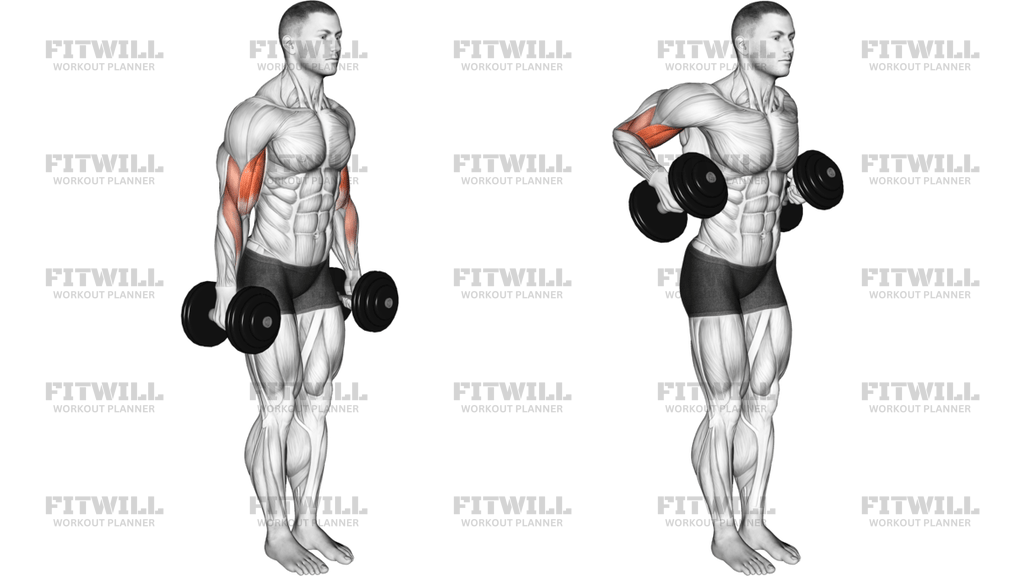
The Dumbbell Hang Snatch is a full-body power movement where you explosively lift a dumbbell in each hand from just below knee height to a locked-out position overhead in one continuous, aggressive motion. The "hang" in the name refers to the starting point: instead of pulling from the floor, you begin with the dumbbells hanging at arm's length around your shins or just below the knees, which shortens the range and puts the emphasis squarely on the explosive hip drive. The image of the movement shows the two key positions clearly - a hip-hinged setup with the weights hanging freely, and a tall finish with the arms fully extended overhead.
This exercise trains what coaches call the triple extension - simultaneous extension of the hips, knees, and ankles - followed by an overhead catch. Your shoulders, upper traps, and arms finish the lift, but the real engine is the posterior chain: glutes, hamstrings, and lower back generate the force, while your core stabilizes the spine through a rapid change of position. Because you are working with two separate dumbbells rather than a barbell, each side has to contribute equally, and the free-swinging nature of the weights demands extra control on the catch.
The Dumbbell Hang Snatch is one of the best strength-and-conditioning tools for athletes who need explosive hip power: sprinters, field sport players, and CrossFit-style trainees all use it. It also suits regular lifters who want a power element without learning the more technical barbell snatch, since the dumbbells can rotate to whatever path feels natural and can be dropped to the hang position safely if a rep goes wrong.
Setup matters more than people expect. Because the weight starts in a hang, there is no momentum from the floor to help you, so your hinged position - flat back, shoulders slightly ahead of the weights, shins near vertical - determines whether the pull starts from your hips or from your arms. A lazy setup usually shows up as an early arm bend, where the elbows start pulling before the hips have fired, and the dumbbells end up being muscled overhead instead of thrown there.
Executed well, each rep feels like a jump that ends with your hands punching the ceiling. The dumbbells travel close to the body on the way up, the elbows stay above the wrists until the final punch, and you catch the weights with straight arms in a shallow quarter squat before standing tall. Because the movement is fast and the lower back is loaded in a hinge, sensible weight selection and solid technique on lighter loads should always come before adding pounds. Three to five sets of three to six reps works well for power, with full recovery between sets.
[ Workout Log & Planner ]
Put your next workout in Fitwill
Keep your plan and training log ready when you are.


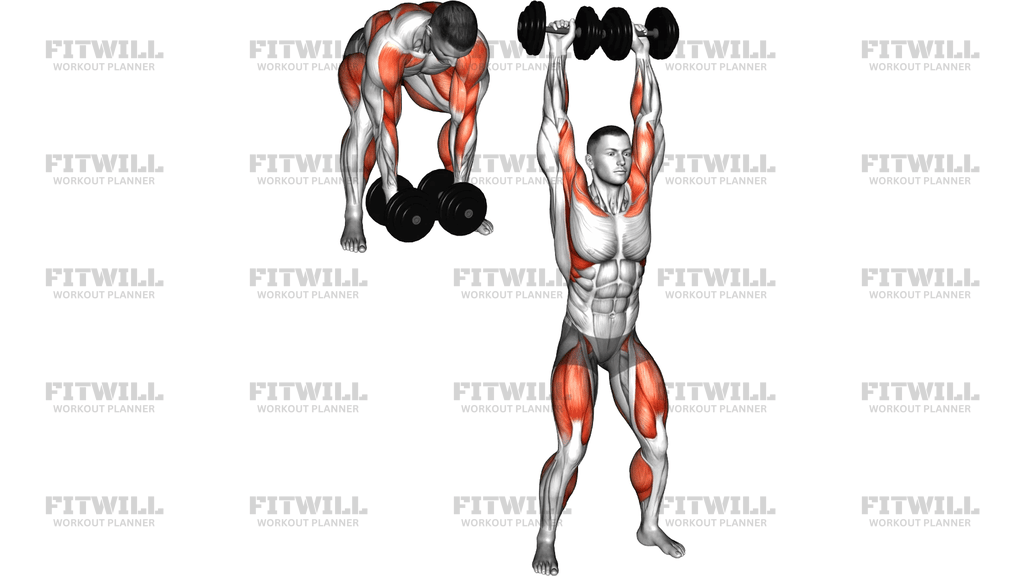
Instructions
- Stand with your feet roughly hip-width apart and hold one dumbbell in each hand at arm's length in front of your thighs, knuckles facing forward and palms turned toward your body.
- Hinge back at the hips with a slight knee bend until the dumbbells hang just below knee level; keep your back flat, chest lifted, and shoulders slightly ahead of the weights.
- Brace your core as if bracing for a light punch, and pull your shoulder blades back so the dumbbells hang still rather than swinging.
- In one explosive motion, drive your hips forward and extend your knees and ankles forcefully, as if performing a vertical jump.
- As the hips finish extending, shrug your shoulders and let the dumbbells travel up close to your body, keeping your elbows above your wrists and pointed out to the sides.
- At roughly chest height, punch both hands aggressively toward the ceiling and drop into a shallow quarter squat, catching the dumbbells with your arms fully locked out overhead.
- Stand up completely from the quarter squat until your hips and knees are extended and the dumbbells are steady overhead, biceps beside your ears.
- Breathe in at the hang, hold the brace through the pull, and exhale as you stand to the overhead finish.
- Lower the dumbbells under control by bending at the hips and letting your arms trail back down to the hang position rather than dropping them quickly.
- Reset your hinge position and grip between every rep so each snatch starts from a still, stable hang instead of a swinging start.
Tips & Tricks
- The most common fault is pulling with the arms too early. The dumbbells should only start rising after your hips have snapped forward - if your elbows bend before you feel your glutes contract, drop the weight and drill the timing.
- Do not let the dumbbells drift away from your body during the pull. Weights that swing forward force your lower back to compensate; keep them skimming your thighs and think "elbows high" before the punch.
- Catch with straight arms. A soft-elbow catch turns the snatch into an overhead press and puts sudden stress on the shoulders - punch hard enough that the arms lock out as you land in the quarter squat.
- Avoid hyperextending your lower back at the top. Finish the hip drive by squeezing your glutes, not by leaning your torso back past vertical.
- Use a weight you could strictly press about five to eight times. If you have to chase the dumbbells with a jump forward on the catch, the load is too heavy to move with good technique.
- Keep your gaze forward and slightly up during the hang, then follow the dumbbells with your eyes as they travel overhead so you find the lockout position consistently.
- If the two-dumbbell version feels chaotic, practice the same hip drive and punch with one dumbbell first - a single-arm hang snatch lets you focus on the bar path with half the coordination demand.
- On the catch, land with your whole foot on the floor, not up on your toes. A forefoot landing makes the weight crash down and wobbles the lockout.
- Do these for quality reps of three to six, not high-rep grinding sets. Power work degrades fast when fatigue sets in, and the last rep should look as crisp as the first.
Frequently Asked Questions
What muscles does the Dumbbell Hang Snatch work?
The hips and legs - glutes, hamstrings, and quads - produce most of the power, while the shoulders, upper traps, and arms finish the lift overhead. Your lower back and core work hard to keep the spine stable through the rapid hinge-to-overhead transition.
Why does the Dumbbell Hang Snatch start at the knees instead of the floor?
Starting from the hang removes the slow first pull from the floor and isolates the explosive part of the movement. It is also easier on the lower back and much simpler to learn than a full snatch from the ground.
Is the Dumbbell Hang Snatch suitable for beginners?
Yes, with light dumbbells and attention to the hip hinge. Beginners should first be comfortable hinging with a flat back, then practice the jump-and-punch pattern slowly before adding speed and load.
Should I squat deeply when I catch the Dumbbell Hang Snatch?
No deep squat is required - a shallow quarter squat is enough to get under the dumbbells as you punch overhead. Most lifters use a power-style catch and stand straight up from there.
How heavy should the dumbbells be for this exercise?
Choose a weight you can move fast and catch with locked arms, roughly something you could strict press for five to eight reps. If your catch is soft or your back rounds, the dumbbells are too heavy for clean technique.
What is the most common mistake in the Dumbbell Hang Snatch?
Bending the elbows early and turning the movement into an upright row plus press. The fix is to let the hip drive launch the dumbbells and only pull with the arms once the hips have fully extended.
How is the Dumbbell Hang Snatch different from a barbell snatch?
The dumbbells hang independently and can rotate freely, so the path is more forgiving and the grip and wrist demands are lower. You trade some maximum load for easier technique and the added stability challenge of controlling two separate weights.
Can I drop the dumbbells if a rep goes wrong?
With hex or rubber-coated dumbbells and rubber flooring, pushing the weights forward and away from your body is a safe bail-out, which is one advantage over a barbell. Release them in front of you, never behind, and make sure no one is standing nearby.
How many reps should I do for the Dumbbell Hang Snatch?
For power and technique, three to six reps per set with full rest works best. Higher-rep conditioning versions exist, but expect your catch position and bar path to get sloppier as fatigue builds.
Is it normal for my lower back to feel worked after this exercise?
Some fatigue in the lower back is expected because it holds the hinge and stabilizes during the pull. Sharp pain or a pinching sensation during the hinge is not - stop, reduce the weight, and check that your back stays flat.